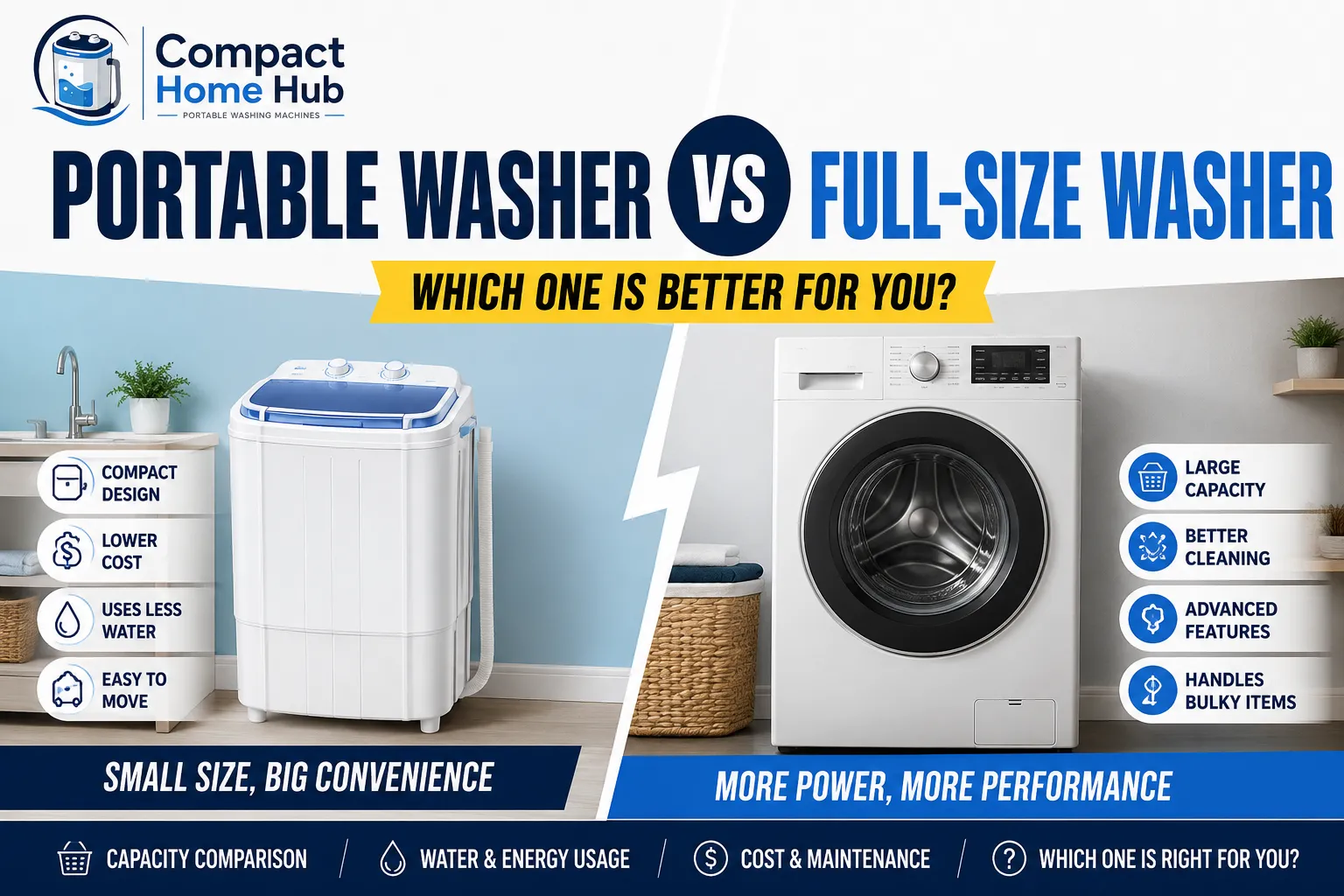
If you’re comparing a portable washer vs full-size washer, the right choice depends on your living space, laundry habits, and budget. A portable washer is best for apartments, RVs, dorms, and small households that wash a few loads each week. A full-size washer is the better option for families, large laundry loads, bulky bedding, and anyone who wants the fastest and most convenient washing experience.
Portable Washer vs Full-Size Washer
A portable washer is better for renters, apartments, RVs and small loads when space or permanent hookups are limited. A full-size washer is better for larger households, frequent large loads and homes with permanent plumbing.
Whether you’re trying to save space, reduce water usage, or avoid trips to the laundromat, choosing the right washing machine can make a huge difference.
If you’re new to compact laundry appliances, it’s worth learning what a portable washing machine is before comparing it with a traditional full-size washer.
By the end, you’ll know exactly which washer fits your lifestyle.
What Is a Portable Washer?
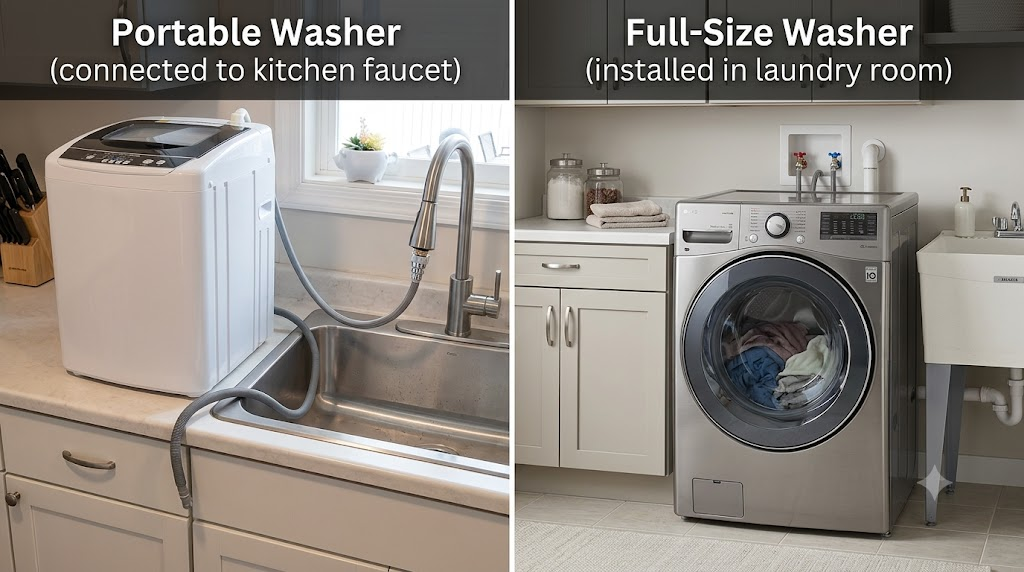
A portable washer is a compact washing machine designed for homes where installing a traditional washer isn’t practical. Most models connect temporarily to a kitchen or bathroom faucet and drain into a sink or bathtub.
Portable washers are popular among:
- Apartment renters
- College students
- RV owners
- Tiny home owners
- Single professionals
- Couples without dedicated laundry rooms
Most portable washers have capacities ranging from 0.9 to 2.8 cubic feet, making them ideal for smaller laundry loads.
Before choosing a compact washer, read our portable washing machine buyer’s guide to understand capacity, features, and what to look for.
What Is a Full-Size Washer?
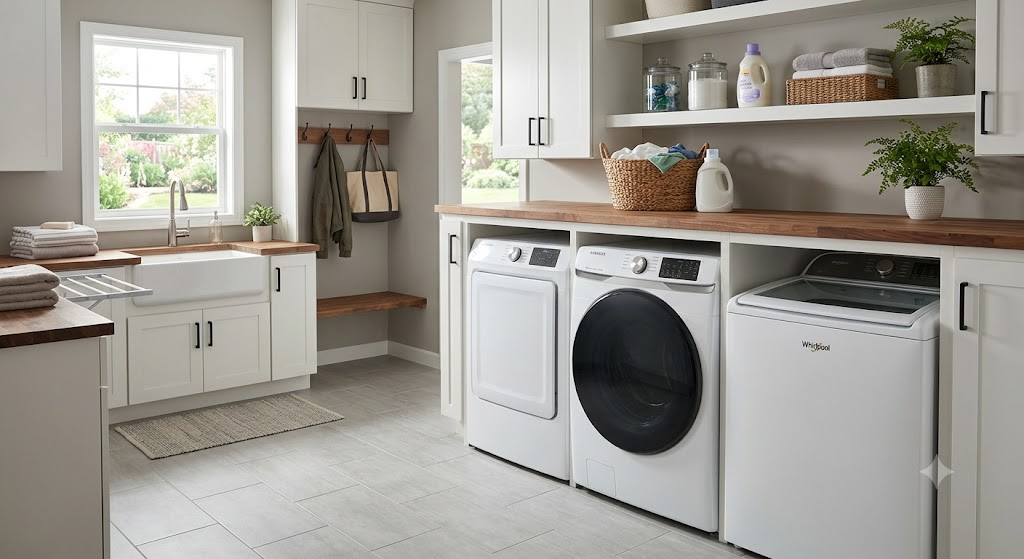
A full-size washer is the standard washing machine found in most American homes. It connects permanently to dedicated water supply lines, a drain, and electrical outlets.
These washers usually offer capacities between 4.0 and 6.5 cubic feet, allowing you to wash:
- Comforters
- Blankets
- Family laundry
- Large towels
- Heavy jeans
- Multiple outfits in one cycle
They are designed for frequent use and larger households.
Portable Washer vs Full-Size Washer: Quick Comparison
| Feature | Portable Washer | Full-Size Washer |
|---|---|---|
| Best For | Apartments, RVs, dorms | Houses and large families |
| Capacity | Small | Large |
| Installation | Temporary faucet connection | Permanent plumbing |
| Laundry Load | 3–10 lbs | 15–25+ lbs |
| Water Usage | Lower | Higher |
| Electricity Use | Lower | Moderate |
| Wash Performance | Good | Excellent |
| Bulky Items | Not suitable | Easily washes comforters |
| Spin Speed | Moderate | High |
| Drying Time | Longer | Shorter |
| Initial Cost | Lower | Higher |
| Long-Term Convenience | Moderate | Excellent |
1. Portable Washer vs Full-Size Washer: Capacity Comparison
Capacity is often the biggest deciding factor.
Portable Washer
Most portable washers can handle:
- 5–10 shirts
- Small towels
- Undergarments
- Baby clothes
- Workout clothes
A queen-size comforter usually won’t fit.
Example: A single person who does laundry twice a week can comfortably use a portable washer.
Full-Size Washer
Full-size washers easily wash:
- Weekly family laundry
- Bedding
- Jackets
- Multiple towels
- Large blankets
Example:
A family of four can wash an entire week’s clothes in just a few loads.
If you’re planning to buy a portable washer, comparing twin tub vs single tub washing machines can help you choose the right type for your laundry needs.
2. Washing Performance
When comparing portable washer vs full-size washer, cleaning performance is one of the biggest differences.
Portable Washer Performance
Portable washers clean everyday clothes surprisingly well.
They’re excellent for:
- T-shirts
- Socks
- Gym clothes
- Children’s clothing
- Office wear
However, heavily soiled clothes may need:
- Longer wash cycles
- Extra detergent
- Pre-treatment
Full-Size Washer Performance
Full-size washers provide:
- Stronger agitation
- More powerful motors
- Better stain removal
- Advanced wash cycles
- Steam cleaning (on many models)
They perform much better with muddy clothes, sports uniforms, pet bedding, and heavy fabrics.
3. Water Consumption
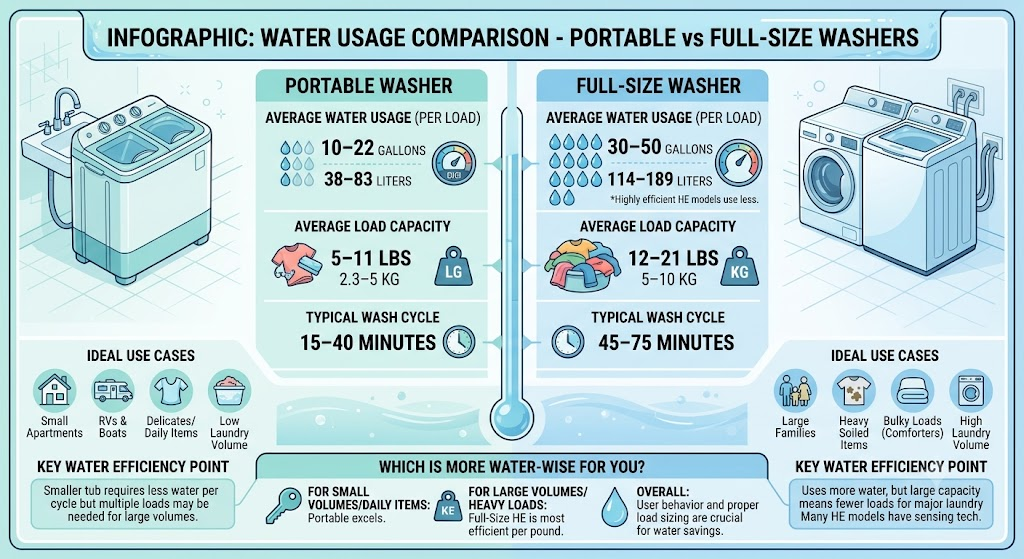
One major advantage of portable washers is lower water usage.
Portable Washer
Typical water use:
8–20 gallons per load Ideal for people trying to reduce utility bills.
Full-Size Washer
Water use varies by model:
- High-efficiency front-loaders: 12–18 gallons
- Standard top-loaders: 25–40 gallons
Although newer ENERGY STAR® models are much more efficient than older machines, portable washers still use less water overall.
Curious about the actual savings? See how much water a portable washer uses compared to traditional washing machines.
4. Electricity Consumption
Portable washers consume less electricity because they have:
- Smaller motors
- Shorter cycles
- Smaller water heating requirements
Most models use between 150–500 watts during operation.
Full-size washers typically use:
- 400–1,400 watts depending on cycle
- Additional electricity if using hot water
If you wash only a few loads each week, a portable washer can noticeably reduce your electric bill.
Portable washers are also energy efficient. Learn how much electricity a portable washer uses to estimate your monthly operating costs.
5. Installation Comparison
Portable Washer
Installation is simple. Most models require:
- Standard electrical outlet
- Faucet adapter
- Sink or bathtub drain
No plumber is usually required. Many users finish setup in under 10 minutes. Before using a portable washer, learn how to connect the water supply, drain hose, and electrical connection correctly with our portable washer installation guide.
Full-Size Washer
Requires:
- Water supply lines
- Drain connection
- Laundry hookups
- Enough installation space
Renters may not have access to these connections. Understanding how a portable washing machine works makes installation and daily operation much easier.
6. Space Requirements
This category strongly favors portable washers.
Portable Washer
Fits inside:
- Closet
- Bathroom
- Pantry
- Kitchen corner
- RV
- Tiny home
Many models include wheels for easy movement. For very small homes, laundry management matters as much as washer size, so these practical tips can help you save space during washing and drying.
Full-Size Washer
Requires:
- Laundry room
- Utility closet
- Basement
- Garage
Not suitable for very small apartments.
7. Noise Level
Portable washers are generally quieter because of smaller motors. However, lightweight machines may vibrate more during the spin cycle if loads aren’t balanced. Full-size washers usually:
- Produce more motor noise
- Have stronger spin cycles
- Stay stable because of their heavier construction
Premium front-load washers are often extremely quiet.
8. Washing Time
Portable washers generally take longer to complete all laundry because of their smaller capacity. Once the washer is installed, our step-by-step guide explains how to load, wash, drain, rinse, and spin clothes correctly.
Example:
Ten loads in a portable washer might equal only three loads in a full-size washer. If you wash laundry every day, this difference becomes noticeable.
Once the washer is installed, our step-by-step guide explains how to load, wash, drain, rinse, and spin clothes correctly.
9. Drying Performance
Portable washers don’t actually dry clothes.
Their spin cycles remove some water, but clothes still require:
- Air drying
- Drying racks
- Portable dryers
Full-size washers often have:
- Faster spin speeds
- Better water extraction
This shortens drying time significantly.
10. Cost Comparison
Portable Washer
Average price:
$180–$500
Operating costs are also lower because they use less:
- Water
- Electricity
- Detergent
Full-Size Washer
Average price:
$600–$1,500+
Premium smart models can cost much more. However, they provide greater convenience for families.
If you’re buying a washer to save money, compare portable washing machine vs laundromat cost to see how quickly your investment can pay for itself.
11. Maintenance
Portable Washer
Maintenance includes:
- Cleaning lint filters
- Wiping the drum
- Draining leftover water
- Cleaning inlet hose
- Descaling occasionally
Full-Size Washer
Maintenance includes:
- Cleaning detergent drawer
- Running drum cleaning cycles
- Checking hoses
- Cleaning drain filter
- Replacing hoses every few years
Both require regular cleaning to prevent mold and odors.
Portable Washer vs Full-Size Washer for Different Households
| Household Type | Winner | Why? |
|---|---|---|
| Single Person | Portable Washer | Small laundry loads don’t justify buying or operating a large machine. |
| Couples (Small Apartments) | Portable Washer | Saves space, uses less water, and is ideal for limited living areas. |
| Couples (Houses) | Full-Size Washer | Offers more capacity and convenience for regular weekly laundry. |
| Families | Full-Size Washer | Large capacity reduces the number of loads and saves significant time each week. |
| College Students | Portable Washer | Helps avoid shared laundry rooms and expensive laundromat fees. |
| RV Owners | Portable Washer | Compact size and portability make it ideal for life on the road. |
| Pet Owners | Full-Size Washer | Handles pet blankets, towels, and heavily fur-covered items much more effectively. |
Pros and Cons
Portable Washer
| Pros | Cons |
|---|---|
| Compact and space-saving design | Small washing capacity |
| Lower purchase price than full-size washers | Requires more loads for larger households |
| Uses less water per wash cycle | Cannot wash large bedding like comforters or king-size blankets |
| Lower electricity consumption | Laundry takes longer to finish overall due to smaller loads |
| Easy installation with no permanent setup | Clothes often require air drying or a separate dryer |
| Ideal for renters and apartments | Less suitable for large families |
| Easy to move and store when not in use | Limited wash programs compared to full-size washers |
| No permanent plumbing required | May struggle with bulky or heavily soiled items |
Full-Size Washer
| Pros | Cons |
|---|---|
| Large capacity for bigger laundry loads | Higher purchase price |
| Excellent cleaning performance | Requires permanent installation and plumbing |
| Faster laundry completion with fewer loads | Needs more floor space |
| Better stain removal for heavily soiled clothes | Higher water and electricity usage |
| Easily handles bulky items like comforters and blankets | Less portable and difficult to move |
| Advanced wash programs and smart features on many models | Installation may require professional assistance in some homes |
| Better resale value and longer lifespan | Not suitable for small apartments without laundry hookups |
| Ideal for families and frequent laundry needs | Higher maintenance and repair costs compared to portable washers |
Which Is Better for an Apartment?
A portable washer is usually more practical for apartments when space is limited or the home does not have dedicated washer hookups. Many models can be connected to a sink and stored away after use.
A full-size washer makes more sense if your apartment has permanent laundry hookups and enough space for a standard machine.
Which Is Better for a Family?
A full-size washing machine is generally better for families because it can handle larger loads and bulky items more easily. This means fewer wash cycles when you have laundry from several people.
A portable washer can still work for a small family if you have limited space and do not mind doing smaller loads more frequently.
Which Is Better for an RV?
A portable washer is the more practical option for RV use. Its smaller size and portability make it easier to store and use in a limited space.
Before buying, check the washer’s weight, water requirements, drainage method, power requirements, and available storage space in your RV.
Which Is Better for Renters?
A portable washer is often a better fit for renters who cannot install a permanent washing machine. Many models can be connected temporarily to a sink and stored when not in use.
However, check your lease agreement first. Some rental properties may restrict portable washers or require approval before using one.
Can a Portable Washer Replace a Full-Size Washer?
Yes, but not for everyone. A portable washer can replace a full-size machine if you mainly wash small loads, have limited space, or cannot install permanent hookups.
For larger households, frequent laundry, comforters, towels, and other bulky loads, a full-size washer is usually more practical.
The key question is how much laundry you need to wash at a time. If you regularly need large loads, a portable washer may become inconvenient because you will need more wash cycles.
Which Washer Saves More Money?
If you’re comparing long-term ownership costs, the answer depends on your laundry habits. Portable washers save money through:
- Lower purchase price
- Lower water bills
- Lower electricity bills
- No installation fees
Full-size washers save time because they complete much larger loads. For large families, fewer loads often outweigh higher operating costs.
habits.
Who Should Buy a Portable Washer?
Choose a portable washer if you:
- Live in an apartment
- Rent your home
- Have limited space
- Wash small loads
- Want lower utility bills
- Live in an RV
- Need a secondary washer
Who Should Buy a Full-Size Washer?
Choose a full-size washer if you:
- Have a family
- Wash bulky bedding
- Want faster laundry
- Need better stain removal
- Own your home
- Have a dedicated laundry area
FAQs
Q. Is a portable washer worth buying?
Yes. If you live alone, rent an apartment, own an RV, or don’t have laundry hookups, a portable washer can save money, reduce trips to the laundromat, and fit into small spaces.
Q. Can a portable washer clean clothes as well as a full-size washer?
For lightly to moderately soiled everyday clothing, most quality portable washers clean very well. However, full-size washers generally offer stronger agitation, more wash programs, and better stain removal for heavily soiled or bulky items.
Q. Can a portable washer wash blankets?
Most portable washers can handle small blankets or throws. Large comforters, king-size blankets, and heavy bedding are usually too bulky and should be washed in a full-size machine.
Q. Do portable washers use less water?
Yes. Most portable washers use significantly less water per load than standard full-size washers, making them a good choice for reducing utility costs.
Q. Can renters use a portable washer?
In many cases, yes. Portable washers are designed for renters because they don’t require permanent plumbing. However, always check your lease agreement and apartment rules before purchasing one.
Q. Which washer lasts longer?
A well-maintained full-size washer typically has a longer service life because it is built for heavier and more frequent use. Portable washers can also last for years when used within their recommended load limits and maintained properly.
Final Verdict
The portable washer vs full-size washer debate doesn’t have a one-size-fits-all answer. If you value compact size, lower utility bills, easy setup, and flexibility, a portable washer is an excellent choice for apartments, dorms, RVs, and small households. On the other hand, if you regularly wash large loads, bulky bedding, or family laundry, a full-size washer delivers better cleaning performance, greater convenience, and saves time in the long run.
Before making your decision, consider your available space, laundry volume, plumbing access, and budget. Choosing the washer that matches your daily needs not just the lowest price will provide the best value over the years.
Recommended Reading:
- Right Detergent Quantity for Portable Washing Machine
- 15 Must-Have Portable Washer Accessories in 2026
- Portable Washer Installation Cost in 2026
- Off-Grid Laundry: Running Your Compact Washer on Solar Power & Inverters

Sourabh researches and writes about home appliances, kitchen gadgets, and common appliance problems to help readers make smarter buying decisions. He specializes in Portable washing machines and appliance troubleshooting guides.
At compactHomeHub, Sourabh focuses on creating easy-to-understand content that simplifies technical appliance issues into practical solutions. His goal is to help users save time, avoid costly mistakes, and choose the right appliances with confidence.