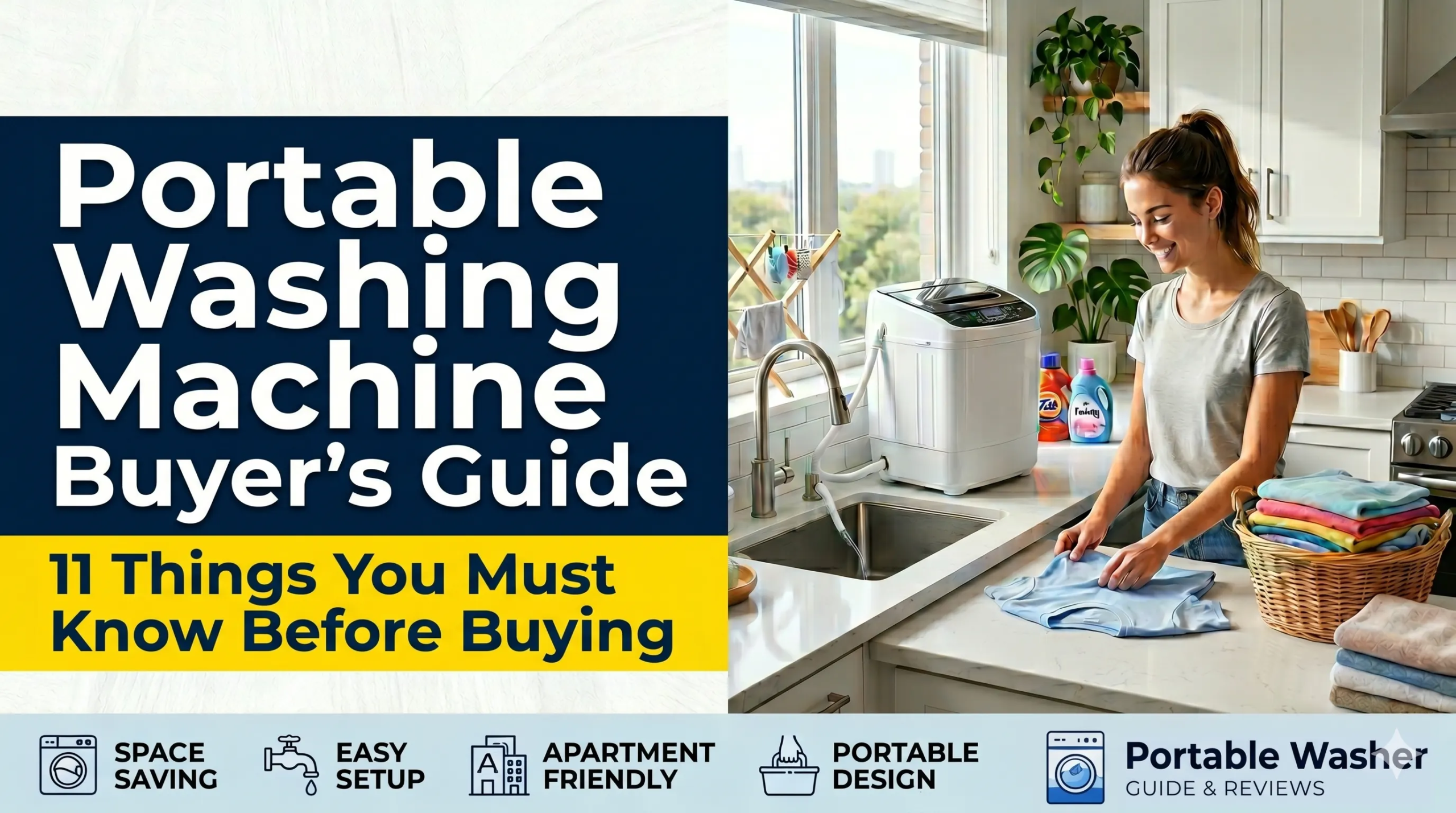
If you’re living in a small apartment, an RV, a college dorm, or a home without hookups, you already know the struggle. Dragging bags of laundry to a laundromat every week is time-consuming, expensive, and just plain inconvenient. That’s why more Americans are ditching the coin-op machines and investing in a portable washing machine.
These compact washers have come a long way in recent years. Modern portable washers handle everything from delicate fabrics to everyday jeans, fit under a kitchen counter, connect directly to your faucet, and cost a fraction of what a full-size washer would run you.
This portable washing machine buyers guide covers everything you need to make a smart buying decision such as the different types available, what capacity you actually need, hidden costs, common mistakes, and honest product recommendations for 2026.
What Is a Portable Washing Machine?
A portable washing machine is a compact washer designed for homes that don’t have permanent laundry hookups. Unlike traditional washers, portable models can connect to a kitchen or bathroom faucet and drain into a sink.
These machines are smaller, lighter, and easier to move than full-size washers.
Types of Portable washing Machine
- Fully automatic portable washers
- Semi-automatic washers
- Twin-tub portable washers
- Compact front-load washers
- Compact top-load washers
If you’re comparing washer types, take a look at how a portable washing machine works to better understand the differences.
Typical Capacity Ranges
- 0.9 cu ft — Small loads, perfect for 1 person
- 1.0–1.5 cu ft — Standard portable range, good for 1–2 people
- 1.6–2.5 cu ft — Larger portable models approaching compact washer territory
Who Should Buy One
Portable washers make the most sense for people in apartments without in-unit laundry, RV travelers, college students in dorms, vacation homeowners, people in tiny homes, those waiting for a permanent washer to be installed, and anyone trying to cut laundromat costs.
Portable Washing Machine Buyers Guide
1. Capacity
Capacity determines how much laundry you can wash in a single load, and it’s the most important spec to get right.
0.9 cu ft — Fits roughly 6–8 pounds of laundry. Good for a single person doing small, frequent washes: underwear, socks, workout clothes, and a few T-shirts. Not great if you want to tackle jeans or bedsheets.
1.0–1.5 cu ft — The sweet spot for most portable washer buyers. Handles 8–12 pounds per load, which covers a full week of clothes for one person or a few days’ worth for a couple. Most of the popular models in the $150–$300 range fall here.
1.6–2.5 cu ft — Approaching compact washer territory. Can handle small families or larger loads. These models are bigger, heavier, and may be harder to store. If you’re at this capacity range, it’s worth comparing them to compact (non-portable) washers.
If you only need to wash small loads such as baby clothes, socks or a few delicate garments, you don’t necessarily need a full-size portable washer. See our guide to the mini washing machine for baby clothes to compare compact options designed for smaller loads.
If you’re single and do laundry every 3–4 days, a 1.0–1.2 cu ft model is plenty. If you’re a couple, aim for 1.5 cu ft or more.
2. Washer Type
Choosing the right type is really about how much hands-on involvement you want and how much you’re willing to spend.
Fully Automatic
- ✅ Set it and forget it — no manual water filling or cycle switching
- ✅ Usually quieter and more refined
- ✅ Better for delicate fabrics
- ❌ More expensive ($200–$500+)
- ❌ Larger footprint
Semi-Automatic
- ✅ Much cheaper ($80–$200)
- ✅ Simple and reliable with few electronic parts to fail
- ❌ Requires manual filling or monitoring
- ❌ You move clothes from wash drum to spin tub by hand
Twin Tub
- ✅ Best value for budget-conscious buyers
- ✅ Can spin one load while washing the next
- ❌ Takes more effort
- ❌ Can be noisy during spin cycles
See the complete difference between twin tub and single tub washing machine.
Compact Front Load
- ✅ Most energy and water efficient
- ✅ Gentlest on fabrics
- ✅ Some models can be stacked with a dryer
- ❌ Most expensive in this category
- ❌ Longer wash cycles
Compact Top Load
- ✅ Familiar, intuitive controls
- ✅ Faster cycles than front-load
- ❌ Uses more water than front-load
- ❌ Harder on delicate fabrics due to agitator
3. Available Space
Before you buy anything, measure your space carefully.
Measure the width, depth, and height of where you plan to keep the machine — not just when it’s in use, but where it will live when stored. Many portable washers have a wheeled cart stand sold separately that adds a few inches of height.
Check door clearance. For top-load models, you need enough vertical clearance to open the lid fully. For front-load, make sure the door can swing open without hitting a wall or cabinet.
Plan your hose routing. The water inlet hose runs from the faucet to the machine, and the drain hose needs to reach a sink or floor drain. The standard hose length is 5–6 feet, but extension hoses are cheap and widely available.
Think about storage. If you don’t have a dedicated laundry spot, you’ll need to roll the machine out for each use and store it in a closet, under a counter, or in a corner. Check dimensions against your storage space, not just your usage space.
4. Water Connection Requirements
Most portable washers connect to a standard kitchen or bathroom faucet using a quick-connect adapter. This is one of the biggest deciding factors for renters.
Faucet adapters are typically included with the machine, but they may not fit every faucet type. Aerator size varies between faucets, and you may need to buy an adapter separately ($5–$15). Check your faucet’s aerator thread size before the machine arrives.
Kitchen sink hookups are ideal — the sink is usually large enough to handle the drain hose, and the counter height makes routing easy.
Bathroom sink hookups work too, though it’s tighter. Make sure the faucet is near enough to thread the inlet hose without kinking it.
Permanent connections are possible with some models. If you have capped washer hookups in your apartment, you may be able to connect a portable washer permanently using standard washing machine hoses. Check your lease and local code before doing this.
Water pressure requirements: most portable washers require a minimum of 14–116 PSI. Standard U.S. household water pressure is 40–80 PSI, so this is rarely an issue. If you’re in a building with known low pressure (some older apartment buildings), run your faucet to full blast and see if it feels strong before assuming it’ll work.
Before buying a portable washer, check how the water inlet connects to your faucet. If you’re using a COMFEE’ portable washer at a sink, you’ll need to make sure the portable washer faucet adapter is compatible with your faucet and inlet hose.
5. Drainage Options
How your machine drains is more important than most buyers realize.
Gravity drain — The water drains through a hose that hangs into a sink. Simple and reliable, but it means your machine needs to be at or above sink level. If the drain hose can’t reach the sink at the right height, water won’t drain properly.
Drain pump — The machine actively pumps water out, so it can drain into a sink even if the drain hose has to go slightly upward. Far more flexible for placement. Most fully automatic models include a drain pump. Look for this feature if you’re worried about your setup.
Sink drainage — Both gravity and pump models typically drain into a sink. Some users route the hose to a floor drain or a utility sink if one is available.
Pro tip: Never leave your drain hose unsecured in the sink. Use a drain hose holder or clip it to the faucet to prevent it from falling out mid-cycle, which would flood your floor.
6. Spin Performance
Spin speed is measured in RPM (revolutions per minute) and directly affects how wet your clothes are when the cycle ends.
Low spin speed (400–600 RPM) leaves clothes noticeably damp — you’ll want to hang them in a warm spot or use a dryer. Higher spin speed (800–1,300 RPM) removes much more moisture, cutting air-dry time significantly.
For apartment dwellers without a dryer, aim for at least 1,000 RPM. If you rely on air drying, the difference between a 600 RPM and a 1,200 RPM spin is several hours of drying time.
7. Energy Efficiency
Portable washers are generally far more energy-efficient than full-size machines, but there’s still variation.
Most compact portable washers use 200–500 watts during operation. A typical full-size washer uses 500–1,000 watts. Running a portable washer for 5 cycles a week at 0.3 kWh per load costs roughly $7–$10 per year in electricity — nearly negligible.
Water use is a bigger consideration. Look for models that use 5–12 gallons per load. Higher-efficiency models — particularly front-loaders — stay below 8 gallons.
Over 10 years, the water and energy savings of a portable washer over laundromat use are substantial. Add in the cost of driving to and from the laundromat, and the savings grow further.
8. Noise Levels
Noise is a real concern if you’re in an apartment with thin walls or close neighbors.
Washing cycles are typically quiet — the main motor hum is minor. Spin cycles are where noise becomes a problem. Some budget twin-tub and semi-auto models vibrate aggressively during spin, especially on hard floors.
Look for models that mention “vibration reduction” or “noise dampening.” Reading user reviews specifically for noise complaints is the most reliable research method. Models with direct-drive motors tend to be quieter than belt-drive motors.
If you’re particularly noise-sensitive, a rubber anti-vibration mat ($15–$25) under the machine helps significantly.
9. Build Quality
Stainless steel drums last longer, resist rust and odor, are gentler on fabrics, and are easier to clean. Worth paying extra for if you plan to use the machine regularly for several years.
Plastic drums are fine for light use and cost less, but they’re more susceptible to staining, scratching, and odor retention over time.
Outer body material matters for durability too. Look for ABS plastic housing, which is impact-resistant and more durable than cheaper plastics. Check the quality of the lid hinge and the controls — cheap rotary dials and wobbly lids are signs of a machine that won’t last.
Check if replacement parts (hoses, belts, lid gaskets) are available. For budget brands, they often aren’t.
10. Warranty and Customer Support
Most reputable brands offer a 1-year limited warranty. Some offer 2 years. Budget import brands may offer only 90 days.
What matters more than the length is how the warranty is honored. Look for brands that have a U.S.-based customer service number, not just an email form. Check reviews to see how the company handles warranty claims do they send replacements, or do they demand you ship the machine back at your cost?
If you’re buying from Amazon, check the return window. Many portable washers sold on Amazon come with an extended return option, which can effectively serve as a 30-day warranty.
11.Budget
- Under $200: Semi-automatic and twin-tub washers comes in this range. These machines clean clothes effectively but require more manual involvement.Good for students and occasional users.
- $200–$350: Most fully automatic portable washers with decent features comes in this range. These machines handle daily laundry well, have stainless steel drums, include multiple wash cycles, and are quiet enough for apartment use.
- $350–$500: Mid-capacity compact washers comes in this range these washer are known for better spin performance, more wash programs, and higher build quality. Good for couples or small families who use the machine daily
- Above $500: Premium models with advanced features and larger drums. These washing machines are closed to semi permanent but they offer full wash performance.
If you already know that a portable washer is right for your home, the next step is comparing specific models. See our picks for the best portable washing machine based on capacity, cleaning performance, portability and features.
Portable Washing Machine Sizes Explained
| Capacity | Load Size | Approx. Number of Items | Best For |
|---|---|---|---|
| 0.9 cu ft | ~6 lbs | 6–8 T-shirts + socks/underwear | Single person, light laundry |
| 1.0–1.2 cu ft | 8–10 lbs | Full week of clothes for 1 person | Apartment singles, dorm rooms |
| 1.3–1.5 cu ft | 10–12 lbs | Couple’s 4–5 days of clothes | Couples, frequent washers |
| 1.6–2.0 cu ft | 12–16 lbs | Family of 3 small loads | Small families, RVs |
| 2.0–2.5 cu ft | 16–20 lbs | Near full-size capacity | Families wanting portable flexibility |
Portable Washing Machine vs Laundromat
| Factor | Portable Washer | Laundromat |
|---|---|---|
| Upfront cost | $100–$400 | $0 |
| Cost per load | ~$0.10–$0.25 | $4–$7 (wash + dry) |
| Annual cost (2 loads/week) | ~$10–$26 | $416–$728 |
| Time required | 30–45 min (at home) | 2–3 hours (travel + wait) |
| Convenience | Wash anytime | Limited hours, travel required |
| Water use per load | 5–15 gallons | 20–40 gallons (shared machines) |
| Fabric care | Controlled | Unknown previous loads |
| Payback period | 3–8 months | N/A |
Portable Washing Machine vs Full-Size Washer
| Feature | Portable Washer | Full-Size Washer |
|---|---|---|
| Typical capacity | 0.9–2.5 cu ft | 3.5–6.0 cu ft |
| Installation | None (faucet hookup) | Permanent plumbing required |
| Purchase price | $100–$500 | $500–$1,500+ |
| Space required | 1–3 sq ft | 6–9 sq ft (+ dryer) |
| Best load size | 1–3 people | 3–6+ people |
| Water use per load | 5–15 gallons | 14–25 gallons (HE) |
| Portability | Yes (on wheels or light enough to carry) | No |
| Ideal for | Renters, small households, travel | Homeowners, families |
| Resale value | Low ($20–$60 used) | Moderate ($100–$400 used) |
If you have already decided that a portable washer fits your space, compare our best portable washing machines to find the right model for your budget and laundry needs.
Expert Buying Recommendations
Best Overall: BLACK+DECKER BPWM09W — Reliable brand, great spin speed, fully automatic, and widely available with genuine U.S. support.
Best Budget: Giantex Portable Mini Compact Twin Tub — Best dollar-per-pound-of-laundry value on the market. Functional and durable for the price.
Best for Apartments: COMFEE Portable Washing Machine — Quiet operation, multiple wash programs, and easy storage make it ideal for apartment living.
Best for RVs: Nictemaw Portable Washer — Compact, lightweight, and low water usage make it the top pick for RV and travel use.
Best for Small Families: Panda PAN6320W — Larger 1.34 cu ft capacity, 10 wash programs, and a rolling cart make it practical for families with higher laundry volume.
Best Twin Tub: Giantex or Auertech (depending on budget) — Both offer solid twin-tub performance. Giantex for the lowest price; Auertech for a bit more capacity.
Best Premium Option: COSTWAY’s higher-capacity fully automatic models — Better build quality, more features, and quieter operation than budget alternatives. Worth the step up if you’re using the machine daily.
Hidden Costs Most Buyers Forget
The sticker price of a portable washer is rarely the total cost of ownership. Here’s what to budget for:
Faucet adapters ($5–$20) — The included adapter may not fit your specific faucet. If your faucet doesn’t have a removable aerator, you’ll need a different connector style. Check before you buy.
Extension inlet hose ($10–$20) — If your washer needs to sit more than 4–5 feet from the faucet, the standard hose won’t reach. Extension hoses are cheap but easy to forget.
Anti-vibration mat ($15–$30) — Essential for hard floors and apartment use. Significantly reduces noise and prevents the machine from walking during spin cycles.
Rolling cart/stand ($30–$60) — Many portable washers are low-profile and awkward to load without a cart that brings them to counter height.
Drying rack ($25–$50) — Without a dryer, you’ll need somewhere to hang or lay clothes. A collapsible drying rack is essential and often overlooked in the buying process.
Laundry detergent for compact machines — Use HE (high-efficiency) detergent or liquid detergent in small amounts. Regular powder detergent in full amounts can produce excessive suds and damage the pump.
Extension cord — Many portable washers need to be close to a power outlet. If your outlet isn’t in the right spot, factor in a heavy-duty extension cord. Never daisy-chain extension cords.
Water line accessories — If you ever want a permanent hookup, expect to spend $40–$80 on proper hose fittings and shut-off valves.
Maintenance costs — Budget $0 for the first year or two, then $15–$40 for occasional hose replacements or lid gasket cleaning supplies.
Common Mistakes People Make When Buying a Portable Washer
- Buying too small
- Not measuring the space first
- Ignoring the faucet compatibility issue
- Choosing gravity drain without considering placement
- Overlooking spin speed
- Using too much detergent
- Not reading noise reviews
- Buying from brands with no U.S. support
- Expecting the same performance as a full-size washer
- Forgetting about drying
- Skipping the test run
- Leaving the machine connected to the faucet
- Not securing the drain hose
- Overloading
- Buying a full-size machine when you actually need portable
Many first-time buyers focus only on features and price. However, understanding the complete pros and cons of portable washing machines can help you avoid choosing a model that doesn’t fit your laundry needs.
Who Should Buy a Portable Washing Machine?
Apartment renters: If you’re paying $3–$5 per load at a building laundry room or $6+ at a laundromat, a portable washer starts saving you money within months.
College students: Dorms or off-campus housing benefit enormously. Campus laundry machines are expensive, often broken, and require carrying quarters. A compact portable washer in your dorm room or apartment pays for itself fast.
RV owners: Those who travel frequently need a laundry solution that doesn’t rely on campground facilities. Portable washers designed for RV use draw minimal water and run off a standard 110V outlet.
Small families: (1–3 people) can cover their laundry needs with a larger portable (1.5–2.0 cu ft) or multiple cycles on a mid-size model.
Elderly users: who have trouble getting to a laundromat especially those who don’t drive — benefit greatly from in-home washing, even at small capacity.
Vacation and second homes: A portable washer stored in a closet provides on-demand washing without permanent installation.
Homeowners waiting for appliance installation: renovations, delayed deliveries, or landlord situations find portable washers a functional stopgap that often sticks around even after the main unit arrives.
Who Should Avoid Buying One?
- Large families (4+ people)
- People with high laundry volumes
- Anyone washing large items regularly
- People in apartments that prohibit appliances
- Anyone with no viable drain solution
Maintenance Tips
Cleaning the drum — Run an empty hot water cycle with a cup of white vinegar monthly. This removes soap residue, mineral deposits, and odor-causing bacteria.
Mold and mildew prevention — After every use, leave the lid open for at least 30 minutes to let the drum dry out. Mold growth inside the drum is the most common complaint from long-term portable washer owners.
Hose inspection — Check both inlet and drain hoses monthly for cracks, kinks, or loose connections. A failing hose is the most likely cause of a water leak. Replace hoses that show wear — they’re cheap ($10–$15) and important.
Lint filter cleaning — Most portable washers have a lint trap. Check your manual for location and clean it after every 5–10 loads. A clogged filter reduces wash performance and stresses the pump.
Faucet adapter — Remove and rinse the faucet adapter monthly. Mineral deposits can build up inside and reduce water flow.
Storage — If storing for more than a week, make sure the drum is completely dry before closing the lid. Leave a small gap in the lid or prop it slightly open during storage.
Winter care — If storing in an unheated space (garage, storage unit) during freezing temperatures, drain all water from the machine and hoses completely. Water left in the hoses will freeze and crack them.
Drum gasket cleaning — For front-load compact models, wipe the door gasket after every use. This is where mold typically starts first.
FAQs:
What size portable washing machine do I need for an apartment?
For a single person, a 0.9–1.2 cu ft model is sufficient. For two people, aim for 1.3–1.6 cu ft. If you have a large closet or utility area, a 1.6–2.0 cu ft model gives you flexibility without the limitations of the smallest options.
Can a portable washing machine connect to any faucet?
Most portable washers include a universal faucet adapter, but they don’t fit every faucet. Standard aerator faucets work fine. Pull-down or pull-out kitchen faucets often require a different adapter. Check your faucet type before buying, and budget $10–$20 for a replacement adapter just in case.
How much water does a portable washing machine use per load?
Depending on the model and cycle, portable washers typically use 5–15 gallons per load. High-efficiency and front-load portables use closer to 5–8 gallons. This compares favorably to 20–40 gallons for a standard full-size top-loader.
Are portable washing machines allowed in apartments?
Most leases don’t specifically address portable washers. The key issue is whether you have a valid drain solution (a sink is fine) and whether your faucet connection is temporary. Check your lease for clauses about laundry appliances. If unsure, ask your landlord before buying.
Do portable washing machines need a special electrical outlet?
No. Most portable washers run on a standard 110V/120V household outlet and use a regular 3-prong plug. They don’t require a 240V dryer-style outlet.
Can I wash jeans and towels in a portable washer?
Yes, but keep loads smaller than the stated capacity when washing heavy items. Jeans and thick towels absorb a lot of water and add significant weight. Washing 2–3 items at a time versus a full drum makes a real difference in clean results.
What’s the best portable washer for an RV?
Look for models specifically noted as RV-compatible — they tend to be lighter weight, use less water per cycle, and have compact dimensions that fit in RV storage spaces. The Nictemaw and BLACK+DECKER models are frequently recommended for RV use.
How long does a cycle take on a portable washer?
Fully automatic machines typically run 30–45 minutes per full cycle. Quick wash cycles on most models finish in 15–20 minutes. Twin-tub and semi-auto machines depend on how much time you set on the timer, typically 15 minutes for washing and 5 minutes for spinning.
Can a portable washer replace a laundromat completely?
For most individuals and couples, yes with the exception of oversized items like comforters. Most everyday laundry (clothing, towels, light bedding) can be handled at home with a portable washer.
How do I prevent mold in a portable washing machine?
Always leave the lid open after use to let the drum air out. Run a cleaning cycle monthly with vinegar. Wipe down the lid gasket and inner drum edge regularly. Never leave wet clothes sitting in the machine.
What is the best detergent for a portable washing machine?
Use liquid HE (high-efficiency) detergent in reduced amounts — about half what the bottle recommends for small loads. Avoid powder detergent if possible. Powder can accumulate in the pump and hoses over time, especially in cold water cycles.
How noisy is a portable washing machine?
Wash cycles are relatively quiet similar to a running dishwasher. Spin cycles are louder, ranging from a gentle hum (good models) to a notable vibration (budget twin-tubs). Place an anti-vibration mat under the machine to reduce noise transmitted to floors.
Can I use a portable washer without a sink or drain?
Technically, some people drain into a bucket and manually empty it, but this is impractical for regular use. A nearby sink is strongly recommended. Some RVs route the drain hose into the shower basin.
What’s the difference between a portable washer and a compact washer?
Portable washers connect temporarily to a faucet and are designed to be moved. Compact washers are smaller versions of traditional machines that typically require permanent plumbing hookups. Compact washers generally offer better performance but require installation.
Is a twin-tub portable washer worth it?
Yes if you don’t mind the manual involvement and want to maximize capacity per dollar. Twin-tubs are the best value in the portable washer category for buyers willing to trade convenience for price.
How long do portable washing machines last?
With regular use, a well-built portable washer from a reputable brand typically lasts 4–8 years. Budget models may last 2–4 years. Proper maintenance (cleaning, hose checks, proper detergent use) significantly extends lifespan.
Do portable washing machines clean as well as full-size ones?
For everyday clothing at normal soil levels, yes. For heavily soiled items or very large loads, full-size washers do better. The agitation mechanism and cycle time in portable washers are adequate for regular laundry needs.
What happens if I overload a portable washer?
Clothes won’t come out as clean, the spin cycle will be less effective, and you risk straining the motor and pump shortening the machine’s life. Stick to 75–85% of the stated capacity for best results.
Conclusion
A portable washing machine won’t replace a full-size washer for a household of five, but for the millions of Americans living in apartments, RVs, dorms, or tiny homes, it’s genuinely one of the best quality-of-life purchases you can make.
Before you buy, confirm your faucet is compatible, plan your drain hose routing, measure your storage space, and budget for the accessories that won’t come in the box. Do those things and your portable washer will pay for itself quickly and save you years of laundromat trips.
The right portable washer is the one that fits your space, meets your capacity needs, and doesn’t make your downstairs neighbors hate you.
Recommended Reading:
- What Is a Portable Washing Machine? The Smart Laundry Solution for Small Spaces
- How Does a Portable Washing Machine Work? Step-by-Step
- Twin Tub vs Single Tub Washing Machine: Which Is Better for Apartments, RVs, and Families?
- 10 Best Portable Washing Machine for Apartments 2026: Top Picks Reviewed & Compared
- Portable Washing Machine Buyers Guide: 11 Things You Must Know Before Buying

Sourabh researches and writes about home appliances, kitchen gadgets, and common appliance problems to help readers make smarter buying decisions. He specializes in Portable washing machines and appliance troubleshooting guides.
At compactHomeHub, Sourabh focuses on creating easy-to-understand content that simplifies technical appliance issues into practical solutions. His goal is to help users save time, avoid costly mistakes, and choose the right appliances with confidence.