
Washing clothes in a tiny house is not just about finding a small washing machine. The bigger challenge is managing the entire process from dirty clothes to completely dry clothes without allowing laundry to take over your limited living space.
The most practical approach is to wash manageable loads, choose portable washing machine capacity based on your actual laundry needs, store equipment when it is not being used, dry clothes vertically, and control indoor moisture.
This guide explains practical Tips for Washing Clothes in a Tiny House with Limited Space, including portable washers, no-hookup setups, drying, storage, humidity control, water use, and when a laundromat makes more sense.
Affiliate disclosure: Some links on this page may be affiliate links. If you purchase through one of these links, we may earn a commission at no additional cost to you. Our recommendations are based on suitability, practicality, features, available product information, and small-space laundry requirements.
The Best Tiny-House Laundry Strategy at a Glance
| Problem | Practical solution |
|---|---|
| Very little floor space | Use a portable, compact or stackable washer |
| Dirty clothes piling up | Wash smaller loads more frequently |
| No room for sorting | Separate clothes as they become dirty |
| No permanent washer connection | Consider a portable washer designed for your setup |
| Limited drying space | Use vertical or wall-mounted drying |
| Clothes remain very wet | Use an appropriate spin cycle when available |
| Detergent takes up counter space | Use a small dedicated storage container |
| Bulky bedding is difficult | Take oversized loads to a laundromat |
| Indoor humidity rises | Ventilate and monitor humidity |
| Laundry becomes a constant chore | Create a fixed routine |
| Washer has nowhere to live | Plan its storage location before buying |
| Limited water or electricity | Check water, drainage and electrical requirements first |
First Decide Which Laundry System Fits Your Tiny House
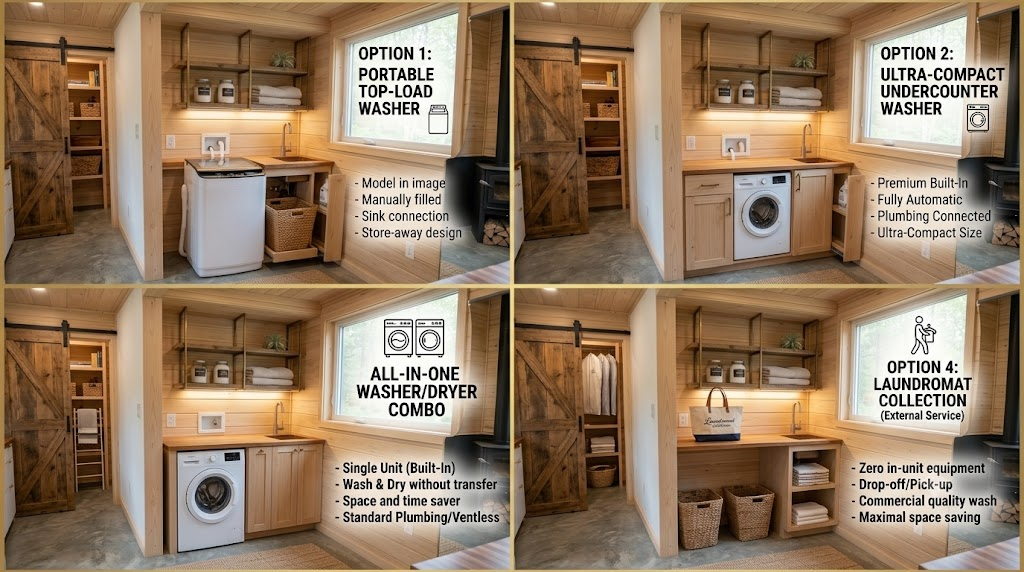
Do not start by shopping for a washing machine. Start by deciding how you want to handle laundry.
| Your situation | Best starting point |
|---|---|
| One person, small loads, very limited space | Portable washer |
| One or two people with a permanent utility area | Compact washer |
| Very limited floor space but adequate height | Stackable washer/dryer |
| Washing and drying must happen in one appliance | Washer-dryer combo |
| Very limited water or electrical capacity | Portable washer or laundromat |
| No practical place to dry clothes | Laundromat or a proper dryer setup |
| Large family loads | Compact/full-size washer plus appropriate drying |
| Mostly small loads but occasional bulky items | Portable washer + laundromat |
Tips for Washing Clothes in a Tiny House
This approach prevents a common tiny-house mistake: buying the washing machine first and figuring out the rest later. Your washer needs to fit your water supply, drainage, electrical system, storage area and drying capacity.
1. Wash Smaller Loads More Frequently
A tiny house does not have the same laundry-storage capacity as a conventional home. If dirty clothes accumulate for a week, they may occupy a large basket, closet or part of the bedroom. Smaller loads can make the entire process easier.
For example:
- Monday: everyday clothes
- Wednesday: towels
- Friday: remaining clothes
- Weekend: bedding or bulky items
You do not have to follow this exact schedule. The important point is to avoid allowing dirty laundry to become a large storage problem.
Why smaller loads help
They can mean:
- Less dirty laundry sitting around
- Less sorting at one time
- Easier movement between washer and drying area
- Less drying space required per session
- Lower risk of overloading a compact machine
- A more predictable routine
For a tiny home, laundry frequency can matter almost as much as washer capacity.
2. Choose Portable Washing Machine Capacity Based on Your Actual Laundry
Do not automatically choose the largest portable washer available. Think about how much laundry you normally generate between washes.
ENERGY STAR specifically recommends considering whether you typically run small or large loads when deciding where to place a washer and what type of washer fits your needs. Certified models are also available in stackable, under-counter and combination designs.
For a tiny house, ask:
How much laundry do I normally wash at one time?
A single person washing every two or three days has very different needs from a couple who washes once a week.
Portable washing machine capacity guide
| Laundry situation | More practical approach |
|---|---|
| One person, frequent washing | Smaller portable washer |
| One person, weekly washing | Medium portable washer |
| Couple, frequent small loads | Medium portable washer |
| Family | Larger compact washer or permanent setup |
| Frequent bedding washing | Larger machine or laundromat |
| Very limited water supply | Smaller loads with careful water planning |
But there is another measurement that is often ignored:
How much wet laundry can you dry at one time?
A washer may have enough capacity for a large load, but that does not mean your tiny house has enough drying space for it.
3. Match Washer Capacity With Drying Capacity
This is one of the most important improvements to your tiny-house laundry planning. Think about these two capacities separately:
Washer capacity = how much you can wash
Drying capacity = how much you can comfortably dry
For example, suppose your washer can handle a large load but your wall-mounted drying rack can comfortably hold only half that amount.
You may end up with:
One large wash → crowded drying rack → slow drying → higher indoor humidity
Instead, you could split the laundry into smaller loads.
Before buying a washer, identify where one complete load will dry. That simple exercise can prevent a lot of frustration.
4. Separate Clothes Before Washing
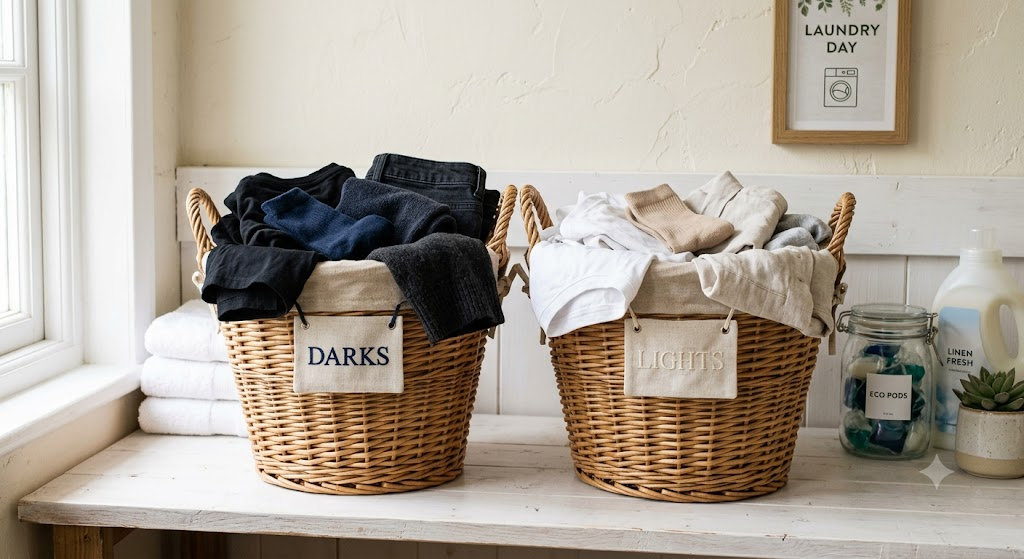
Sorting laundry becomes harder when there is no dedicated laundry room. If everything goes into one basket, you may eventually have to spread clothes across the bed, sofa or floor to separate them. Avoid that problem by sorting as clothes become dirty.
You could use:
- Two small laundry bags
- Separate sections in a collapsible basket
- One bag for everyday clothing
- One bag for towels and heavier items
- A small mesh bag for delicate items
The exact system does not matter. The goal is to prevent laundry sorting from becoming another space-consuming chore.
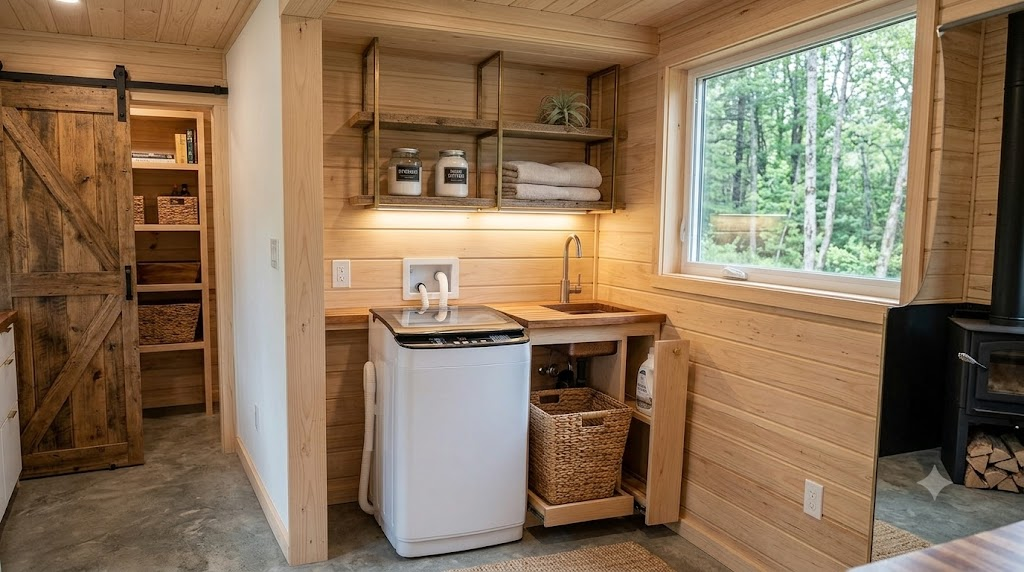
5. Choose a Washer You Can Actually Store
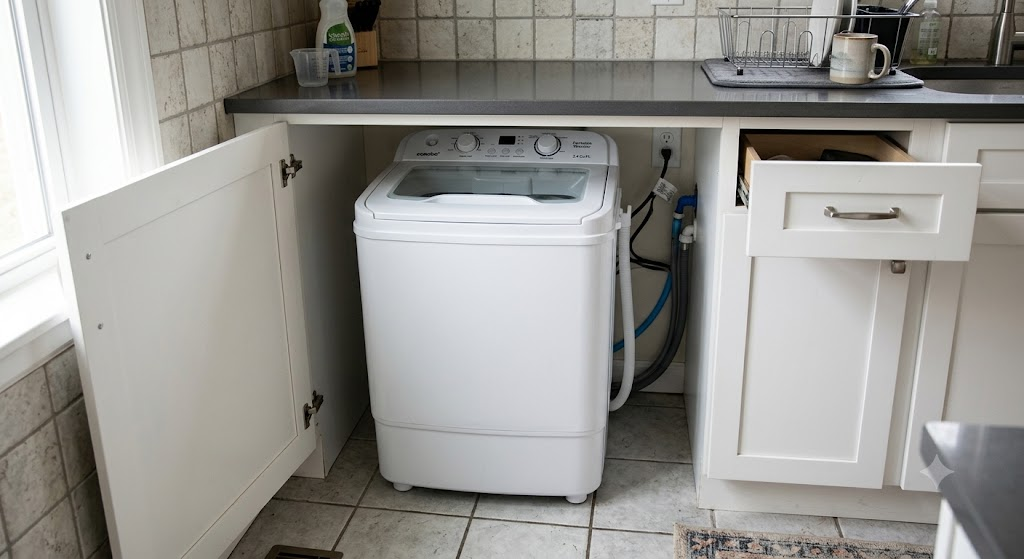
A portable washer only saves space if you have a realistic plan for storing it. Before buying one, identify its storage location. Possible locations include:
- Under a counter
- Inside a utility cabinet
- Under a worktop
- Beside a bathroom cabinet
- On a suitable rolling cart
- In a dedicated utility corner
Measure the storage space before buying. Do not rely only on the machine’s advertised dimensions. Leave room for the connections and for moving the machine into position.
After washing, follow the manufacturer’s instructions for draining and drying the machine before storage. Even a tiny laundry corner can work with the right layout, so see these small laundry room ideas for storage and placement inspiration.
6. Create a Fixed Laundry Station
Even if the washer moves, your laundry supplies should have permanent homes. Keep the following close together where practical:
- Washer
- Detergent
- Laundry basket
- Water connection
- Drain hose
- Drying accessories
The ideal workflow is:
Dirty clothes → washer → spin → drying → folding → storage
Every unnecessary trip across the tiny house adds work and increases the chance of spills or wet clothes being left somewhere.
7. Keep Detergent in a Small Dedicated Container
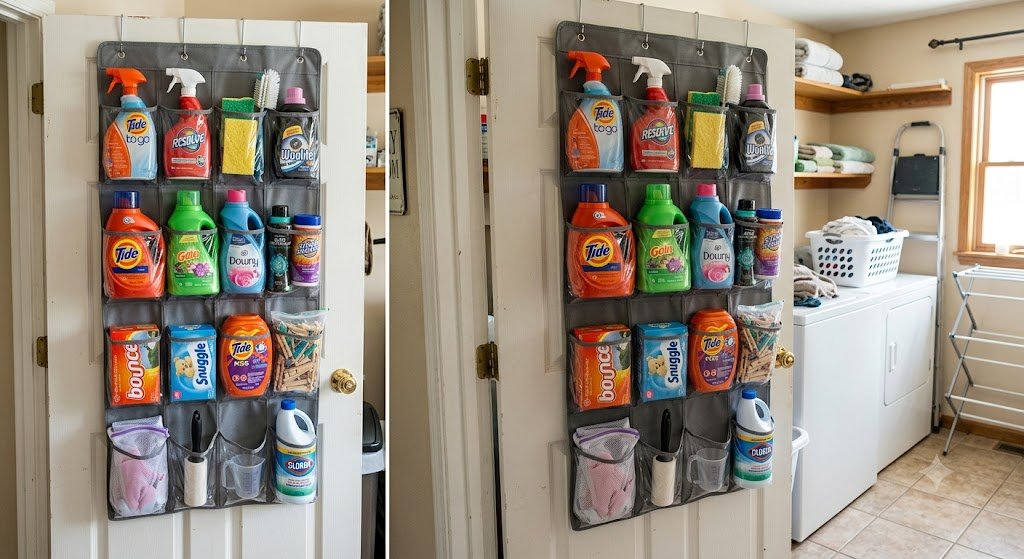
Large detergent bottles can consume valuable counter or cabinet space. A smaller container can work better if it is suitable for the detergent and securely stored. Possible locations include:
- A wall shelf
- Inside a cabinet
- Above the laundry area
- On a narrow utility shelf
- On a small laundry cart
Keep detergent away from children and pets and follow the product’s storage instructions. The goal is simple keep laundry supplies accessible without turning your counter into a laundry shelf.
Using too much detergent can create unnecessary rinsing problems, so check the guide to detergent quantity for a portable washing machine.
8. Wash Near the Sink or Tub When Practical
Portable washers are easier to manage when they are close to a suitable water source and drainage point. If your setup allows it, washing near a sink or tub can reduce the distance you need to move:
- Water
- The washer
- Wet clothes
- Drain hoses
Before connecting a portable washer to a sink or tub, follow the manufacturer’s instructions and make sure the drain hose is securely positioned. This is particularly important in tiny homes because even a small water spill can affect a large part of the living area.
Before choosing a permanent location, check this portable washer installation guide for water, drainage and placement considerations.
9. Plan for a No-Hookup Setup
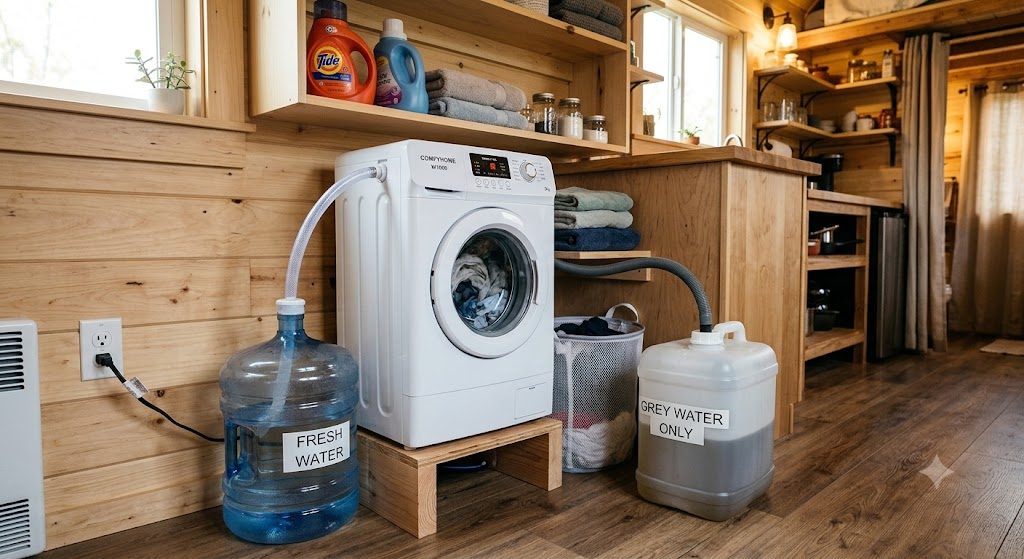
Some tiny houses do not have a standard washer hookup. That does not automatically rule out laundry at home, but it changes what you need to consider. If your tiny house does not have a standard washer connection, see these ways to use a portable washer without a washer hookup. Before buying a portable washer, determine:
- Where will the washer get water?
- Where will wastewater drain?
- Is the electrical supply suitable?
- Can the washer be moved safely?
- Where will it be stored?
- Where will the wet clothes dry?
A portable washer may be convenient, but it still needs a workable water and drainage arrangement. Do not buy the appliance before solving these basic questions.
If the washer fills but the water does not leave properly, see this guide on what to do when a portable washing machine is not draining.
10. Use an Appropriate Spin Cycle
The washing cycle is only half of the problem. Wet clothing can take much longer to dry than lightly damp clothing. If your machine provides different spin options, use an appropriate setting for the load and fabric.
A higher suitable spin speed can remove more water before drying, but do not assume that the maximum setting is correct for every fabric. Follow the garment-care label and washer instructions.
The goal is not simply to use the strongest spin. The goal is to send less excess water into your drying area while treating the clothing appropriately.
11. Avoid Washing Too Many Bulky Items at Once
Bulky items create problems throughout the laundry process.
Examples include:
- Blankets
- Comforters
- Large towels
- Jeans
- Heavy sweatshirts
- Bedding
Even if an item physically fits inside a washer, check whether the manufacturer says the machine is suitable for that load. Bulky laundry can also consume a large amount of drying space. For many tiny-house setups, a better strategy is:
Everyday clothes at home + oversized items at a laundromat
rather than trying to make one small machine do everything.
12. Use a Collapsible Laundry Basket
A rigid laundry basket occupies space even when it is empty. A collapsible basket can be folded or flattened when it is not being used. Look for one that:
- Fits your normal laundry volume
- Collapses for storage
- Has practical handles
- Can tolerate damp clothing
- Fits the storage space you already have
The basket should disappear when it is not needed. That is more valuable in a tiny home than having a large basket sitting permanently in the living area.
13. Dry Clothes Vertically
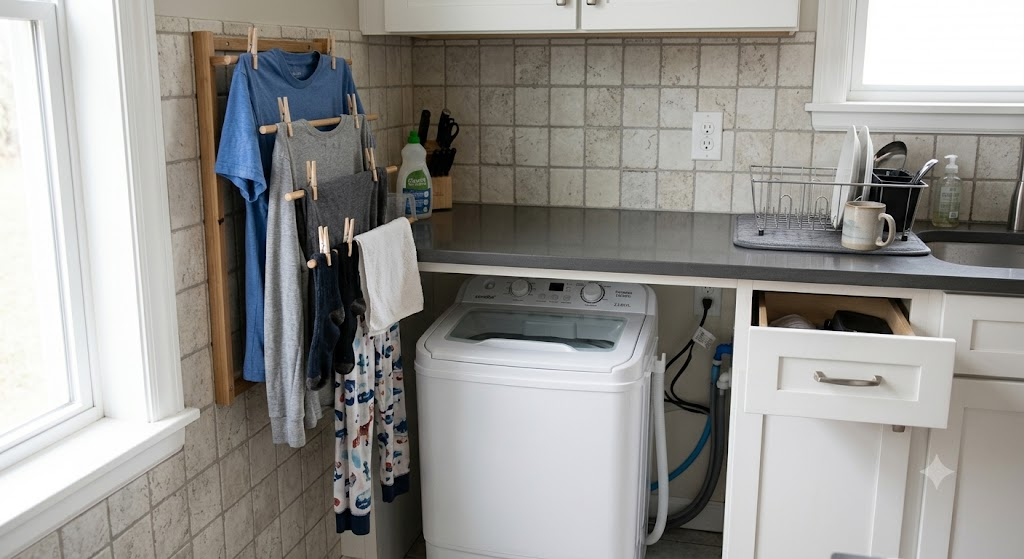
Floor space is usually the most valuable space in a tiny house. That makes vertical drying particularly useful.
Consider:
- Wall-mounted drying racks
- Retractable clotheslines
- Wall rails
- Suitable shower rods
- Over-door hooks
- Hangers
- Foldable drying racks
Tiny-house laundry guides commonly recommend wall-mounted and vertical drying approaches because they reduce the floor footprint of laundry. The best drying solution is usually one that can be folded, retracted or removed when the laundry is finished.
14. Do Not Crowd Wet Clothes Together
A common mistake is to find one drying area and hang every wet item there. The result can be a dense mass of clothing with poor airflow. Instead:
- Leave space between garments
- Spread thick items farther apart
- Use hangers when practical
- Avoid stacking wet clothing
- Keep clothes away from surfaces where moisture can accumulate
- Position the drying area where air can circulate
Your drying equipment does not need to be large if you use it efficiently.
15. Move Wet Clothes Immediately
Do not treat the washing machine as a temporary storage basket. Move clothes to the drying area promptly after the wash and spin process is complete. A simple workflow is:
Wash → spin → hang → ventilate
rather than:
Wash → leave clothes inside → remember later → deal with damp laundry
The second routine creates unnecessary delays and can make laundry feel much more difficult.
16. Control Indoor Humidity
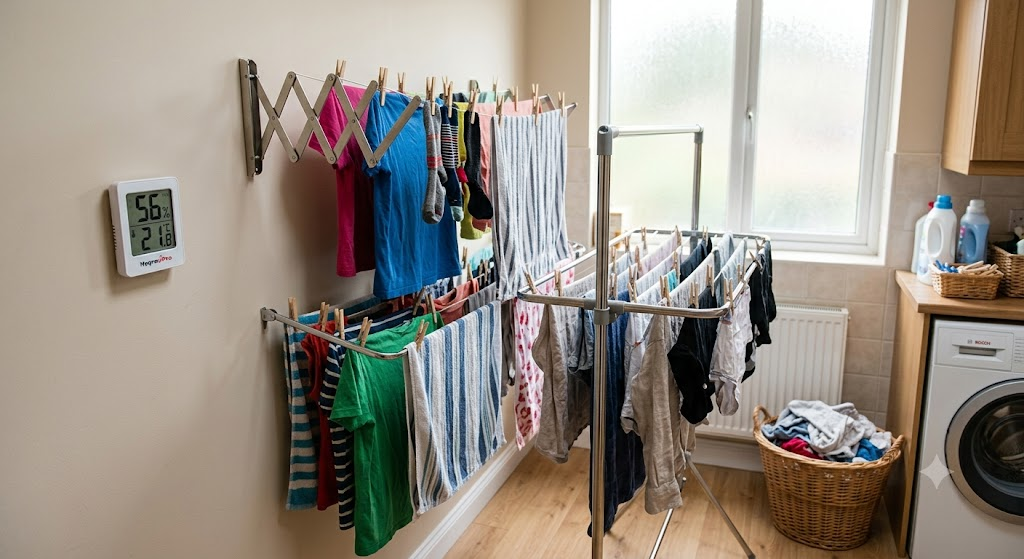
This is especially important in a tiny home. Drying wet clothes indoors releases moisture into the surrounding air. The EPA recommends keeping indoor relative humidity below 60%, ideally between 30% and 50%. A small humidity meter can help you monitor the space.
If you regularly dry clothes indoors
Consider:
- Opening windows when outdoor conditions allow
- Using bathroom exhaust ventilation where appropriate
- Improving air circulation
- Using a dehumidifier when appropriate
- Avoiding large amounts of wet laundry in one enclosed area
- Monitoring indoor humidity
If you see condensation on windows, walls or pipes, treat it as a warning sign. EPA guidance recommends acting quickly to reduce the moisture source and dry wet surfaces.
17. Do Not Let Drying Become a Moisture Problem
A tiny house has limited air volume, so repeated indoor drying can become noticeable. A useful rule is:
If the clothes are dry but the room remains damp, your laundry system needs better moisture control. Do not solve the problem simply by adding more drying racks.
First improve:
- Ventilation
- Air circulation
- Drying spacing
- Load size
- Drying location
If necessary, consider a dehumidifier.
18. Consider a Washer-Dryer Combo If Drying Is the Main Problem
A washer-dryer combo can be useful when your main limitation is not washing but drying. ENERGY STAR recognizes combination washer-dryer designs among smaller-space laundry options.
However, check:
- Electrical requirements
- Water requirements
- Drainage
- Capacity
- Drying method
- Cycle duration
- Service availability
- Manufacturer installation requirements
A combo makes more sense when you have limited drying space but enough permanent utility infrastructure. If you already have an excellent outdoor drying area, a simpler washer may be more practical.
19. Consider a Stackable Washer and Dryer When You Have Vertical Space
If your tiny house has a permanent laundry area but limited floor space, stacking can make better use of the available footprint. The advantage is:
Two appliances occupying approximately one appliance’s floor area.
But stacking should only be done when the appliances and manufacturer-approved stacking equipment support that configuration.
Also check:
- Ceiling clearance
- Electrical requirements
- Water connections
- Drainage
- Service access
- Appliance weight and installation requirements
20. Use Multipurpose Laundry Equipment
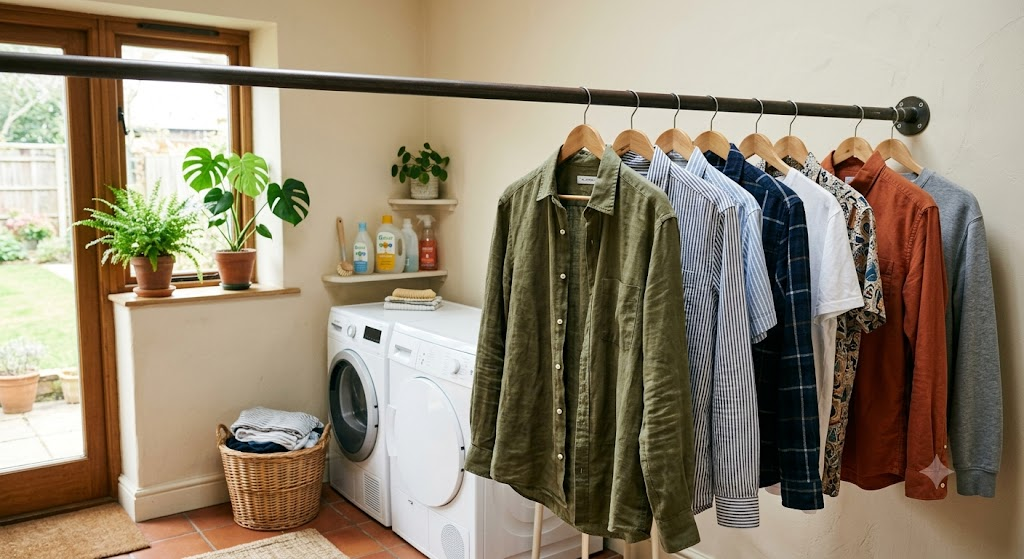
In a tiny home, equipment that disappears when not in use is particularly valuable.
Examples include:
- Foldable drying racks
- Collapsible laundry baskets
- Rolling utility carts
- Folding surfaces
- Wall rails
- Retractable clotheslines
The best question to ask is:
What happens to this item when laundry is finished?
If the answer is “it folds away,” it is generally better suited to a tiny home than an item that permanently occupies floor space.
21. Think About Water and Electricity Before Buying
A tiny-house laundry system has to work within the home’s infrastructure.
Ask:
Water
Can the home provide enough water for the chosen washer?
Drainage
Where will wastewater go?
Electricity
Can the electrical system safely support the appliance?
Drying
Can you dry the resulting load without creating excessive indoor humidity?
Storage
Where will the appliance go between laundry sessions?
ENERGY STAR also provides water- and energy-efficiency metrics for certified residential washers. IMEF is used to compare energy efficiency, while a lower IWF indicates greater water efficiency.
However, do not assume a portable washer automatically has an ENERGY STAR certification. Check the specific model if certification is important to you.
22. Establish a Fixed Laundry Routine
A fixed routine prevents laundry from becoming a daily space problem.
| Person | Laundry Schedule |
|---|---|
| One person | Monday: Clothes Thursday: Towels and miscellaneous items Saturday: Bedding or remaining clothes |
| A couple | Tuesday: Everyday clothes Friday: Everyday clothes Sunday: Towels and bedding |
The exact schedule does not matter. What matters is avoiding the situation where dirty clothes accumulate until they become a large pile.
23. Deal With Bulky Laundry Separately
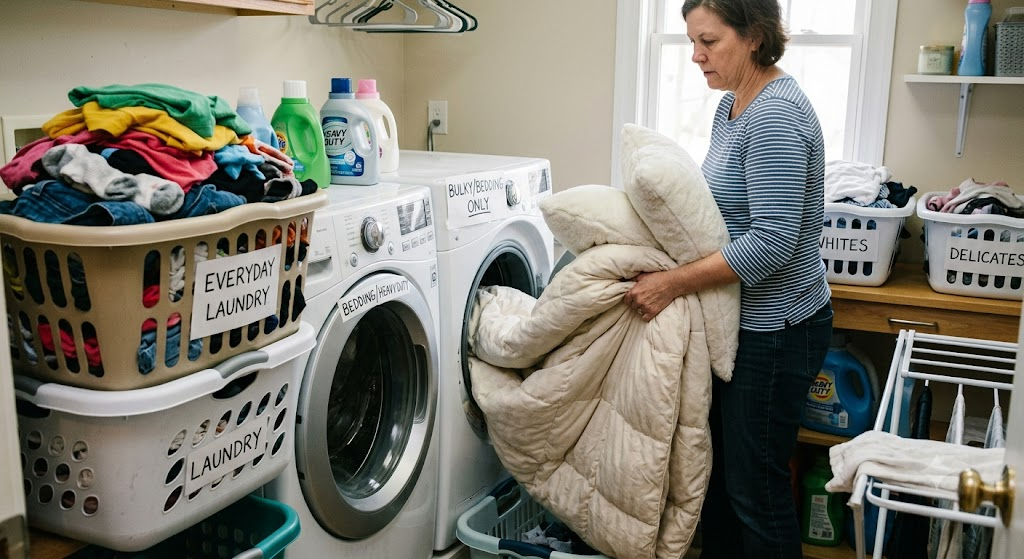
Not every item needs to go through your tiny-house washer. Create a separate category for:
“Laundromat loads.”
This could include:
- Comforters
- Large blankets
- Oversized bedding
- Heavy rugs where appropriate
- Very large loads
- Items that exceed the washer’s stated capacity
This makes your home laundry system much more predictable.
24. When Does a Laundromat Make More Sense?
A laundromat is often the better option when:
- You have no practical place for a washer
- Your water supply is limited
- You cannot dry clothes indoors safely or comfortably
- You frequently wash bulky items
- Your household produces large laundry loads
- You do laundry only occasionally
- Buying and storing equipment would create more problems than it solves
You do not have to choose between “washer at home” and “laundromat.”
A hybrid approach can work extremely well.
Example
Portable washer: everyday clothing, small towels and small loads
Laundromat: comforters, blankets and large bedding
This can keep the home laundry setup small without forcing a compact machine to handle oversized loads.
25. Reuse Suitable Graywater Only Where Allowed
Graywater reuse can be attractive in a tiny home, particularly where water availability is limited. However, laundry wastewater cannot simply be redirected wherever convenient. Rules vary by location. If you are considering graywater reuse:
- Check local regulations
- Follow plumbing requirements
- Follow washer instructions
- Consider detergent ingredients
- Use only approved reuse methods
Do not assume that advice written for one state or municipality applies to another.
26. A Simple Tiny-House Laundry Workflow
Here is the complete process I would recommend.
Step 1: Sort as clothes become dirty
Keep everyday clothing, heavier items and delicates separated.
Step 2: Decide whether the load belongs at home
Ask:
Can my washer handle it?
Can I dry it afterward?
If either answer is no, consider the laundromat.
Step 3: Wash a manageable load
Do not fill the washer simply because there is empty space.
Step 4: Use the correct detergent amount
Follow the detergent and washer instructions.
Step 5: Use an appropriate spin setting
Remove excess water without ignoring fabric-care requirements.
Step 6: Move clothes immediately
Transfer wet clothing directly to the drying area.
Step 7: Dry vertically
Use the available wall, rail, line or hanging space.
Step 8: Control moisture
Ventilate and monitor humidity when drying indoors.
Step 9: Fold and put away
Do not let clean laundry become another permanent pile.
Step 10: Store the equipment
Once the equipment is ready to be stored, return it to its designated location.
Portable Washer vs. Laundromat for a Tiny House
| Situation | Portable washer | Laundromat |
|---|---|---|
| Small everyday loads | Excellent | Usually unnecessary |
| Frequent laundry | Convenient | Less convenient |
| Very limited floor space | Good if storage is planned | Excellent |
| Large blankets | Often unsuitable | Better |
| Comforters | Usually limited | Better |
| No washer storage area | Less practical | Better |
| Limited water supply | Depends on setup | Better |
| Limited drying space | Depends on drying setup | Better |
| Large household | May be limiting | Better |
| Occasional laundry | Good | Good |
| No permanent hookup | Potentially useful | Very practical |
| Want laundry completely out of the home | Not suitable | Excellent |
What to Check Before Buying a Tiny-House Washer
Do not buy based on capacity or price alone.
Check these 10 things:
1. Capacity
Does it match your normal laundry load?
2. Drying capacity
Can you dry a full load afterward?
3. Physical footprint
Can it fit where you plan to use it?
4. Storage
Where will it go when laundry is finished?
5. Water connection
How will the machine receive water?
6. Drainage
Where will wastewater go?
7. Electrical requirements
Can your tiny home’s electrical system support it?
8. Spin performance
Does the machine provide an appropriate spin option?
9. Service and warranty
Can you obtain support, parts or service if something fails?
10. Bulky-item limitations
What types of laundry will you still need to take to a laundromat?
This checklist is more useful than simply asking, “What is the smallest washing machine?”
Common Tiny-House Laundry Mistakes
- Buying too much capacity: A bigger washer can create a bigger drying problem.
- Ignoring drying space: The washer may fit perfectly while the wet laundry does not.
- Waiting too long between washes: A huge laundry pile consumes valuable living space.
- Sorting everything at once: Pre-sorting reduces the amount of space needed on laundry day.
- Leaving wet clothes in the washer: Move them to the drying area promptly.
- Crowding the drying rack: Air needs to circulate around wet clothing.
- Drying large loads in an enclosed room: This can add substantial moisture to a small living space.
- Ignoring condensation: Condensation on windows or other surfaces can indicate excessive moisture.
- Buying equipment before checking utilities: A washer must work with your water, drainage and electrical setup.
- Trying to wash every bulky item at home: A laundromat can be the more practical solution.
Final Recommendation: Tips for washing clothes in tiny house
For many tiny-house owners, the best setup is:
manageable loads + suitable portable washing machine capacity + planned storage + vertical drying + good airflow + a fixed laundry routine.
A portable washer makes sense when you regularly wash small loads and have a practical place to connect, drain and store it. A compact or stackable washer makes more sense when you have permanent utility space. A washer-dryer combo can be worth considering when drying space is your biggest limitation.
And a laundromat remains useful for bulky items or situations where your home’s water, electrical or drying limitations make home washing impractical. The most important rule is:
Plan the entire journey from dirty clothes to completely dry clothes before choosing the washing machine.
That prevents one of the most common tiny-house laundry mistakes: solving the washing problem while creating a bigger drying, storage or humidity problem.
FAQs
Q. How often should you wash clothes in a tiny house?
There is no universal schedule. Washing smaller loads more frequently can be easier than allowing dirty clothes to accumulate for an entire week. Your ideal routine depends on household size, clothing use, washer capacity and available drying space.
Q. What portable washing machine capacity is best for a tiny house?
Choose capacity based on the amount of laundry you normally wash, but also consider how much wet laundry you can dry afterward. The largest washer is not necessarily the best choice for a tiny home.
Q. Should I buy a larger portable washer if I have limited space?
Not necessarily. Larger capacity can mean fewer wash cycles, but it can also require more storage space and produce a larger amount of wet laundry at once. Match the machine to both your washing and drying capacity.
Q. Can I dry clothes inside a tiny house?
Yes, but indoor drying adds moisture to the air. The EPA recommends keeping indoor relative humidity below 60%, ideally between 30% and 50%.
Q. How can I dry clothes without taking up floor space?
Use wall-mounted drying racks, retractable clotheslines, rails, hangers and other vertical solutions. Foldable equipment is particularly useful because it can be stored after use.
Q. Is a portable washer better than a full-size washer?
Not automatically. A portable washer is useful when you have limited space and mostly wash small loads. A permanent compact or full-size washer may be better when you have adequate utilities and larger laundry requirements.
Q. Can I wash blankets in a portable washer?
Check the manufacturer’s stated capacity and instructions. Large blankets and comforters can be difficult to wash and dry in compact equipment. A laundromat may be more practical for oversized items.
Q. What should I do if my tiny house becomes humid while drying clothes?
Increase ventilation, improve airflow, reduce the size of the load being dried and consider a dehumidifier if appropriate. A humidity meter can help you determine whether indoor humidity is becoming excessive. EPA recommends keeping indoor RH ideally between 30% and 50%.
Q. Can I reuse washing-machine graywater?
Possibly, but local rules determine what is allowed. Check the regulations applicable to your location before designing a graywater system.
Q. Is a laundromat a better option for a tiny house?
Sometimes. It makes particular sense for bulky bedding, very large loads, limited water supplies or homes without a practical place to dry clothes.
Recommended Reading:
- 10 Best Portable Washers for Tiny Homes in 2026: Compact & Powerful Picks
- 17 Common Laundry Mistakes and How to Avoid Them
- How to Dry Your Laundry Indoors Faster: 13 Easy Methods That Actually
- 17 Small Laundry Room Ideas That Make Room for a Portable Washer

Sourabh researches and writes about home appliances, kitchen gadgets, and common appliance problems to help readers make smarter buying decisions. He specializes in Portable washing machines and appliance troubleshooting guides.
At compactHomeHub, Sourabh focuses on creating easy-to-understand content that simplifies technical appliance issues into practical solutions. His goal is to help users save time, avoid costly mistakes, and choose the right appliances with confidence.
1 thought on “26 Tips for Washing Clothes in a Tiny House With Limited Space”