It’s Sunday afternoon, your laundry pile has taken on a life of its own, and you’re standing in the appliance aisle completely lost between a twin tub and a single tub washing machine. The salesperson is hovering. You have no idea which one is right for you. Sound familiar?
Choosing between a twin tub vs single tub washing machine is one of those decisions that feels simple on the surface but has real consequences for your daily life your water bill, your electricity bill, your mornings, and even the size of your apartment. Get it right and laundry day becomes a non-event. Get it wrong and you’ll be cursing that machine every single week.
If you’re shopping for a portable washing machine for an apartment, an RV washing machine for road trips, or simply looking for a budget-friendly laundry solution, understanding these differences can save you money.
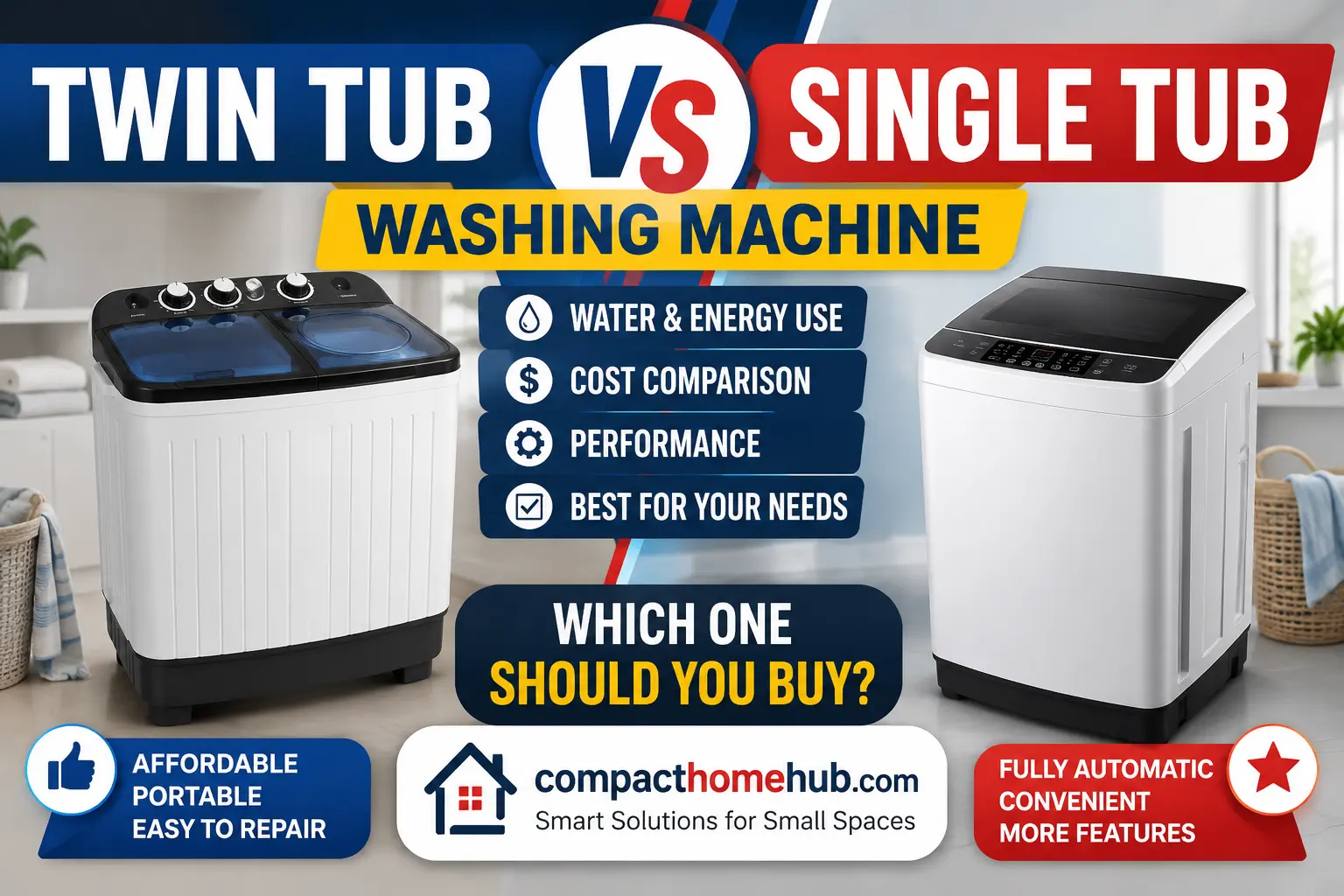
Twin Tub vs Single Tub Washing Machine
For most people, a single tub washing machine is the better choice because it offers greater convenience, automation, and ease of use. However, a twin tub washing machine remains an excellent option for budget-conscious buyers, apartment renters, RV owners, and anyone who wants lower repair costs and more control over the washing process.
| Twin Tub | Single Tub (Automatic) | |
| Best For | Budget buyers, renters, RV owners | Families, busy professionals, seniors |
| Starting Price | $60–$150 | $300–$600+ |
| Automation Level | Semi-automatic (manual transfer) | Fully automatic (set and forget) |
| Water Efficiency | Better (you control rinse water) | Varies by model; HE models excellent |
| Convenience | Moderate — requires attention | High — hands-off operation |
| Portability | Excellent | Good (compact models available) |
| Ideal Home Size | Studio, 1BR apartment, RV | Any home, especially 2+ people |
What Is a Twin Tub Washing Machine?
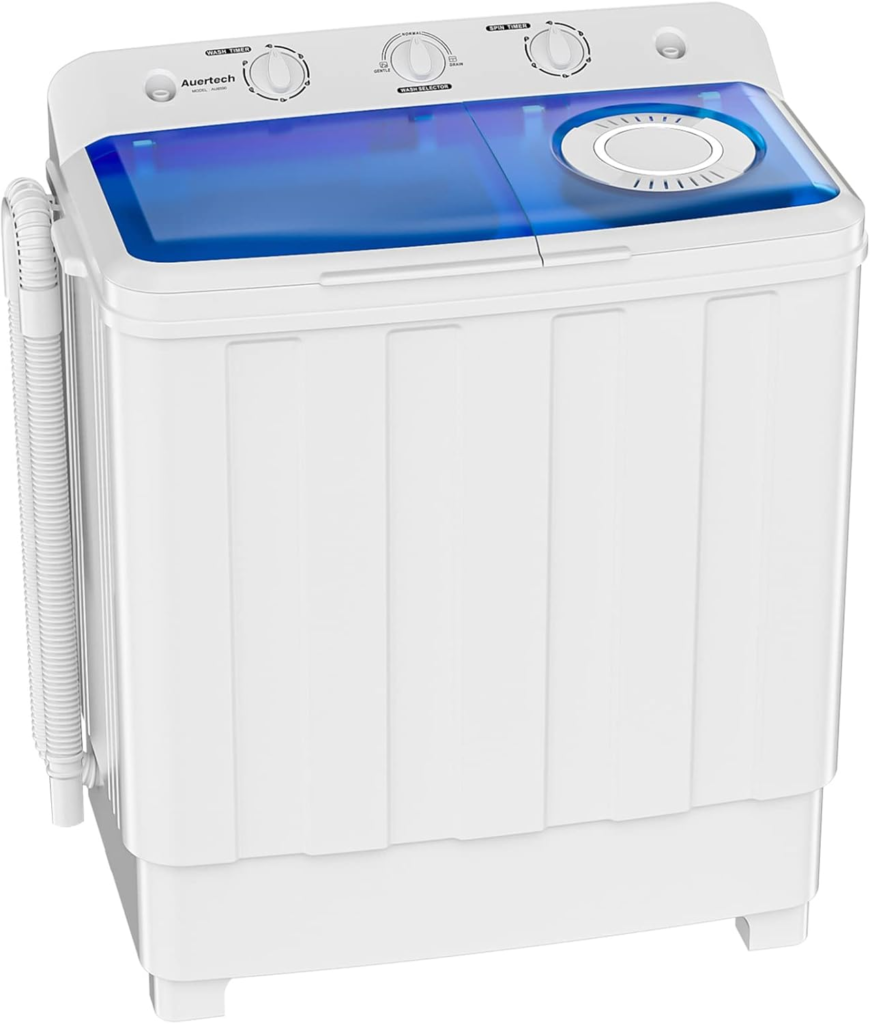
A twin tub washing machine contains two separate compartments.
The first tub is used for washing clothes, while the second tub is dedicated to spin drying. After washing is complete, you manually move clothes from the wash tub to the spin tub.
This design has been around for decades and remains popular among apartment renters, RV owners, college students, and budget-conscious households.
Main Components of a Twin Tub
- Wash tub: Usually 10–15 lbs capacity, with an agitator that moves clothes through soapy water
- Spin tub: Smaller capacity (around 6–10 lbs), spins at high speed to extract water
- Two separate timers: One for washing, one for spinning
- Water inlet: Usually connects to a faucet via hose
- Drain hose: Drains from both tubs via gravity or pump
| Advantages | Limitations |
|---|---|
| Lower upfront cost | Requires manual transfer of clothes between wash and spin tubs |
| Compact design that fits small spaces | Less convenient than fully automatic models |
| Easy and inexpensive repairs | Usually offers smaller capacity |
| Lightweight construction for portability | Requires more user involvement during laundry |
| Faster spin drying due to a dedicated spin tub | Not ideal for users seeking a hands-free washing experience |
If you’re new to portable laundry appliances, learn how a portable washing machine works step-by-step before choosing a model.
What Is a Single Tub Washing Machine?
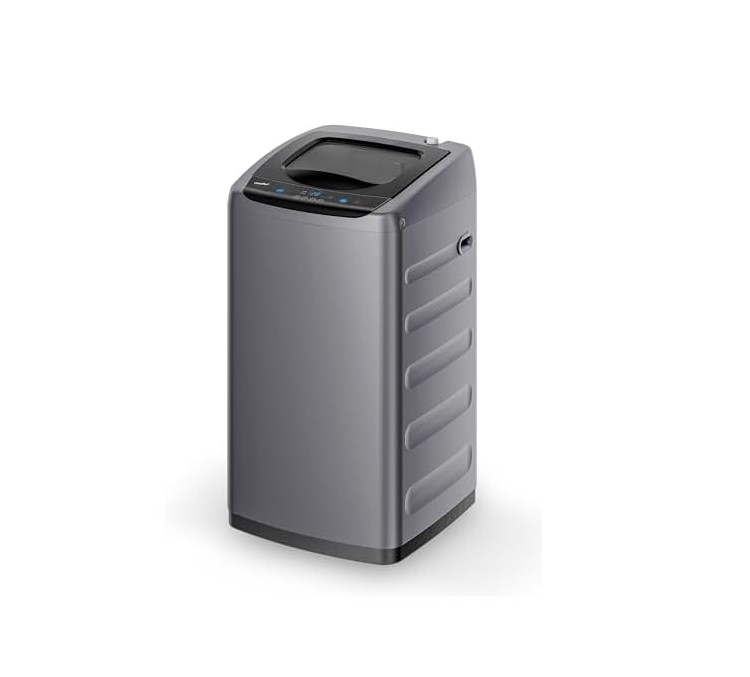
A single tub washing machine performs washing, rinsing, and spinning inside the same drum.
Most modern single tub models are fully automatic, meaning you simply load your clothes, add detergent, select a cycle, and let the machine handle the rest.
This convenience makes single tub machines the preferred choice for most American households.
Main Components of a Single Tub Washer
- Single drum: Does all washing, rinsing, and spinning in one compartment
- Control panel: Digital or dial controls for selecting wash programs
- Water inlet valves: Hot and cold water connections (or cold-only with internal heater)
- Pump: Actively drains water after each cycle stage
- Motor: Powers the drum rotation at variable speeds for different programs
| Advantages | Limitations |
|---|---|
| Lower upfront cost | Requires manual transfer of clothes between wash and spin tubs |
| Compact design | Less convenient than fully automatic models |
| Easy and inexpensive repairs | Usually offers smaller capacity compared to larger automatic machines |
| Lightweight construction, making it easy to move | Requires more user involvement throughout the wash cycle |
| Faster spin drying due to a dedicated spin tub |
Twin Tub vs Single Tub Washing Machine: Detailed Comparison
| Feature | Twin Tub | Single Tub (Automatic) |
| Washing Performance | Good for regular loads | Excellent, multiple programs |
| Spin/Drying Performance | Moderate — clothes still damp | Excellent — clothes nearly dry |
| Ease of Use | Moderate — needs attention | Very easy — fully automatic |
| Water Consumption | Low (manual control) | Varies; HE models very efficient |
| Energy Efficiency | Excellent — small motor | Good to excellent (HE models) |
| Portability | Excellent — lightweight | Moderate (compact models only) |
| Purchase Price | $60–$150 | $300–$1,500+ |
| Maintenance | Simple — few parts | Moderate — more electronics |
| Durability | High for basic use | High with proper care |
| Noise Level | Moderate during spin | Quiet to moderate |
| Capacity | 10–15 lbs wash / 6–10 lbs spin | 12–25+ lbs |
| Best Use Cases | Apartments, RVs, budget buyers | Families, busy households |
| Repair Costs | Low — simple parts | Moderate to high |
| Hot Water Option | Manual (use hot tap water) | Built-in heating available |
| Wash Cycles Available | 1–2 basic cycles | 5–15+ programs |
Detailed Comparison: What Really Matters
Washing Quality
A common misconception is that twin tub machines don’t clean clothes as well as single tub models. In reality, many twin tub washers provide surprisingly strong cleaning performance because their agitators create aggressive water movement.
However, modern single tub washing machines often offer multiple wash programs, load sensors, and optimized drum movements that improve stain removal while being gentler on fabrics.
Winner: Single Tub Washing Machine
Drying Performance
Twin tub washing machines often surprise buyers here. Their dedicated spin tubs can remove a large amount of water from clothing. Many users report that clothes come out of the spin tub nearly dry, reducing drying time significantly.
Single tub machines also spin clothes effectively, but compact portable models may not remove quite as much moisture.
Winner: Twin Tub Washing Machine
Water Usage
Water efficiency has become increasingly important in the many countries, especially in regions where water costs are high. Most modern single tub washing machines use sensors to determine the correct water level automatically.
Twin tub machines typically require manual filling and draining, which can lead to higher water consumption if not used carefully.
Winner: Single Tub Washing Machine
Electricity Consumption
Twin tub washers typically use 200–400 watts. A full wash-and-spin cycle takes about 45–60 minutes. That’s roughly 0.2–0.4 kWh per load very economical.
Standard single tub washers use 500–1,200 watts per cycle. A full automatic cycle including multiple rinses runs 45–90 minutes, using 0.5–1.8 kWh per load. HE front-loaders are more efficient, often 0.5–0.8 kWh per load.
Over a year washing 5 loads per week, the difference can be $20–$50 in electricity costs not huge, but it adds up.
Winner: Twin Tub Washing Machine
Laundry Capacity
Twin tub models are commonly available in capacities ranging from 10 to 20 pounds. Single tub machines are available in much larger capacities suitable for families.
Twin tub wash tubs typically handle 10–15 lbs of dry laundry. The spin tub holds less usually 6–10 lbs. If you have a family of four, you’re looking at 3–4 loads of laundry per session.
Single tub washers range from compact 1.6 cu. ft. models (about 10–12 lbs) up to large capacity 5–6 cu. ft. machines that can handle 20+ lbs. For families, a single tub simply gets the job done faster.
| Household Size | Recommended Capacity |
|---|---|
| 1 Person | 1.0–1.5 cu. ft. |
| 2 People | 1.5–2.0 cu. ft. |
| 3–4 People | 2.5–4.0 cu. ft. |
| 5+ People | 4.0+ cu. ft. |
Winner: Single Tub Washing Machine
If you mainly need to handle small loads rather than the laundry of an entire family, a compact model may be more practical. Our guide to the compact washing machine for small loads compares mini washers that can be useful for baby clothes and other frequent small-batch laundry.
Convenience
Twin tubs require you to stay nearby: fill the tub, wait for the wash cycle, transfer clothes to the spin tub, drain the wash tub, add fresh rinse water, wait again, transfer back, run the spin again. That’s a 45-minute hands-on experience.
Some people actually prefer the involvement of a twin tub it’s a workout hack. But for most busy people, the automation of a single tub washer is worth the extra cost. Just load the clothes and press start.
Winner: Single Tub Washing Machine
Portability
Twin tubs are genuinely portable. Most weigh 15–25 lbs and are small enough to store in a closet. They connect to any standard faucet with an adapter. This makes them perfect for apartment renters who can’t install a permanent washer, RV dwellers, or people who move frequently.
Single tub units are generally heavier and bulkier. Compact single tub washers exist, and they can connect to a sink, but they still weigh 40–60 lbs and take up more space.
Winner: Twin Tub Washing Machine
Maintenance
Twin tub washers have simple mechanical designs. Cleaning is easy just run an empty cycle with a little white vinegar monthly.
Single tub washers have more to maintain: door gaskets, detergent dispensers, self-cleaning drum cycles, lint filte, and electronic control boards. They require monthly maintenance cycles and occasional deep cleaning.
Winner: Twin Tub Washing Machine
Lifespan
With proper care, a twin tub can last 8–12 years. Its simplicity means fewer failure points.
A quality single tub models may last after 5–7 years. Brands like LG, Speed Queen, and Miele are known for exceptional longevity.
Winner: Twin Tub Washing Machine
Repair Costs
Twin tub repairs are cheap and simple. Agitator issues, drain hose replacements, and timer fixes rarely exceed $30–$60 and can often be done at home.
Single tub repairs are costilier. A control board replacement can run $150–$400. Door seal replacements on front-loaders cost $80–$200 including labor. If a repair approaches the machine’s value, most technicians will recommend replacement instead.
Typical repair expenses:
| Repair Type | Twin Tub | Single Tub |
| Motor Replacement | Low | Moderate |
| Control Board | Rare | Expensive |
| Drain Pump | Low | Moderate |
| Timer Replacement | Low | Moderate |
Winner: Twin Tub Washing Machine
Noise Levels
Twin tubs can be surprisingly noisy during the spin cycle the lightweight body vibrates more on hard floors. On carpet or with anti-vibration pads, they’re manageable.
Single tub machines usually include improved balancing systems and insulation. Quality single tub front-loaders like the LG WM4000HBA operate at 49–52 dB comparable to a quiet conversation. Top-loaders tend to be noisier at 60–70 dB.
Winner: Single Tub Washing Machine
Purchase Price
Twin tubs: $60–$180 new. You can find excellent options under $100 on Amazon.
Single tub top-loaders: $350–$700 for reliable mid-range models. Front-loaders: $700–$1,500. Budget compact single tubs can be found for $250–$350.
New buyers should review our portable washer buying guide to avoid common mistakes.
Winner: Twin Tub Washing Machine
Long-Term Operating Cost
Over five years, your total ownership cost includes:
| Cost Factor | Twin Tub | Single Tub (Standard) |
| Purchase Price | $80–$150 | $400–$700 |
| Annual Electricity (5x/week) | ~$15–$25 | ~$45–$80 |
| Annual Water Cost | ~$20–$35 | ~$50–$100 |
| Maintenance/Repairs (5 yr) | ~$20–$60 | ~$100–$300 |
| Total 5-Year Cost (est.) | $215–$395 | $795–$1,480 |
Suitability for Apartments
Twin tubs are excellent for apartments they’re small, lightweight, and don’t need a permanent hookup. The downside is that you need to run a hose to your kitchen or bathroom sink, which requires the unit to be near plumbing.
Compact single tub washers also work in apartments and often look more polished. They require the same sink connection setup but handle larger loads with full automation.
Apartment renters should compare these top portable washing machines for small spaces before making a purchase.
Winner: Twin Tub Washing Machine
Suitability for RVs
Twin tubs are the top choice for RVs. Lightweight, compact, and low-power, they fit naturally into the RV lifestyle where water is precious and electricity runs off a battery or generator. Models like the Panda PAN56 weigh under 25 lbs and fit in a van.
Single tub portable washers work in RVs too, but they’re heavier, slower, and need more electricity. For serious full-time RV living, most experienced travelers prefer twin tubs.
Winner: Twin Tub Washing Machine
Suitability for Large Families
Twin tubs struggle with large families. The capacity per cycle is limited, and the manual nature of the process means laundry day is a genuine time commitment for big loads.
Single tub machines with 4.5+ cu. ft. capacity can handle 20 lbs of laundry in one shot. Pair a large-capacity top-loader with a dryer and a family of five can get through their weekly laundry in a few hours, hands-free.
Winner: Single Tub Washing Machine
Suitability for Small Households
For one or two people, either type works well. The twin tub’s smaller capacity is perfectly matched to a 1–2 person household. You’ll likely do 2–3 small loads per week and spend less money on both the machine and utilities.
Winner: Twin Tub Washing Machine
Key Advantages of Twin Tub Washing Machines
- Lower purchase price
- Excellent portability
- Easier repairs
- Longer lifespan
- Faster spin drying
- Great for apartments
- Ideal for RV owners
- Lower electricity usage
- Compact design
- Better control over wash cycles
Real-World Example: Imagine living in a studio apartment in New York City. Space is limited, and every square foot matters. A compact twin tub washing machine can fit inside a bathroom corner and be stored when not in use.
Key Advantages of Single Tub Washing Machines
- Fully automatic operation
- Better convenience
- Larger capacities
- Advanced wash programs
- Better fabric protection
- Lower water consumption
- Less user involvement
- Quieter operation
- Better for families
Real-World Example: A family of four doing five or six laundry loads weekly will appreciate simply loading clothes and letting the machine do all the work.
Who Should Buy a Twin Tub Washing Machine?
- College Students
- Apartment Renters
- RV Owners
- Budget-Conscious Buyers
- Vacation Home Owners
Who Should Buy a Single Tub Washing Machine?
- Busy Professionals
- Families
- Seniors and Users with Mobility Issues
- User who value convenience
Beyond choosing between twin-tub and single-tub designs, it’s also worth reviewing the overall portable washer benefits and drawbacks before deciding.
Common Mistakes Buyers Make
- Buying Too Small a Capacity
- Ignoring Space Requirements
- Overlooking Water Connections
- Focusing Only on Price
- Ignoring Noise Levels
- Not Checking the Electrical Requirements
Maintenance Tips to Extend Your Washer’s Life
For Twin Tub Washers:
- Run an empty cycle with 1 cup of white vinegar every month to clean out mineral deposits and soap scum
- After each use, leave both lids open to air out and prevent mildew
- Check the drain hose monthly for kinks or buildup
- Clean the agitator fins by removing them every 3 months and rinsing under a faucet
- Store in a dry location when not in use moisture in non-running machines causes rust
For Single Tub Washers:
- Run the self-clean cycle monthly with a washer cleaning tablet or 1/4 cup of bleach
- For front-loaders: wipe the door gasket weekly with a dry cloth
- Clean the detergent dispenser drawer monthly
- Check and clean the pump filter every 3 months on front-loaders
- Don’t overload running at 80% capacity rather than 100% extends motor and bearing life significantly
FAQs: Twin Tub vs Single Tub Washing Machine
Q. Is a twin tub washing machine better than a single tub?
Not necessarily. Twin tub models are better for portability, affordability, and simple maintenance. Single tub models are better for convenience and automation.
Q. Which uses less electricity?
Twin tub washing machines generally use slightly less electricity due to their simpler design.
Q. Which is better for apartments?
Twin tub washing machines are often better for small apartments because they are lightweight and compact.
Q. Can twin tub washers wash blankets?
Yes, but capacity matters. Small models may struggle with large comforters.
Q. Which lasts longer?
Twin tub washers often last longer because they have fewer electronic components
Q. Are twin tub washers worth it in 2026?
Yes. They remain a practical choice for apartment renters, RV owners, students, and budget-conscious households.
Q. Which is easier to repair?
Twin tub machines are usually easier and less expensive to repair.
Q. Which saves more water?
Modern single tub washing machines generally use less water because they automatically adjust water levels.
Q. Which is best for RV living?
Twin tub portable washers are typically the preferred choice for RV owners due to their portability and compact size.
Q. Which is best for a family of four?
A larger-capacity single tub washing machine is usually the better option.
Q. Can I use a portable washer in an apartment?
Yes. Many apartment residents use portable washing machines successfully, but always check building rules first.
Q. Do portable washing machines clean clothes well?
Yes. Most quality portable washers provide cleaning performance that is more than adequate for everyday laundry.
Final Verdict: Twin Tub vs Single Tub Washing Machine
Choosing between a twin tub vs single tub washing machine ultimately comes down to your lifestyle, budget, and laundry habits.
Choose a Twin Tub Washing Machine If:
- You want the lowest upfront cost.
- You live in an apartment.
- You need an RV washing machine.
- You value portability.
- You prefer simple maintenance and lower repair costs.
Choose a Single Tub Washing Machine If:
- You want maximum convenience.
- You wash laundry several times per week.
- You have a family.
- You prefer automation.
- You want advanced wash programs.
For most American households, a single tub washing machine offers the best overall experience because of its convenience and hands-free operation.
However, if you’re looking for an affordable, space-saving, and highly portable laundry solution, a twin tub washing machine remains one of the smartest purchases you can make.
Before buying, consider your available space, laundry volume, budget, and whether convenience or portability matters most. Choosing the right machine today can save you money, time, and frustration for years to come.
Recommended Reading:
- 10 Best Portable Washing Machine for Apartments 2026: Top Picks Reviewed & Compared
- Portable Washing Machine Buyers Guide: 11 Things You Must Know Before Buying
- How Does a Portable Washing Machine Work? Step-by-Step
- What Is a Portable Washing Machine? The Smart Laundry Solution for Small Spaces

Sourabh researches and writes about home appliances, kitchen gadgets, and common appliance problems to help readers make smarter buying decisions. He specializes in Portable washing machines and appliance troubleshooting guides.
At compactHomeHub, Sourabh focuses on creating easy-to-understand content that simplifies technical appliance issues into practical solutions. His goal is to help users save time, avoid costly mistakes, and choose the right appliances with confidence.