If your apartment, RV, dorm, basement, or tiny home doesn’t have a traditional washer hookup, you don’t necessarily have to haul every load to a laundromat. A portable washer can give you another option, but there’s a catch: the best setup depends on the type of portable washer you own.
Some models connect temporarily to a faucet. Others can be filled with a bucket or pitcher. Manual washers can operate without plumbing or electricity at all.
There’s no single winner because your situation matters more than the machine’s marketing label.
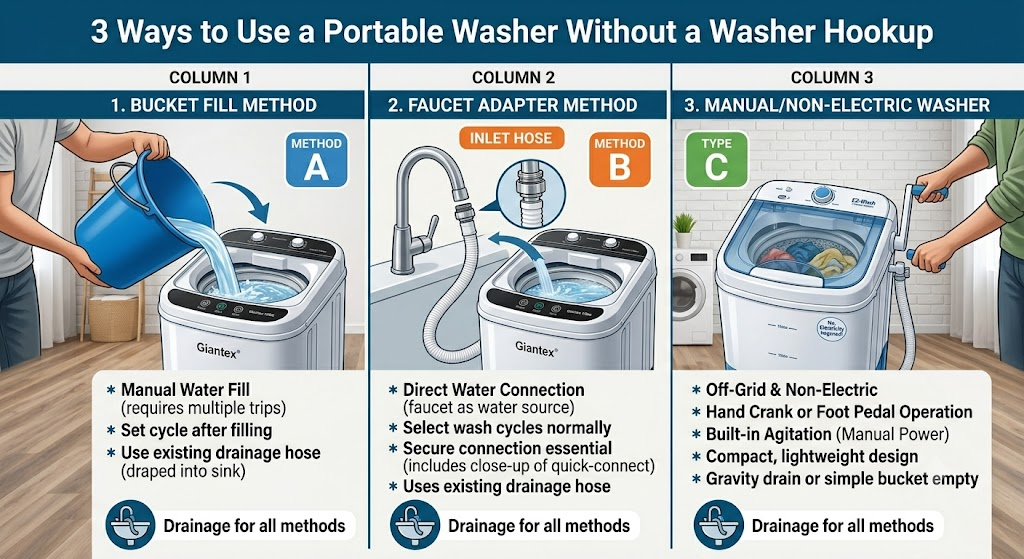
| Method | Best For | Main Advantage | Main Drawback |
|---|---|---|---|
| Bucket/manual fill | Renters, small loads | No faucet connection | Carrying water |
| Temporary faucet connection | Apartments, frequent laundry | Convenient automatic filling | Requires compatible faucet |
| Manual washer | RVs, camping, off-grid | No electricity or plumbing | More physical effort |
3 ways to use a portable washer without a washer hookup?
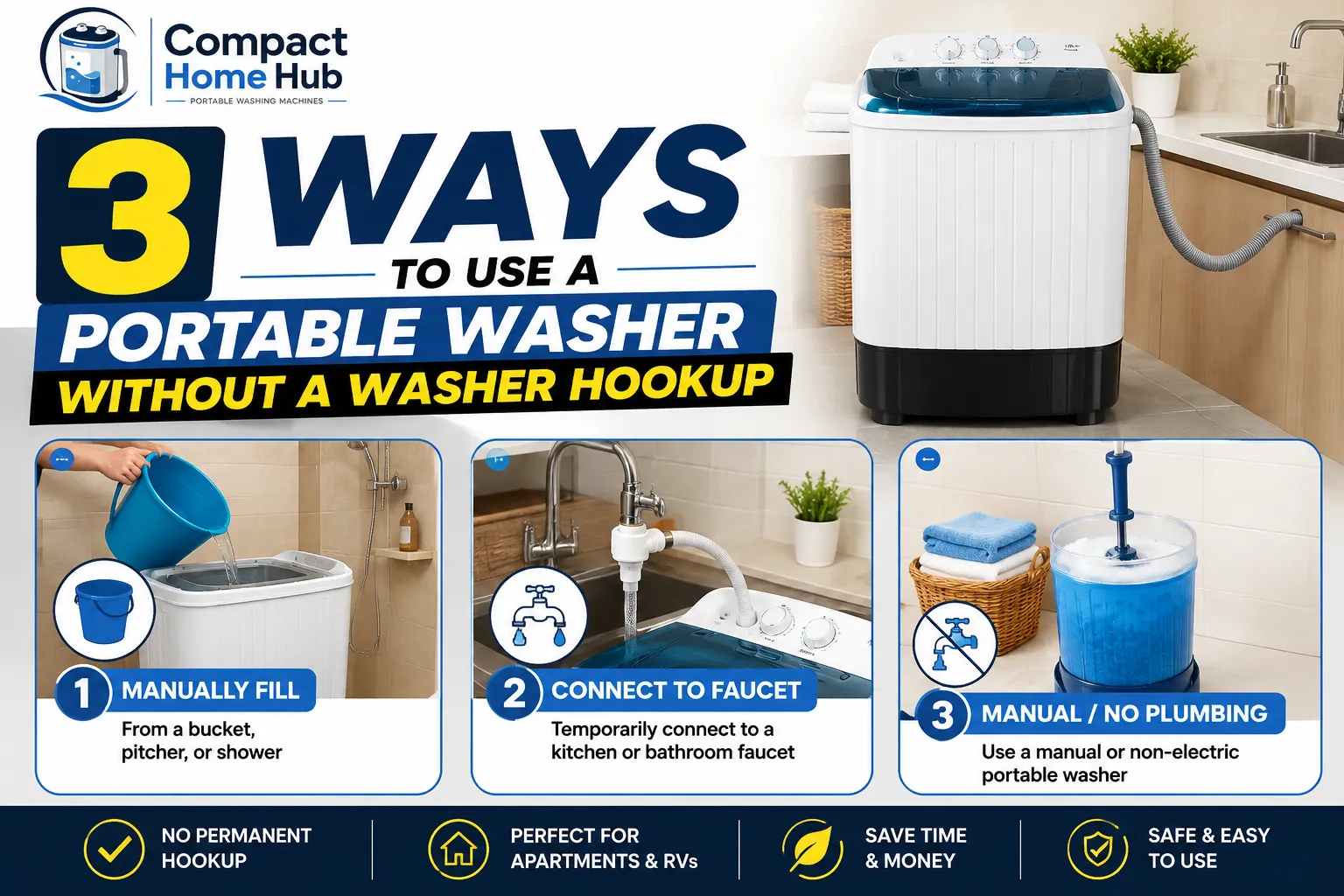
You can use a portable washer without a permanent washer hookup in three practical ways:
- Manually fill the washer from a bucket, pitcher, or shower.
- Temporarily connect the washer to a kitchen or bathroom faucet.
- Use a manual or non-electric portable washer that needs no plumbing connection.
The important part is choosing a washer that actually supports the method you want. For example, Haier says some of its portable washers cannot be manually filled because they require pressurized water for their fill function.
This guide explains how each method works, what equipment you need, the advantages and drawbacks, and which option makes the most sense for different situations in the U.S.
What Does “No Washer Hookup” Actually Mean?
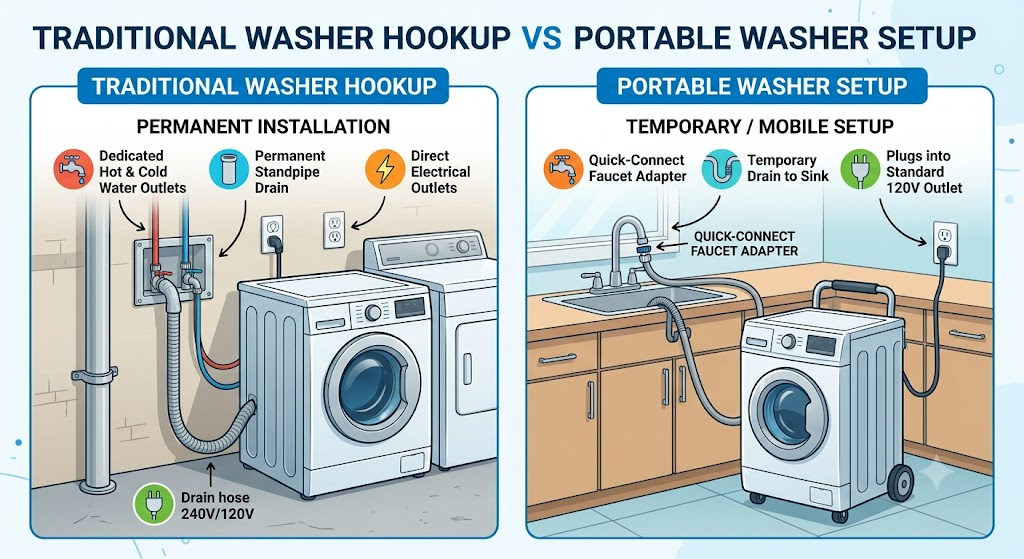
A traditional washing machine usually has a dedicated water supply, drain, and electrical connection. A portable washer is designed to be much more flexible.
When people say they need a washer without a hookup, they may actually mean one of several things:
- There is no dedicated washing-machine water line.
- There is no permanent drain connection.
- The apartment has no laundry-room plumbing.
- The user doesn’t want to modify the plumbing.
- The washer needs to be stored after every use.
- The machine will be used in an RV, cabin, or temporary space.
- The user wants to wash clothes somewhere away from the house.
A portable washer can solve some of these problems, but not every portable washer solves all of them.
Method 1: Manually Fill the Portable Washer With a Bucket
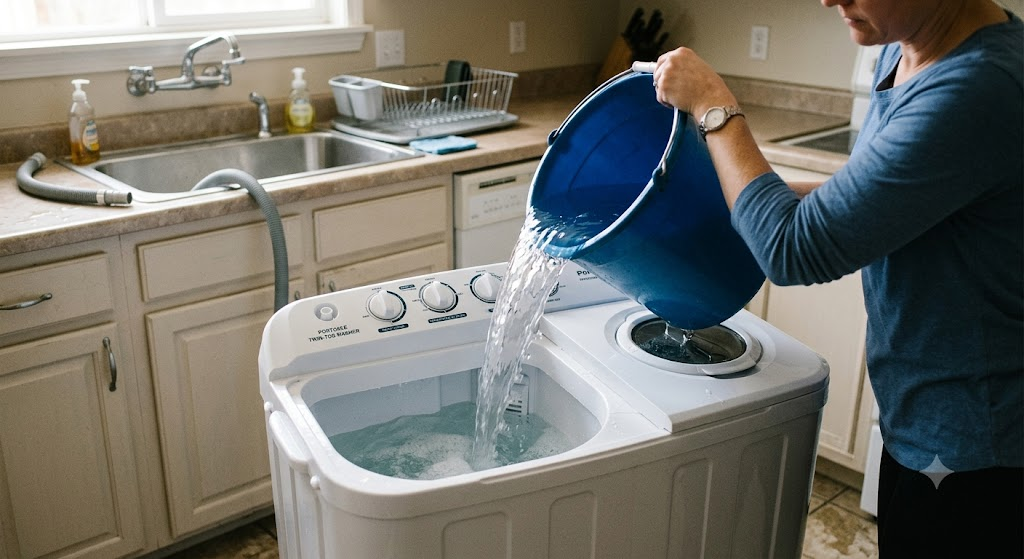
For people who don’t have a washer hookup and don’t want to connect the machine to a faucet, manual filling can be the simplest solution.
The basic idea is straightforward:
Fill → Wash → Drain → Refill → Rinse → Drain → Spin
You supply the water yourself instead of letting the washer automatically draw water from a plumbing connection.
Some semi-automatic and twin-tub portable washers are designed for this type of operation. Certain washer manuals specifically state that a bucket or shower head can be used to fill the wash tub.
How to manually fill a portable washer
- Put the washer somewhere that can safely handle water.
- Place the drain hose in a bathtub, sink, or suitable drain.
- Add clothes without overloading the tub.
- Add the recommended amount of detergent.
- Pour water into the washer using a bucket or suitable container.
- Select the wash cycle.
- Let the washer complete the wash.
- Drain the dirty water.
- Refill the tub with clean water for rinsing.
- Drain again.
- Transfer clothes to the spin tub if your washer has one.
- Run the spin cycle.
- Hang the clothes to finish drying.
A five-gallon bucket can be useful because it gives you a reasonably manageable amount of water per trip, but the actual amount required depends on the washer.
Example: Apartment with no laundry plumbing
Imagine you’re renting a small apartment where the landlord doesn’t allow you to modify the plumbing.
You could keep a semi-automatic portable washer in the bathroom. When laundry day arrives, fill a bucket from the bathtub or sink, carry the water to the washer, and manually fill the tub.
After washing, place the drain hose into the bathtub and let the wastewater leave there. You haven’t installed a permanent water line or changed the apartment’s plumbing.
If you own a Giantex twin-tub washer, our step-by-step instructions explain how to fill, wash, drain, rinse, and spin a load.
Benefits of manual filling
- No permanent water connection: This is the biggest advantage. You don’t need to install a dedicated washer water line.
- Useful for renters: If you’re worried about modifying plumbing or your lease prohibits certain appliances, a manual-fill design can reduce installation requirements. You should still check your lease and building rules.
- Works in unusual locations: A bucket can supply water almost anywhere you have access to a safe water source.
- Good for occasional laundry: If you’re washing a few shirts, workout clothes, underwear, or other small loads, carrying water may be manageable.
The downside: carrying water gets old
This is where online guides sometimes make manual filling sound easier than it really is. Water is heavy. A U.S. gallon of water weighs about 8.34 pounds. Five gallons weighs roughly 41.7 pounds before you even account for the bucket.
So if your washer needs several gallons per cycle, you may make multiple trips. That’s not necessarily a problem for small loads, but it can become annoying when you’re washing towels, jeans, bedding, or several loads at once.
Important warning: not every portable washer supports manual filling
So before buying, look for wording such as:
- Manual fill
- Bucket fill
- Gravity fill
- No faucet required
- Manual water addition
Method 2: Temporarily Connect the Washer to a Sink or Faucet
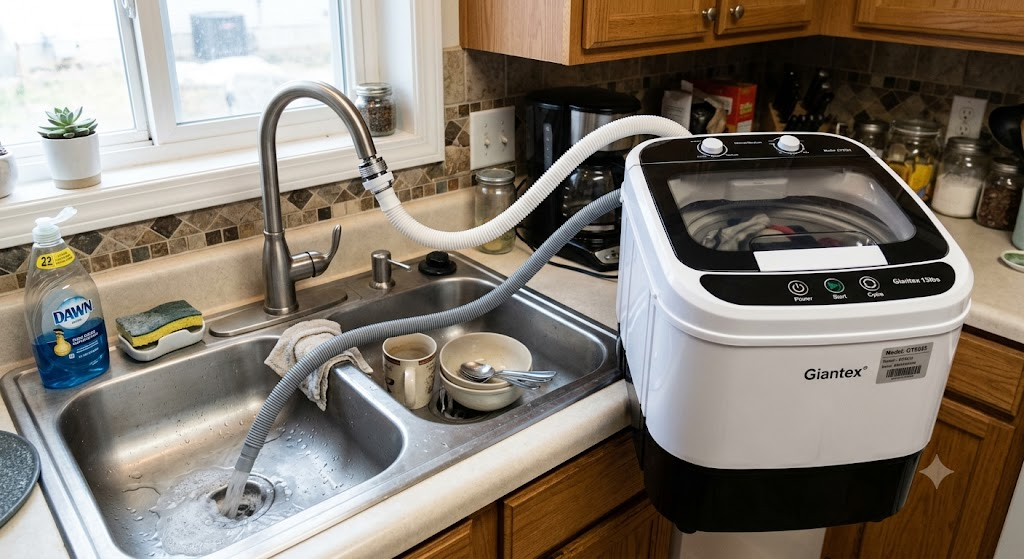
This is probably the most convenient method for many apartment residents. You don’t need a permanent washer hookup. Instead, you connect the portable washer’s inlet hose to an existing kitchen or bathroom faucet when you want to do laundry.
When you’re finished, disconnect it and store the washer. That’s the main idea behind many portable washing machines.
How the temporary faucet method works
A typical setup looks like this:
Faucet → Faucet adapter → Inlet hose → Portable washer
And for wastewater:
Portable washer → Drain hose → Sink, bathtub, or suitable drain
Many portable washer systems use faucet adapters because household faucets aren’t automatically designed to accept washing-machine hoses. Some models use fittings compatible with 3/4-inch garden-hose-style connections, although the exact faucet and adapter requirements vary.
Step-by-step setup
- Move the washer close to the sink.
- Check the manufacturer’s faucet requirements.
- Remove the faucet aerator if the instructions require it.
- Install the appropriate faucet adapter.
- Attach the washer’s inlet hose.
- Place the drain hose securely inside the sink or bathtub.
- Make sure the hose can’t jump out during drainage.
- Plug the washer into an appropriate grounded electrical outlet.
- Turn on the water.
- Check all connections for leaks.
- Run the washing cycle according to the owner’s manual.
- Turn off the water when finished.
- Disconnect the hose if your setup is intended to be temporary.
- Remove the adapter if necessary and store the equipment.
Why this method is popular
You don’t have to carry buckets of water back and forth. That’s a major practical advantage.
For example, if you live in a studio apartment and wash three small loads every week, manually carrying water could become a chore. A temporary faucet connection lets the washer fill itself during the cycle.
But faucet compatibility matters
This is where buyers often get into trouble. Not every faucet accepts the same adapter. A standard threaded faucet may be relatively straightforward, while a pull-out or pull-down kitchen faucet can be much harder or impossible to connect to depending on its design.
Before ordering an adapter, check:
- Faucet thread type
- Faucet aerator size
- Washer inlet connection
- Adapter compatibility
- Whether the faucet has a removable aerator
- Manufacturer instructions
Don’t buy an adapter simply because the listing says “universal.” “Universal” doesn’t guarantee that it will fit your particular faucet.
A faucet adapter, suitable drain hose, and leak detector can make a temporary portable washer setup much easier to manage.
What about the bathroom shower?
A shower can sometimes provide a water source, but this is more complicated than using a compatible faucet.
Shower plumbing and garden-hose-style washer fittings use different thread standards, so an appropriate adapter may be required. A poorly matched adapter can leak or fail to connect properly.
For renters, there’s another consideration: don’t modify plumbing just to make a portable washer work.
If the setup requires cutting pipes, replacing fixtures, drilling walls, or making permanent plumbing changes, stop and check your lease or ask the property manager.
Benefits of a temporary faucet connection
- Less manual work: The washer fills itself instead of requiring repeated bucket trips.
- Faster setup: Once you’ve found the correct adapter, connecting the washer can be relatively quick.
- Good for apartments: You can use existing kitchen or bathroom plumbing without installing a dedicated washing-machine line.
- Better for frequent laundry: If you’re doing several loads every week, the convenience becomes much more valuable.
Downsides
- You need a compatible faucet.
- You’ll need to connect and disconnect the hose.
- The faucet may become temporarily unavailable while washing.
- A bad connection can cause leaks.
- You need a safe place for wastewater.
- Some models require pressurized water and won’t work from a bucket.
If you plan to use a temporary faucet connection, our portable washer installation guide explains how to set up the water and drain hoses safely.
Method 3: Use a Manual Portable Washer With No Plumbing Connection
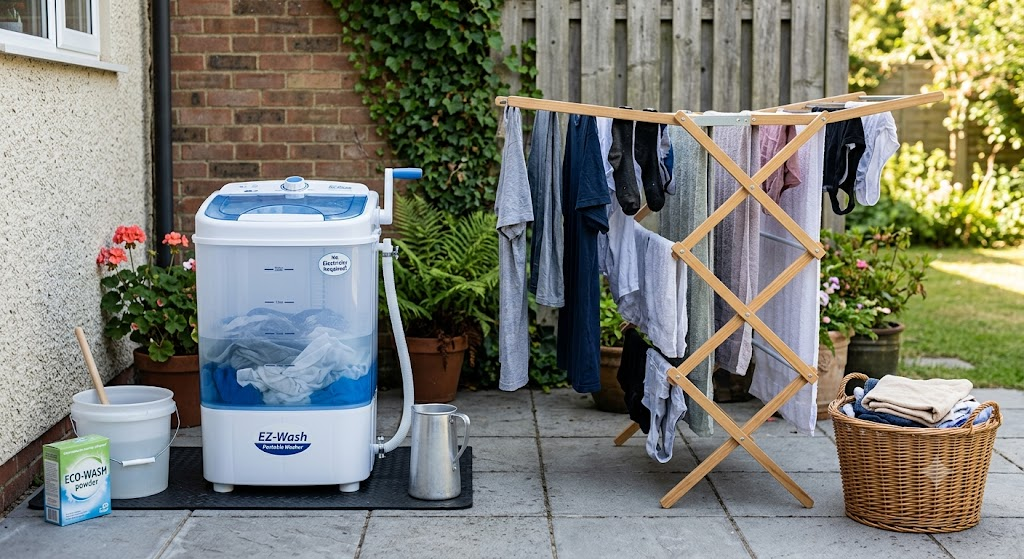
If your definition of “without a washer hookup” means no plumbing and no electricity, a manual washer is the most straightforward option. These machines don’t operate like conventional electric washers.
Instead, you add water and detergent manually, agitate the clothing using the machine’s mechanism, drain the water, rinse, and remove excess water using a separate method.
If you’re comparing an electric portable washer with a manual model, it’s also worth looking at how much electricity portable washers actually use.
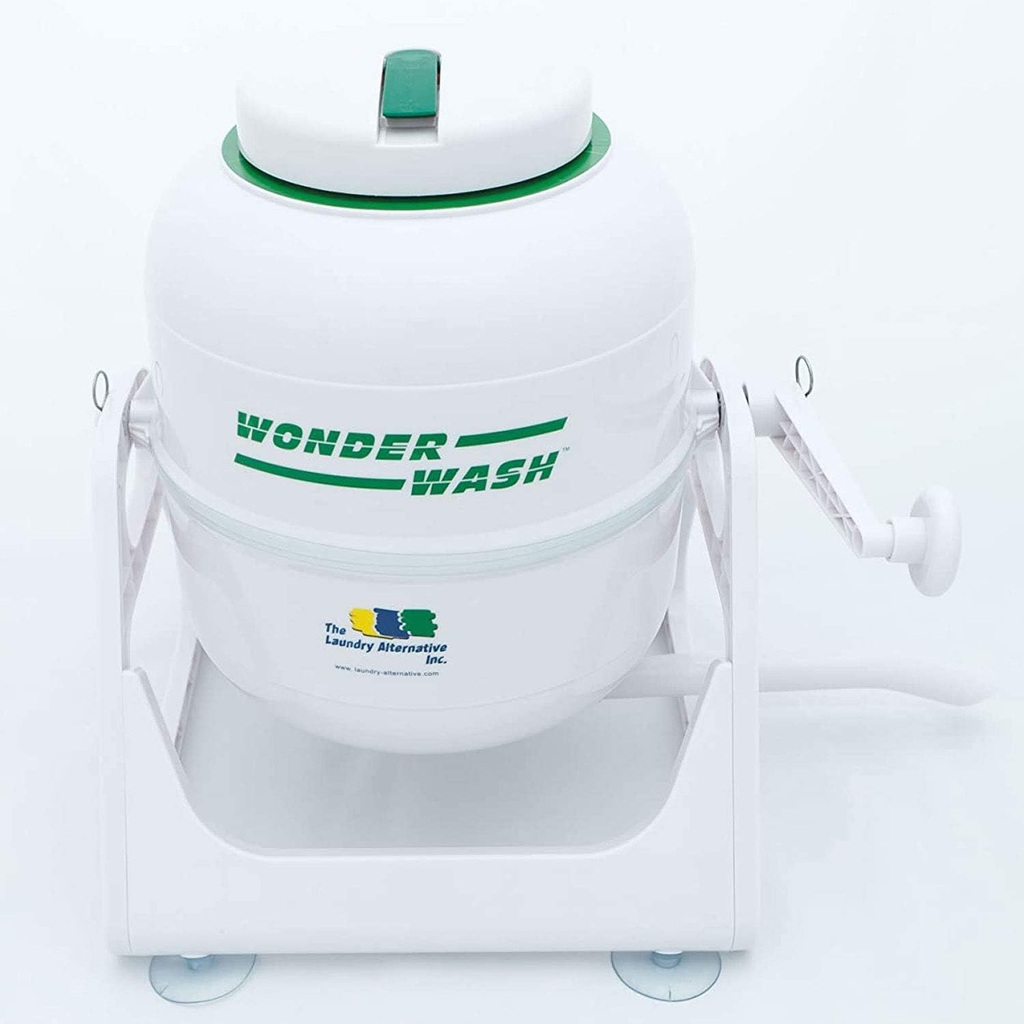
One example is the WonderWash, which the manufacturer describes as hand-powered and requiring no hookup or electricity.
How it works
The basic process is:
- Add clothes.
- Add water.
- Add detergent.
- Agitate the clothes manually.
- Drain the dirty water.
- Add clean rinse water.
- Agitate again.
- Drain.
- Remove excess water.
- Hang the clothes to dry.
There’s no faucet hose to connect and no electrical cord to plug in.
Who should consider this option?
A manual washer can make sense for:
- RV travelers
- Campers
- Off-grid cabins
- Emergency preparedness
- Tiny homes
- People without reliable electricity
- Travelers
- Very small laundry loads
- Delicate clothing
It’s particularly useful when your real problem isn’t simply “no washer hookup.”
Maybe you’re camping. Maybe you’re in a cabin. Maybe you’re traveling in an RV. Or maybe there’s simply no convenient electrical outlet or plumbing nearby. In those cases, a manual washer changes the problem entirely.
The biggest trade-off: effort
The convenience of eliminating electricity and plumbing comes with a price.
You become part of the washing machine.
A manual washer requires physical effort, and you’ll generally need to handle the water and move clothes through the wash and rinse stages yourself.
That’s perfectly reasonable for a few lightweight garments. It becomes much less appealing when you have a mountain of towels staring at you.
What about drying?
This is another detail that deserves more attention. A washer doesn’t necessarily mean dry clothes. Many portable washers have spin functions, but manual washers may not.
The WonderWash, for example, does not include a spin cycle and the manufacturer recommends pairing it with a separate spin dryer for faster drying.
After washing, you may need:
- A drying rack
- Clothesline
- Hang-drying area
- Separate spin dryer
- Conventional dryer
Spinning removes some water, but it doesn’t replace a heated clothes dryer. For a closer look at a manual washer that doesn’t depend on traditional plumbing or electricity, see our Lavario review.
Which of the 3 Ways Is Best?
Choose manual filling if…
You have easy access to water but don’t want to connect a hose to your faucet. A bathroom with a tub can be particularly convenient because you can fill the machine and drain wastewater in the same general area.
Choose a temporary faucet connection if…
You wash clothes frequently and want the least amount of manual work. For many apartment dwellers, this is likely to be the most practical arrangement provided the washer supports it and the faucet is compatible.
Choose a manual washer if…
You want the greatest independence from plumbing and electricity. This is especially relevant for camping, RV travel, cabins, emergency situations, and off-grid living.
Can You Use a Portable Washer Without Any Hookup at All?
Yes, but only with the right type of machine.
A portable washer can mean:
- Portable but faucet-connected
- Portable and manually filled
- Portable and fully manual
- Portable but dependent on pressurized water
Those aren’t interchangeable.
A fully automatic portable washer may still need an inlet hose connected to a pressurized faucet. A semi-automatic twin-tub washer may allow manual filling. A hand-powered washer may need neither electricity nor plumbing.
That one question can save you from buying a machine that doesn’t work in your home.
How to Drain a Portable Washer Without a Washer Drain
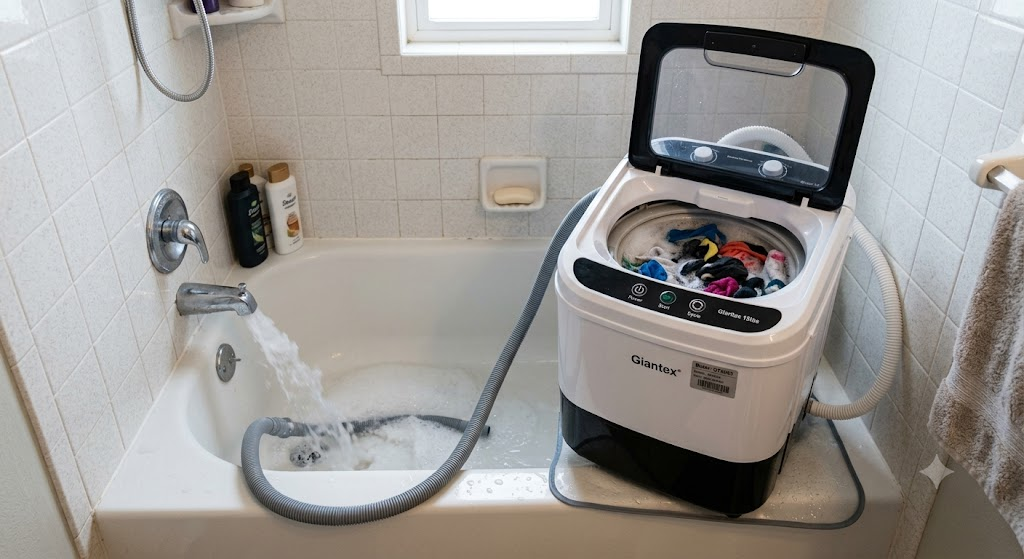
The water supply gets most of the attention, but drainage is just as important. You still need somewhere for dirty water to go.
Common options include:
- Bathtub
- Utility sink
- Kitchen sink, where appropriate
- Bathroom sink, if the hose and water volume are suitable
- Approved floor drain
- Other manufacturer-approved drainage point
Many portable washer manuals specify a sink, bathtub, or suitable drain for the drain hose. If wastewater isn’t leaving the machine properly, see our guide to troubleshooting a portable washing machine that isn’t draining.
Keep the drain hose secure
Don’t simply toss the hose into a sink and walk away. A portable washer can move during operation, and a loose drain hose can end up spraying wastewater across the floor. Secure the hose according to the manufacturer’s instructions.
Watch the drain height
Some portable washers rely on gravity while others use a drain pump. A pumped model may be able to push wastewater upward to a sink, while a gravity-drain model may require the receiving drain to be positioned appropriately.
One portable washer specification, for example, lists a maximum pump drain height, showing why you shouldn’t assume every machine can drain to any height.
If you need more troubleshooting help, see our guide to Portable Washing Machine Not Draining? 10 Ways to Fix It.
How Much Water Do You Need?
There’s no universal number because portable washer designs vary substantially. A small manual washer may need only a few gallons, while a larger portable washer can require considerably more. Don’t choose a bucket size based solely on convenience.
Instead, check the washer’s instructions for:
- Minimum water level
- Maximum water level
- Wash water amount
- Rinse water requirements
- Load size
- Manual-fill instructions
More water isn’t automatically better. If the manufacturer specifies a particular water level, follow it.
What Type of Portable Washer Is Best Without a Hookup?
If your goal is specifically ways to use a portable washer without a washer hookup, the washer type matters more than the brand name.
Semi-automatic twin-tub washers
These can be attractive for people who don’t mind more hands-on laundry. Typically, you wash clothes in one compartment and spin them in another.
Pros:
- Often relatively simple
- Can be compact
- Some models allow manual filling
- Separate spin tub
Cons:
- More manual work
- Clothes may need to be transferred between tubs
- Wash and spin capacities can differ
Fully automatic portable washers
These are generally easier to operate once connected correctly.
Pros:
- Less manual intervention
- Automated washing/rinsing/spinning
- Convenient for frequent use
Cons:
- Some require pressurized water
- Faucet compatibility matters
- Usually less suitable for truly off-grid use
Manual washers
These offer the most independence.
Pros:
- No electrical connection
- No permanent plumbing
- Extremely portable
- Useful for travel and emergencies
Cons:
- Physical effort
- Small loads
- Often no spin cycle
- Drying takes longer
Safety Tips for Using a Portable Washer Without a Hookup
A temporary laundry setup still involves water and electricity, so don’t treat it like a toy.
- Keep electrical connections away from water
- Check hoses before every use
- Don’t modify the machine
Common Mistakes People Make
- Buying the wrong washer
- Assuming every portable washer is manual-fill
- Ignoring the faucet
- Forgetting about storage
- Forgetting drying
How We Evaluated These Three Methods
This article does not claim hands-on testing of these setups.
The recommendations are based on manufacturer specifications and operating instructions, portable washer product information, and published user experiences, with particular attention to how different washer designs handle water supply and drainage.
Because portable washer specifications can change between models and product revisions, always verify the current manufacturer’s manual and product listing before buying.
FAQs
Can I use a portable washing machine without a hookup?
Yes, depending on the model. Some portable washers can be manually filled, some connect temporarily to a faucet, and manual washers can operate without plumbing or electricity. Check the manufacturer’s instructions because some fully automatic models require pressurized water.
Can I fill a portable washer with a bucket?
Some models support bucket filling, particularly certain semi-automatic or manual-fill designs. However, some automatic portable washers specifically require pressurized water and won’t operate correctly with manual filling.
Can I use a portable washer in an apartment without hookups?
Yes. A portable washer can often use a temporary connection to a compatible kitchen or bathroom faucet and drain into a sink or bathtub. Always check the lease and the washer’s installation requirements first.
Can I drain a portable washer into a bathtub?
Many portable washer designs allow the drain hose to discharge into a bathtub, but you should follow the manufacturer’s instructions for hose positioning and maximum drain height. (Manuals+)
Do portable washing machines need plumbing?
Not necessarily. Some require a faucet connection, while others can be manually filled. Manual washers may require neither plumbing nor electricity.
Can I use a portable washer with no water hookup?
Yes, if the particular washer supports manual filling or is a manual washer. Don’t assume every portable washer can work this way.
Can I use a portable washer without electricity?
Yes, but you’ll need a manual washer designed to operate without electricity. Electric portable washers still require electrical power even when they don’t require permanent plumbing.
Can I use a portable washer in an RV?
Yes, but the best option depends on your RV’s water and electrical setup. A manual washer can be useful when you don’t want to rely on RV plumbing, while a powered portable washer may work well when water and electricity are available.
Is a portable washer better than a laundromat?
It depends on your laundry volume, space, water access, electricity, and local laundromat prices. A portable washer can be convenient for small, frequent loads, but a laundromat may still be more practical for large loads such as blankets and bulky bedding.
Does a portable washer need a drain hookup?
It needs somewhere to discharge wastewater, but that doesn’t necessarily mean a permanent drain hookup. Depending on the model, the drain hose may discharge into a sink, bathtub, or suitable drain.
Final Verdict: Which Method Should You Use?
The best of the 3 ways to use a portable washer without a washer hookup depends on what you mean by “without a hookup.”
For most apartment renters: a portable washer with a temporary faucet connection is likely the most convenient choice if the faucet and washer are compatible.
For people who don’t want to connect a hose: choose a portable washer specifically designed for manual filling.
For camping, RVs, cabins, and off-grid situations: a manual washer that doesn’t require electricity or plumbing offers the most independence.
A machine can be “portable” and still require a pressurized water supply. Another may happily accept bucket-filled water. A manual washer may need neither plumbing nor electricity.
Before buying, answer these four questions:
- Where will my wash water come from?
- How will I drain the wastewater?
- Does this exact washer support that setup?
- Where will I dry and store the clothes?
Get those four things right, and a missing washer hookup doesn’t necessarily mean you’re stuck with the laundromat.
Image Suggestions
| Image concept | Section to add |
|---|---|
| Portable washer being filled with a 5-gallon bucket | Method 1: Manually Fill the Portable Washer |
| Close-up of bucket pouring water into portable washer | How to manually fill a portable washer |
| Portable washer beside a kitchen sink with faucet adapter connected | Method 2: Temporary Faucet Connection |
| Diagram showing faucet → inlet hose → washer → drain hose → bathtub | How the temporary faucet method works |
| Portable washer draining into bathtub | How to Drain a Portable Washer |
| Manual portable washer with clothes and water | Method 3: Manual Portable Washer |
| Manual washer beside drying rack | What about drying? |
| Three-column visual comparing bucket, faucet, and manual washer | Which of the 3 Ways Is Best? |
| Portable washer setup in a small apartment bathroom | Apartment/no-hookup example |
| Decision-tree graphic showing how to choose the right method | A Better Way to Choose Your Setup |
Internal Link Suggestions
| Target Article | Suggested Natural Sentence to Add | Placement | Why It Is Relevant |
|---|---|---|---|
| Portable Washer Installation Guide | “If you plan to use a temporary faucet connection, our portable washer installation guide explains how to set up the water and drain hoses safely.” | Method 2 section | Directly supports readers who need installation instructions. |
| Portable Washing Machine Not Draining? 10 Ways to Fix It | “If wastewater isn’t leaving the machine properly, see our guide to troubleshooting a portable washing machine that isn’t draining.” | How to Drain a Portable Washer section | Strong problem-solving relevance and natural contextual link. |
| 15 Must-Have Portable Washer Accessories | “A faucet adapter, suitable drain hose, and leak detector can make a temporary portable washer setup much easier to manage.” | Method 2 section | Supports readers looking for setup accessories. |
| How Much Electricity Does a Portable Washer Use? | “If you’re comparing an electric portable washer with a manual model, it’s also worth looking at how much electricity portable washers actually use.” | Method 3 section | Helps readers compare electric and manual options. |
| Lavario Portable Clothes Washer Review | “For a closer look at a manual washer that doesn’t depend on traditional plumbing or electricity, see our Lavario review.” | Method 3 section | Highly relevant product-specific supporting content. |
| Solar Power Portable Washing Machine | “If you’re trying to create a laundry setup away from the electrical grid, a solar-powered portable washer is another option worth considering.” | RV/off-grid section | Extends the topic into off-grid laundry. |
| Giantex Twin Tub Washing Machine Instructions | “If you own a Giantex twin-tub washer, our step-by-step instructions explain how to fill, wash, drain, rinse, and spin a load.” | Manual filling section | Excellent supporting content for twin-tub users. |
| How to Clean Portable Washing Machine Mold Smell | “Because portable washers can stay damp between loads, regular cleaning and drying can help prevent musty odors.” | Safety/Maintenance section | Adds a useful maintenance topic after explaining repeated use. |
High-CTR SEO Title
3 Ways to Use a Portable Washer Without a Washer Hookup (Easy Setup Guide)
Alternative CTR Titles
- No Washer Hookup? 3 Easy Ways to Use a Portable Washing Machine
- How to Use a Portable Washer Without a Hookup: 3 Simple Methods
- 3 Ways to Use a Portable Washing Machine Without Plumbing
Meta Description
No washer hookup? Learn 3 easy ways to use a portable washer with a bucket, faucet, or no plumbing at all, plus setup tips, drainage, and safety advice.

Sourabh researches and writes about home appliances, kitchen gadgets, and common appliance problems to help readers make smarter buying decisions. He specializes in Portable washing machines and appliance troubleshooting guides.
At compactHomeHub, Sourabh focuses on creating easy-to-understand content that simplifies technical appliance issues into practical solutions. His goal is to help users save time, avoid costly mistakes, and choose the right appliances with confidence.
1 thought on “3 Ways to Use a Portable Washer Without a Washer Hookup: Easy Setup Guide”
Comments are closed.