
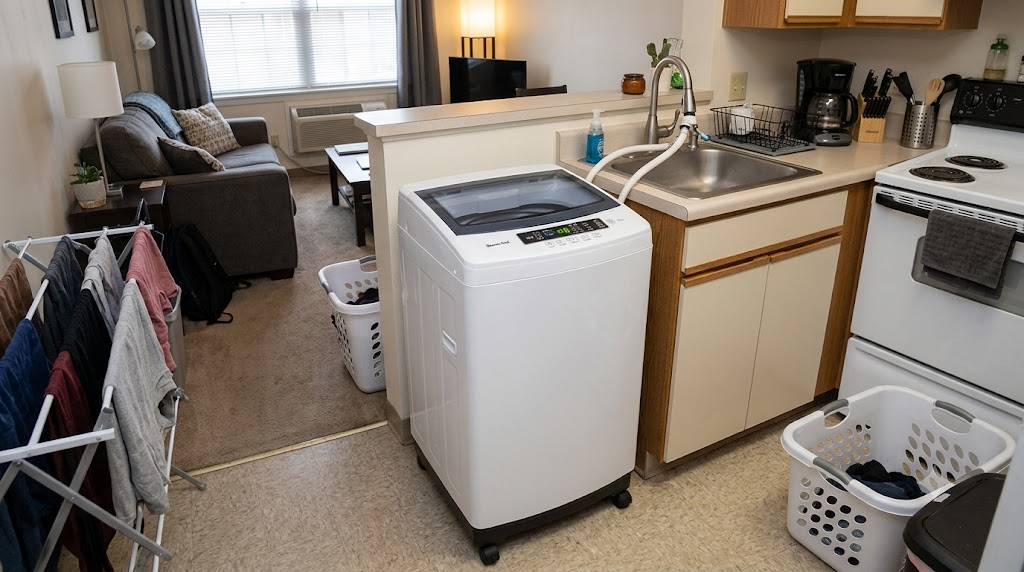
Need a portable washing machine that can handle larger laundry loads without requiring a traditional laundry room? A large-capacity portable washer can be a practical option for apartments, small homes, rental properties, and other spaces where installing a full-size washer is difficult.
However, advertised capacity can be confusing. Fully automatic portable washers usually list drum capacity in cubic feet and may also provide a maximum laundry weight. Twin-tub models have separate washing and spinning compartments, so their combined capacity does not represent the amount of laundry you can wash in one cycle.
Which Large-Capacity Portable Washing Machine Is Best?
The BLACK+DECKER BPW30MW is the largest fully automatic option, with a 3.0-cu.-ft. drum and 26.5-lb. capacity.
For semi-automatic washing, the Auertech AU8590 offers an 18-lb. wash tub and 10-lb. spinner. Its 28-lb. combined capacity does not mean 28 lb can be washed in one load. Other options include the COMFEE’ CLV24N2AMG (2.4 cu. ft.) and Giantex 20-lb. twin tub (12-lb. wash tub).
Compare actual wash capacity, dimensions, machine weight and drainage requirements, not just advertised combined capacity.
In this guide, we compare large-capacity portable washing machines based on their stated wash capacity, drum size, spinner capacity, dimensions, weight, water connections, and drainage requirements. We also explain which models are fully automatic, which require manual transfers, and why a spin cycle is not the same as heated drying.
Out Top Picks
- Best Overall: BLACK+DECKER BPW30MW – 3.0 cu. ft. automatic portable washer
- Best for Smaller Spaces: COMFEE’ 2.4 Cu. Ft. Portable Washing Machine
- Best Large-Capacity Twin Tub: Auertech AU8590 – 28 lb combined capacity
- Best Lightweight Option: Giantex 20 lb Twin-Tub Portable Washer
- Best Budget Twin Tub: KUPPET 26 lb Twin-Tub Portable Washer
Best Large Capacity Portable Washing Machine Comparison
eplace it with this table.
| Model | Type | Wash capacity | Spin capacity | Drum volume / combined rating | Check Price |
|---|---|---|---|---|---|
| BLACK+DECKER BPW30MW | Automatic | Up to 26.5 lb | Spin-only cycle | 3.0 cu. ft. | Check Price |
| COMFEE’ CLV24N2AMG | Automatic | 6-7 kg | Spin stage | 2.4 cu. ft. | Check Price |
| Auertech AU8590 | Twin tub | 18 lb | 10 lb | 28 lb combined | Check Price |
| KUPPET 26-lb | Twin tub | 18 lb | 8 lb | 26 lb combined | Check Price |
| Giantex 20-lb | Twin tub | 12 lb | 8 lb | 20 lb combined | Check Price |
| BLACK+DECKER BPWM20W | Automatic | 15.4 lb | Spin cycle | 2.0 cu. ft. | Check Price |
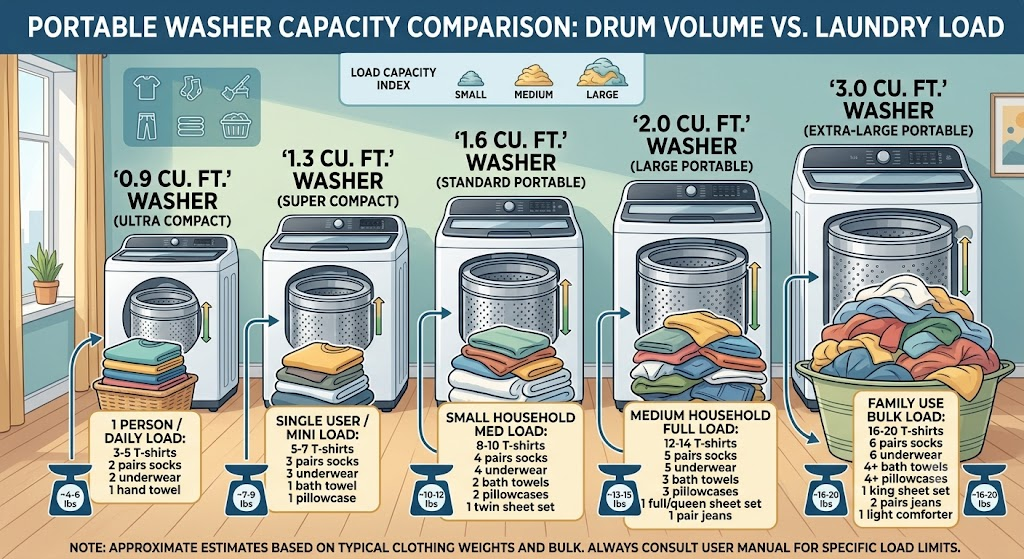
Important: Portable washer capacity is not always measured in the same way. A fully automatic washer may list its drum volume in cubic feet and its maximum laundry load in pounds. A twin-tub washer has two separate compartments: one for washing and another for spinning.
For example, the Auertech AU8590 has an 18-lb washing tub and a 10-lb spinner. Its 28-lb combined rating is not a 28-lb washing capacity.
Always compare the wash-tub capacity when deciding how much laundry the machine can clean in one load. Check the spinner limit separately when evaluating how much laundry can be spin-extracted at once.
How Much Laundry Can You Actually Wash in a Large Portable Washer?
A portable washer’s maximum stated capacity is a useful starting point, but it does not mean every type of laundry can be loaded up to that weight. The amount of laundry you can wash depends on its dry weight, bulk, fabric type and the manufacturer’s loading instructions.
For example, lightweight T-shirts may occupy less drum space than thick towels or jeans, even when both loads have a similar weight.
Why Maximum Capacity Does Not Always Mean Maximum Usable Load
Consider these factors before loading a portable washer:
- Fabric thickness: Towels, denim and heavy cotton items take up more space.
- Bedding size: Comforters and blankets may occupy most of the drum even when their dry weight appears manageable.
- Load movement: Clothes need enough room to move during the wash cycle.
- Spinner capacity: A twin-tub spinner may hold less laundry than the washing compartment.
- Manufacturer instructions: Some models have specific restrictions for bedding, bulky items and different fabric types.
Load-Size Limitations to Check
| Laundry type | What to check |
|---|---|
| Everyday clothing | Maximum stated wash load and available drum space |
| Jeans and heavy clothing | Weight, fabric bulk and manufacturer’s loading guidance |
| Bath towels | Available space and the machine’s load instructions |
| Bedsheets | Drum dimensions and whether the sheets can move freely |
| Comforters and blankets | Specific bedding restrictions and dry-weight limit |
| Mixed laundry | Fabric compatibility and balanced loading |
Do not assume that a portable washer can handle a comforter or blanket just because the item fits inside the drum.
For twin-tub washers, also check whether the spinner can accommodate the washed load. You may need to divide a larger wash load into multiple spin batches. The safest approach is to follow the maximum load and item restrictions in the exact model’s user manual.
If you do not regularly wash large loads, our guide to portable washers for small spaces may help you find a more compact alternative.
How We Evaluated Portable Washing Machines
Capacity and Fit
We reviewed published load capacities and product dimensions to assess whether each portable washing machine suits small apartments, dorm rooms, RVs, and other space-limited homes.
Setup and Water Connections
We checked available manuals and product documentation for faucet compatibility, water inlet requirements, drainage methods, and installation needs.
Ease of Use and Convenience
We compared automatic wash programs, separate wash and spin tubs, operating controls, and other features that can make everyday laundry easier.
Warranty and Ownership
We reviewed available warranty terms, owner manuals, product documentation, and replacement-part information where available to understand potential ownership concerns.
Features and Value for Money
We assessed whether each machine’s features, limitations, and intended use justify its price, rather than assuming that more features always mean better value.
Our Research Method
Our recommendations are based on research, not hands-on laboratory or household testing by our team. We reviewed manufacturer specifications, available owner manuals, warranty information, retailer listings, product dimensions, connection requirements, and customer-feedback patterns.
We distinguish manufacturer claims from customer experiences and check model-specific details against available documentation. When information is missing or uncertain, we identify that limitation instead of presenting an unverified claim as fact.
10 Best Large Capacity Portable Washing Machine
1. BLACK+DECKER BPW30MW 3.0 Cu. Ft. — Best Maximum Capacity
⭐⭐⭐⭐⭐ 4.4/5
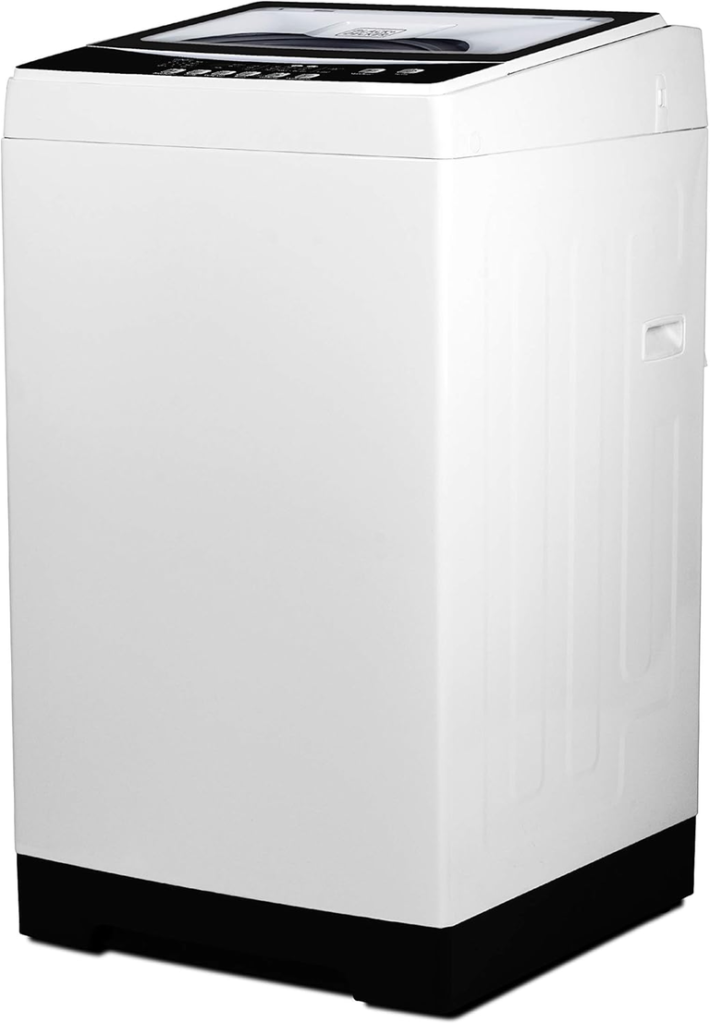
The BLACK+DECKER BPW30MW is the capacity leader in this roundup, with a 3.0-cu.-ft. drum and stated 26.5-lb. laundry capacity. It is aimed at households that have outgrown small portable washers but still cannot install a conventional full-size machine. Its stainless-steel tub, six wash cycles, transparent lid, LED display, auto-unbalance detection, and roller wheels make it considerably more appliance-like than basic twin-tub machines.
The main advantage is obvious: more room for clothing, sheets, towels, and other everyday laundry. The trade-off is size and weight. At roughly 99 lb. according to current competitor data, it isn’t something most people will casually carry upstairs.
Price: $459
| What We Liked | What We Didn’t Like |
|---|---|
| 3.0-cu.-ft. capacity | Very heavy |
| 26.5-lb. stated capacity | Takes substantial floor space |
| Stainless-steel tub | Not ideal for frequent carrying |
| Six wash cycles | Roller wheels don’t eliminate the weight |
| LED controls | Larger investment than small portable washers |
Key Features
- 3.0-cu.-ft. capacity
- 26.5-lb. stated laundry capacity
- Six wash cycles
- Stainless-steel tub
- Transparent lid
- LED display
- Auto-unbalance detection
Who Should Buy This?
Buy it if your biggest problem is running too many loads and you have enough floor space to leave the washer in place.
Who Should Avoid It?
Avoid it if you’re in a tiny apartment, dorm, RV, or upstairs room where the machine must be carried regularly.
Value for Money: Strong value for households that genuinely need maximum portable capacity.
Editor’s Verdict: The best choice when capacity matters more than portability.
2. BLACK+DECKER BPWM20W 2.0 Cu. Ft. — Best Overall Balance
⭐⭐⭐⭐⭐ 4.4/5
The BLACK+DECKER BPWM20W occupies a useful middle ground between very small portable washers and the much larger 3.0-cu.-ft. BPW30MW. It has a 2.0-cu.-ft. capacity, six wash cycles, a stainless-steel tub, three water-level selections, LED controls, and auto-unbalance detection.
The machine is still heavy compared with lightweight twin tubs, but its capacity makes it more practical for couples and small households than sub-1.5-cu.-ft. washers. Customer feedback also shows that the machine can handle everyday clothing and some bedding when loads are kept within its limits.
Price: Check current retailer price
| What We Liked | What We Didn’t Like |
|---|---|
| Good capacity-to-size balance | Heavy |
| Stainless-steel tub | Not truly lightweight |
| Six cycles | Needs suitable faucet connection |
| LED display | Bulky items require care |
| Strong customer-review history | Higher cost than twin tubs |
Key Features
- 2.0-cu.-ft. capacity
- Six wash cycles
- Stainless-steel tub
- Three water levels
- LED display
- Auto-unbalance detection
- Quick-connect sink adapter
Who Should Buy This?
Couples, apartment renters, secondary-washer buyers, and small households that want more capacity without going all the way to a 3.0-cu.-ft. machine.
Who Should Avoid It?
Avoid it if you need a washer that you can easily lift and store after every use.
Value for Money: One of the best compromises between capacity and practicality.
Editor’s Verdict: The safest all-around pick for many apartment households.
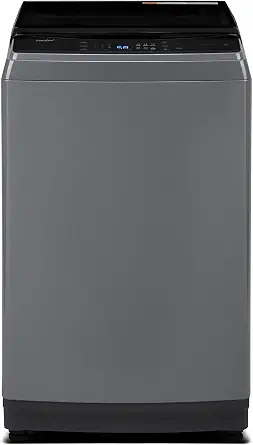
3. COMFEE’ 2.4 Cu. Ft. Portable Washing Machine — Best Large Fully Automatic
⭐⭐⭐⭐⭐ 4.4/5
The COMFEE’ 2.4-cu.-ft. portable washer is designed for buyers who want substantial capacity without giving up automatic operation. Its listed specifications include 2.4 cu. ft. capacity, eight programs, a stainless-steel drum, LED controls, child lock, and a maximum spin speed of 780 RPM.
At 88.2 lb., however, this is not a lightweight machine. The strongest reason to buy it is convenience: once connected, the automatic design requires less hands-on work than a traditional twin-tub washer. COMFEE’ also highlights Hygiene+ and Turbo Wash features.
Price: $355.99
| What We Liked | What We Didn’t Like |
|---|---|
| 2.4-cu.-ft. capacity | Heavy |
| Fully automatic | Premium price |
| Eight programs | Less convenient to move |
| Stainless-steel drum | Not ideal for ultra-small spaces |
| Child lock | Spin speed is lower than some twin tubs |
Key Features
- 2.4-cu.-ft. capacity
- Eight wash programs
- Stainless-steel drum
- LED controls
- Child lock
- Turbo Wash
- Hygiene+ mode
Who Should Buy This?
Apartment renters and small families who want automatic washing and don’t plan to move the machine frequently.
Who Should Avoid It?
Avoid it if low weight and easy storage are more important than automation.
Value for Money: Worth considering if you want large capacity with minimal manual intervention.
Editor’s Verdict: A strong premium option for buyers who want a more conventional washing experience.
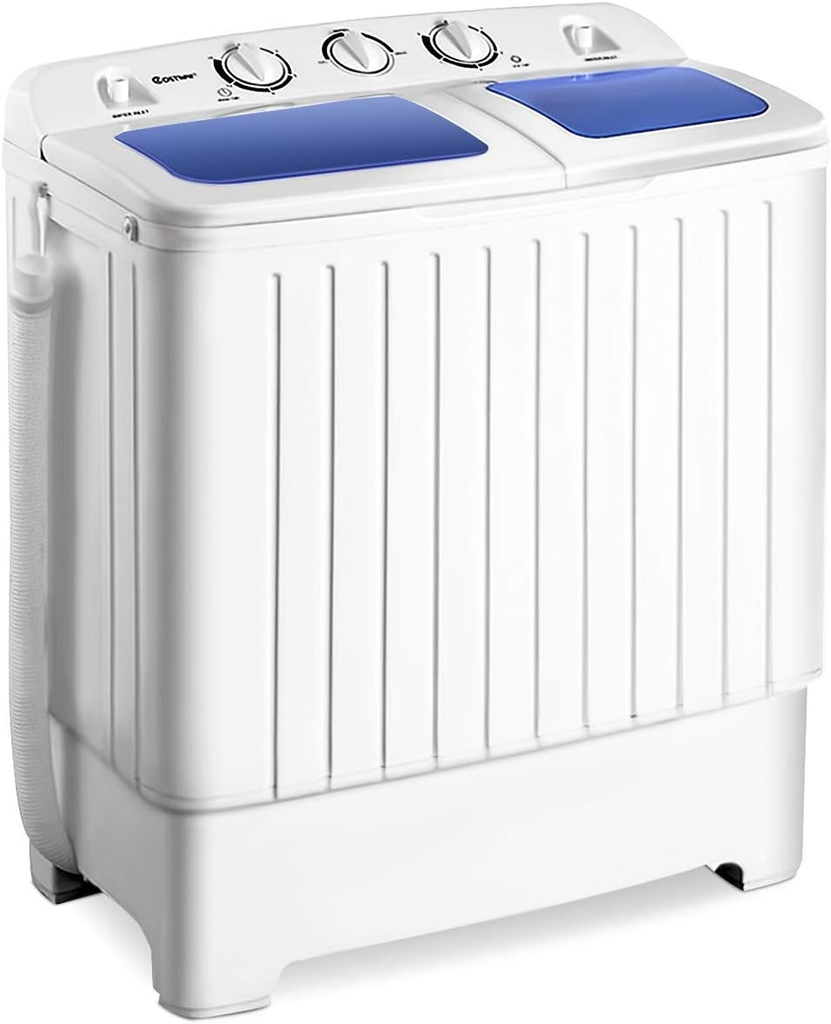
4. Giantex 20-Lb. Twin Tub — Best High-Review Twin-Tub Option
⭐⭐⭐⭐⭐ 4.2/5
The Giantex 20-lb. twin-tub washer is one of the most heavily reviewed portable washing machines in the group, with current marketplace data showing more than 15,000 customer reviews. Its design separates washing and spinning, allowing users to wash one load while spinning another. The machine weighs about 28 lb. and has a compact footprint, making it much easier to move than large automatic portable washers.
The major advantage is capacity relative to physical size. The major limitation is manual operation: you have to manage water, transfer clothes between tubs, and coordinate the cycles. It makes more sense for hands-on users than anyone expecting push-button automation.
Price: Check current retailer price
| What We Liked | What We Didn’t Like |
|---|---|
| 20-lb. total capacity | Manual operation |
| Lightweight for its capacity | Clothes must be transferred |
| Separate wash and spin tubs | Gravity drainage on some versions |
| Compact footprint | Plastic construction |
| Large customer-review history | More hands-on work |
Key Features
- 20-lb. total capacity
- Separate wash and spin tubs
- Up to 1,350 RPM spin speed
- Compact design
- Lightweight body
- Timer controls
- Portable construction
Who Should Buy This?
RV owners, van-life travelers, renters, and budget shoppers who don’t mind managing the wash manually.
Who Should Avoid It?
Avoid it if you want one-button automatic washing.
Value for Money: Excellent capacity for a relatively compact and lightweight twin-tub design.
Editor’s Verdict: A practical choice for buyers who prioritize capacity and portability over automation.
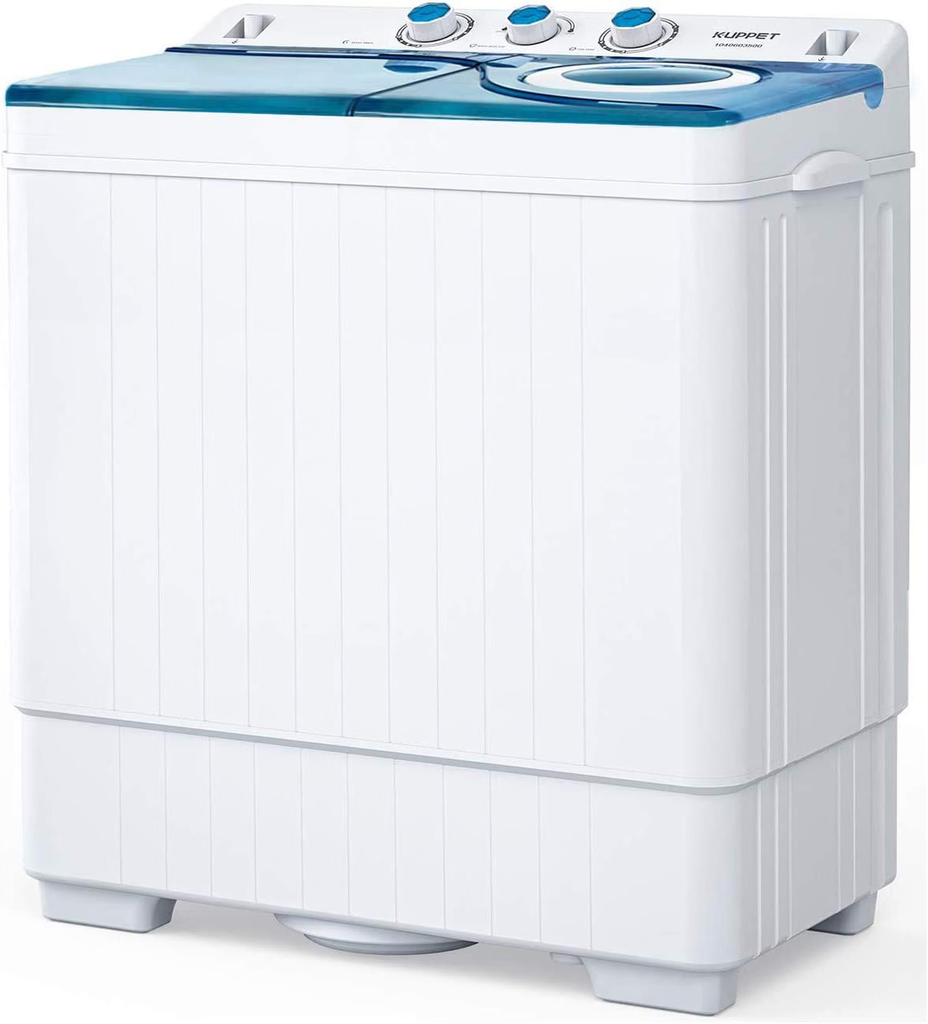
5. KUPPET 26-Lb. Twin-Tub Washer — Best for Large Split Loads
⭐⭐⭐⭐⭐ 4.2/5
The KUPPET 26-lb. twin-tub portable washer divides its stated capacity between an 18-lb. washing compartment and an 8-lb. spinner. . Its 1,300-RPM spin system and separate wash/spin controls make it appealing for users who don’t mind transferring clothes between compartments.
The big advantage is the amount of laundry you can process without buying a conventional washer. The limitation is that the 26-lb. figure is a combined capacity, not a 26-lb. wash load. That distinction matters when comparing it with single-drum washers such as the BLACK+DECKER BPW30MW.
Price: Check current retailer price
| What We Liked | What We Didn’t Like |
|---|---|
| 26-lb. combined capacity | Only 18 lb. wash capacity |
| 8-lb. spinner | Manual transfer |
| 1,300-RPM spin | Large footprint for a twin tub |
| Compact compared with full-size washers | Less automation |
| Large review history | Separate tubs require more attention |
Key Features
- 18-lb. washer
- 8-lb. spinner
- 26-lb. combined capacity
- 1,300-RPM spin
- Twin-tub layout
- Timer controls
- Portable design
Who Should Buy This?
Families in apartments, RV owners, and renters who want a high combined capacity at a lower price.
Who Should Avoid It?
Avoid it if you want to wash a 26-lb. load in one drum.
Value for Money: Good if you understand the difference between wash capacity and combined capacity.
Editor’s Verdict: A capable high-capacity twin tub for hands-on users.
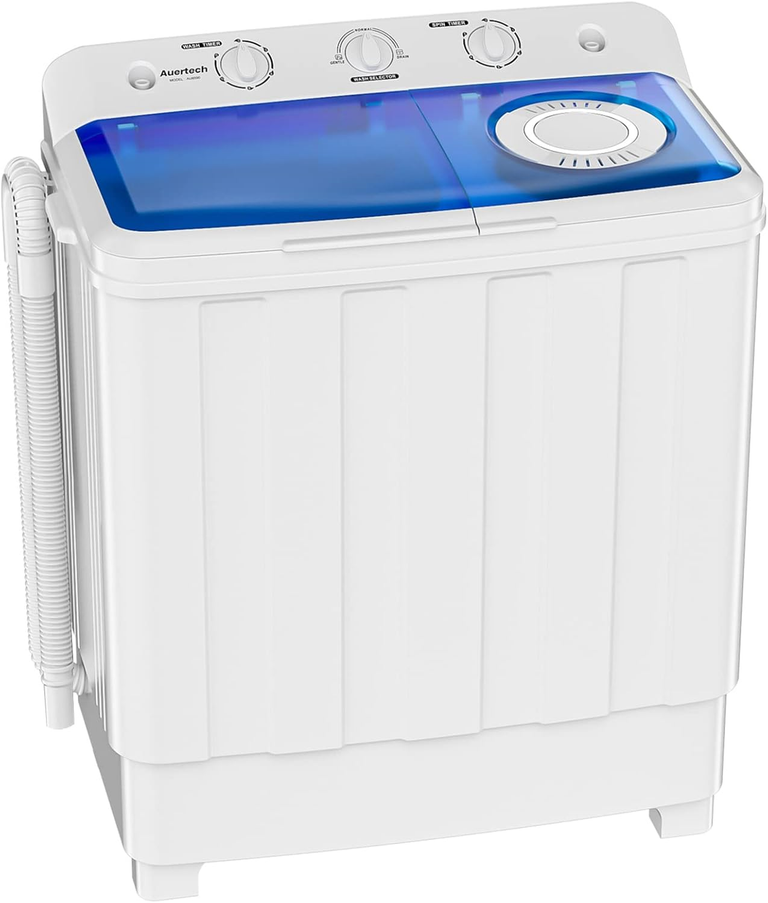
6. Auertech 28-Lb. Twin-Tub Washer — Best for High Total Capacity
⭐⭐⭐⭐⭐ 4.2/5
The Auertech 28-lb. portable twin-tub washer combines an 18-lb. washing compartment with a 10-lb. spinner. The design includes separate wash and spin controls and a 1,300-RPM spinner. Its biggest strength is processing a relatively large amount of laundry while remaining dramatically lighter than 80- to 100-lb. automatic machines.
The trade-off is manual operation. You must move clothing from the washer to the spinner, and the exact drain configuration varies by model.
Price: $181.99
| What We Liked | What We Didn’t Like |
|---|---|
| 28-lb. combined capacity | Manual operation |
| 18-lb. wash capacity | Clothes require transfer |
| 10-lb. spinner | Large width |
| 1,300-RPM spin | Model variations exist |
| Relatively light | Not fully automatic |
Key Features
- 18-lb. washer
- 10-lb. spinner
- 28-lb. combined capacity
- 1,300-RPM spin
- Twin-tub design
- Separate timers
- Portable construction
Who Should Buy This?
RVers, apartment renters, and families who want more capacity without lifting a 90-lb. automatic portable washer.
Who Should Avoid It?
Avoid it if you want completely automatic laundry.
Value for Money: Strong for buyers comfortable with a twin-tub workflow.
Editor’s Verdict: One of the more practical choices for high-capacity portable washing on a budget.
What Does Large Capacity Mean in a Portable Washing Machine?
Portable washing machine capacity is usually described in cubic feet, pounds of laundry, or a combination of both. Understanding these measurements is important because a larger advertised number does not always mean the machine can wash more clothes in one cycle.
Cubic Feet vs. Pounds: What Is the Difference?
Cubic feet measures the internal volume of the washing drum. Pounds describe the stated weight of the laundry that a machine can handle.
For example, the BLACK+DECKER BPW30MW has a 3.0-cu.-ft. drum and a manufacturer-stated maximum laundry capacity of up to 26.5 lb.
These measurements describe different characteristics. Drum volume indicates available space, while the laundry weight indicates the stated load limit.
Wash Capacity vs. Spin Capacity
Twin-tub portable washing machines have two separate compartments.
- The washing compartment cleans clothes using water and detergent.
- The spinning compartment extracts excess water after washing.
For example, the Auertech AU8590 has an 18-lb wash tub and a 10-lb spinner. Its combined rating is 28 lb, but its washing compartment is rated for only 18 lb.
Always use the wash-tub rating when comparing how much laundry a machine can clean in one load.
Advertised Capacity vs. Practical Load Size
The maximum stated capacity should not be treated as a promise that every type of laundry can be washed at that weight.
Bulky towels, jeans, bedding and thick fabrics can occupy more drum space than lightweight clothing. A load that fits by weight may still be too bulky to move freely inside the tub.
Follow the manufacturer’s load instructions and avoid packing clothes tightly. Leave enough room for laundry to move during the wash cycle.
How Much Capacity Do You Need?
Your ideal portable washer depends on laundry frequency, fabric types, available floor space and how much manual work you are comfortable doing.
| Household situation | What to consider |
|---|---|
| One person | A smaller automatic washer may be sufficient for frequent everyday loads. |
| Couple | Consider a larger drum if you regularly wash towels, jeans and bedding. |
| Small family | A higher wash-load rating can reduce the number of separate loads, but check the manufacturer’s limits. |
| Frequent bulky laundry | Prioritize drum space and the manual’s bedding restrictions. |
| RV or tiny home | Consider weight, storage, water use and wastewater disposal as well as capacity. |
These are buying considerations, not universal capacity rules. Your actual load requirements depend on the type and amount of laundry you wash.
If you live in a tiny home or have very limited storage, compare our recommendations for portable washers for tiny homes before choosing a larger model.
Large Capacity Portable Washer vs. Full-Size Washer
A large portable washer is useful because it can solve a specific problem: you need a real electric washer, but you can’t install a conventional one.
| Feature | Full-Size Washer | Portable Washer |
|---|---|---|
| Drum Space | More usable drum space | Smaller drum and load capacity |
| Installation | Requires permanent plumbing and installation | Lower installation commitment; many models connect to a sink |
| Load Capacity | Better for larger loads and families | Best for smaller, more frequent loads |
| Mobility | Designed to stay in one location | Easier to move when needed |
| Space Required | Larger footprint | Smaller footprint |
| Plumbing | Permanent water and drain connections | Often uses temporary sink-based connections |
| Best For | Large families and households doing heavy laundry | Apartments, RVs, dorms, tiny homes, and limited laundry spaces |
| Convenience | More automated and built for regular heavy use | Practical when space or plumbing is limited |
A large-capacity portable washer can be a practical alternative when a conventional laundry installation is unavailable. However, it may not provide the same laundry throughput or bulky-item capacity as a full-size machine. If you regularly wash large bedding, multiple family loads or heavy items, compare the manufacturer’s load limits carefully before deciding.
The right choice depends on your living situation, not simply the capacity number. If you’re unsure how many pounds you actually need, our portable washing machine capacity guide explains how to match capacity to household size.
What to Check Before Buying a Large-Capacity Portable Washer
Choosing a large portable washer involves more than comparing drum capacity. Before ordering, check whether the machine fits your available space, connects to your water supply and can drain wastewater safely.
1. Measure the Installation Space
Measure the washer’s width, depth and height before purchasing.
Remember to allow space for:
- Opening the lid fully.
- Connecting the water inlet hose.
- Positioning the drain hose.
- Accessing controls and maintenance points.
- Moving the appliance into its intended location.
Also check doorway and hallway clearance if you need to move a heavy machine into your apartment.
2. Check Faucet Compatibility
Many portable washers are designed to connect to a sink using a supplied faucet adapter and inlet hose. However, the adapter is not guaranteed to fit every faucet.
Before buying:
- Check whether your faucet has a removable aerator.
- Identify whether the faucet has internal or external threads.
- Compare the faucet connection with the supplied adapter.
- Check whether the manufacturer offers an alternative adapter for incompatible faucets.
- Confirm that the inlet hose can reach the machine without stretching.
Pull-down, pull-out and integrated-spray faucets may require additional compatibility checks. Do not assume a universal adapter will work.
3. Understand the Drainage System
Portable washers use different drainage arrangements.
| Drainage type | How it works | What to check |
|---|---|---|
| Built-in drain pump | Pumps wastewater through the drain hose | Maximum permitted drain height and hose length |
| Gravity drainage | Wastewater flows out through a positioned hose | Required hose position, slope and suitable drain location |
Follow the specific washer manual for drain-hose routing. A pump-equipped machine and a gravity-drain twin tub do not necessarily have the same installation requirements. Secure the hose before starting a cycle to prevent it from slipping out of the sink or drain.
Before using a new portable washer, follow our guide to installing a portable washing machine, including faucet connections, inlet hoses and drainage setup.
4. Check Machine Weight and Portability
A portable washer is not necessarily lightweight.
For example, the BLACK+DECKER BPW30MW weighs 99.2 lb, while the COMFEE’ CLV24N2AMG is listed at 88.2 lb.
If you plan to move the machine regularly, check its weight, handles, rollers and the route between its storage and operating locations.
5. Check Electrical Requirements
Check the voltage, electrical rating, plug and grounding instructions for the exact model.
Use an appropriate grounded outlet and follow the manufacturer’s electrical safety instructions. Do not assume an extension cord or power strip is acceptable.
6. Check Whether You Need a Separate Dryer
A portable washer’s spin cycle removes excess water but does not necessarily dry clothes completely.
If you need clothes to come out ready to wear, consider a genuine washer-dryer combination or a separate clothes dryer. Check the actual drying method and installation requirements before purchasing.
Once you’ve chosen the right capacity, learning how to use a portable washer correctly can make laundry much easier.
Does a Portable Washing Machine Also Dry Clothes?
Not every portable washing machine includes a clothes-drying function. Some models wash clothes and use a spin cycle to remove excess water, while others require a separate dryer or air-drying rack.
There are three different appliance configurations to understand.
1. Washer-Only Portable Machines
A washer-only portable machine cleans clothes using water and detergent. Depending on the model, it may include a spin cycle to remove excess water. After washing and spinning, clothes generally need to be air-dried or transferred to a separate dryer.
2. Twin-Tub Washer with Spin Extractor
A twin-tub machine has separate washing and spinning compartments.
After the wash cycle, clothes must be transferred manually into the spinner. The spinner rotates at high speed to remove excess water, helping clothes dry faster when hung on a rack or clothesline.
However, spin extraction is not heated drying. Clothes normally remain damp after this process.
3. Genuine Portable Washer-Dryer Combination
A genuine washer-dryer combination includes both washing and a dedicated drying function. Depending on the model, drying may use heated air or another manufacturer-specified drying technology.
Before buying a machine advertised as a washer-dryer combo, check whether it has an actual drying program rather than simply a spin-extraction cycle.
Which Type Should You Choose?
| Appliance type | Washes clothes | Removes excess water | Heated drying |
|---|---|---|---|
| Washer-only | Yes | Depends on model | No |
| Twin tub with spinner | Yes | Yes, in separate spinner | No |
| Washer-dryer combination | Yes | Yes | Depends on the drying technology |
If you already have space to air-dry clothes, a portable washer with a spin function may be sufficient. If you need clothes dried inside the appliance, look for a genuine washer-dryer model and verify its drying specifications.
Is a 3.0 Cu. Ft. Portable Washer Really Worth It?
For some buyers, absolutely. For others, no. The 3.0-cu.-ft. BLACK+DECKER makes the most sense if you have:
- A family-sized laundry workload
- A permanent place for the washer
- Enough floor space
- A suitable water connection
- A need to reduce the number of loads
It makes less sense for:
- Dorm rooms
- Frequent RV travelers
- People who carry the machine upstairs
- Very small bathrooms
- Buyers doing only a few pounds of laundry at a time
In other words, capacity solves one problem while creating another: size.
Which Large-Capacity Portable Washer Is Right for Your Household?
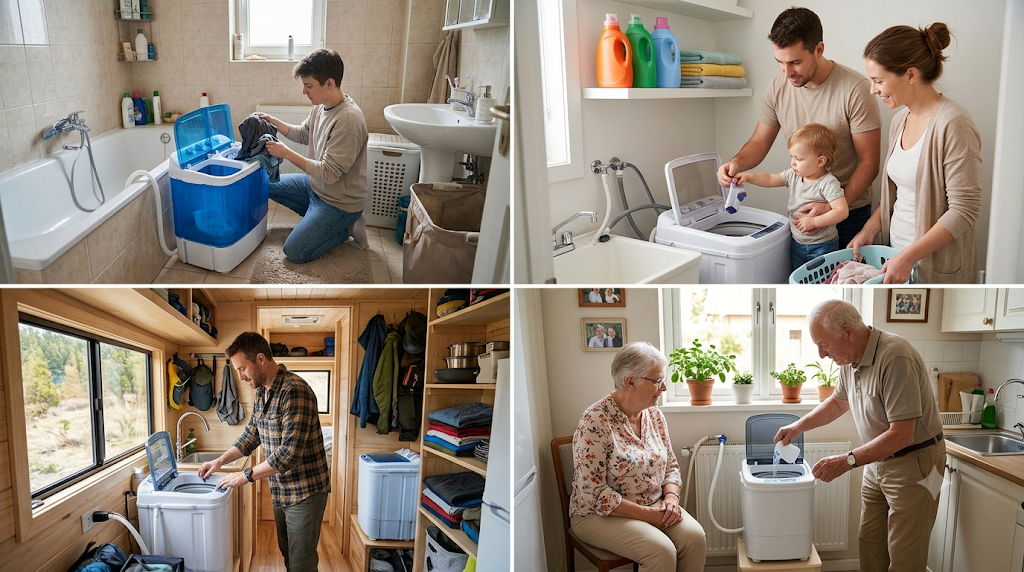
The right portable washer depends on where you plan to use it, how frequently you do laundry and how much effort you want to spend managing each load.
For Apartment Renters
Apartment renters should prioritize machine dimensions, weight, faucet compatibility and drainage. A large automatic model may reduce manual work, but it can be difficult to move or store.
Check your lease and building rules before installing or operating a portable washer.
For Couples and Small Families
A larger automatic washer can be convenient when you regularly wash towels, jeans and everyday clothing. Compare the actual wash-load rating rather than choosing solely by drum volume.
If you choose a twin-tub washer, remember that the wash and spinner compartments have separate limits.
For RV Owners and Tiny Homes
RV and tiny-home owners should consider more than laundry capacity.
Check the available floor space, electrical supply, water availability, wastewater handling, machine weight and storage requirements. A large washer may be unsuitable if it uses too much of your available storage or water capacity.
For Seniors or Buyers Who Prefer Less Manual Work
Fully automatic portable washers may be easier to operate because they do not require manual transfers between washing and spinning compartments.
However, large automatic models can be heavy. Check the installation location, controls, lid access and ability to move the machine safely.
When a Smaller Washer May Be Better
If you wash small loads frequently, a smaller portable washer may be more practical than a large model.
It may take up less space, weigh less and be easier to store. Compare the small-space alternatives before paying extra for capacity you may rarely use.
FAQs
What is the largest-capacity portable washing machine in this comparison?
The BLACK+DECKER BPW30MW is the largest fully automatic model in this comparison. It has a 3.0-cu.-ft. drum and a manufacturer-stated laundry capacity of up to 26.5 lb. Twin-tub models may advertise higher combined capacities, but those figures include separate washing and spinning compartments.
What is the difference between wash capacity and spin capacity?
Wash capacity refers to the amount of laundry the washing compartment can handle. Spin capacity refers to the amount of laundry the spinner can accommodate when extracting excess water. Twin-tub washers have separate limits for these compartments.
Is a 28-lb twin-tub washer capable of washing 28 lb at once?
Not necessarily. The Auertech AU8590 has an 18-lb wash compartment and a 10-lb spinner. Its 28-lb figure is the combined capacity of both compartments, not its maximum single wash load.
Is a 3.0-cu.-ft. portable washer better than a 2.4-cu.-ft. model?
A 3.0-cu.-ft. washer has a larger drum volume, but the better choice depends on the manufacturer’s laundry-weight limit, machine dimensions, weight and your available space. Compare the complete specifications rather than drum volume alone.
Can a large portable washer wash blankets?
It depends on the washer’s load limit, drum dimensions and the blanket’s weight and bulk. Check the manufacturer’s manual to confirm whether the specific blanket is suitable. Do not assume that a blanket is safe to wash simply because it fits inside the drum.
Do large portable washing machines need a special faucet?
Many portable washers use a supplied faucet adapter and inlet hose, but compatibility depends on the faucet design and the washer’s connection system. Check whether your faucet has a removable aerator and compatible threads before purchasing.
Do portable washing machines have a built-in dryer?
Some portable washers have a spin-only function or a separate spinner compartment. These features extract excess water but do not provide heated drying. Check for an actual drying program if you need a washer-dryer combination.
Are large portable washing machines difficult to move?
Some large automatic portable washers are heavy. For example, the BLACK+DECKER BPW30MW weighs 99.2 lb. Check the machine’s weight, rollers, handles and installation location before purchasing.
Final Verdict
Choosing the best large-capacity portable washing machine is not simply about finding the highest advertised number. You should compare the actual wash-load limit, drum volume, machine weight, drainage system and amount of manual work involved.
The BLACK+DECKER BPW30MW is our main recommendation for buyers who want a large fully automatic portable washer. Its 3.0-cu.-ft. drum and stated 26.5-lb laundry capacity make it the capacity leader among the automatic models compared here.
The COMFEE’ CLV24N2AMG is another automatic option with a 2.4-cu.-ft. drum, while the Auertech AU8590 is worth considering if you prefer a twin-tub design and are comfortable transferring laundry manually.
The Giantex 20-lb twin tub is a more compact alternative, and the KUPPET twin tub may suit buyers looking for a larger separate wash compartment, subject to verifying the exact model.
Before purchasing, check the wash and spinner limits separately, confirm faucet compatibility, plan the drainage route and measure the available installation space.
The most suitable washer is the one that handles your normal laundry loads while fitting your space and operating preferences, not necessarily the one with the biggest combined capacity figure.
Recommended Reading:
- 10 Best Portable Washers for Tiny Homes in 2026
- 9 Best Portable Washer for Small Spaces
- 10 Best Portable Washing Machine for Camping
- 10 Best Portable Washer for Dorm Rooms in 2026

Sourabh researches and writes about home appliances, kitchen gadgets, and common appliance problems to help readers make smarter buying decisions. He specializes in Portable washing machines and appliance troubleshooting guides.
At compactHomeHub, Sourabh focuses on creating easy-to-understand content that simplifies technical appliance issues into practical solutions. His goal is to help users save time, avoid costly mistakes, and choose the right appliances with confidence.