

A laundry room doesn’t have to be a full-size room. In an apartment, condo, tiny home, or rental, it might be a narrow closet, an awkward corner beside the kitchen, or a few feet of unused bathroom space. The problem is that a portable washer still needs somewhere to live.
That’s where smart planning matters. Instead of trying to squeeze a full-size laundry setup into a tiny area, you can use vertical storage, rolling carts, folding surfaces, compact drying solutions, and a portable washing machine that can be moved or stored when you’re done.
In this guide, you’ll find 17 practical Small Laundry Room Ideas designed specifically for compact homes. You’ll also learn where to put a portable washer, how to handle water and drainage, what measurements to take before buying, and which attractive laundry-room ideas aren’t actually practical for renters.
What Is the Best Small Laundry Room Setup?
The best small laundry room setup is usually a portable washer positioned near an existing sink or suitable drain, with vertical storage above it and a foldable or removable surface nearby.
For an apartment, a practical layout might look like this:
Sink or faucet → portable washer → nearby drain → wall shelf → folding/drying area
If you have very little floor space, prioritize these five things:
- Choose a washer that physically fits the available footprint.
- Keep the water source and drain close to the washer.
- Use wall space instead of adding bulky cabinets.
- Leave enough room to connect hoses and move the washer.
- Plan where wet clothes will dry before buying the washer.
The last point gets overlooked constantly. A washing machine solves the washing problem. It doesn’t magically solve the drying problem.
How We Evaluated These Ideas: We evaluated each setup against real small-space requirements, including floor footprint, access to water and drainage, storage efficiency, portability, drying space, ventilation, renter-friendliness, and everyday usability. We also compared portable-washer requirements with manufacturer information and established laundry-efficiency guidance. We do not claim hands-on testing of every washer or room shown in this guide, and product specifications can change, so check the current manufacturer’s instructions before buying.
17 Small Laundry Room Ideas for a Portable Washer
Here are some of the best Small Laundry Room Ideas for a Portable Washer that saves space at your home:
1. Turn an Unused Closet Into a Laundry Zone
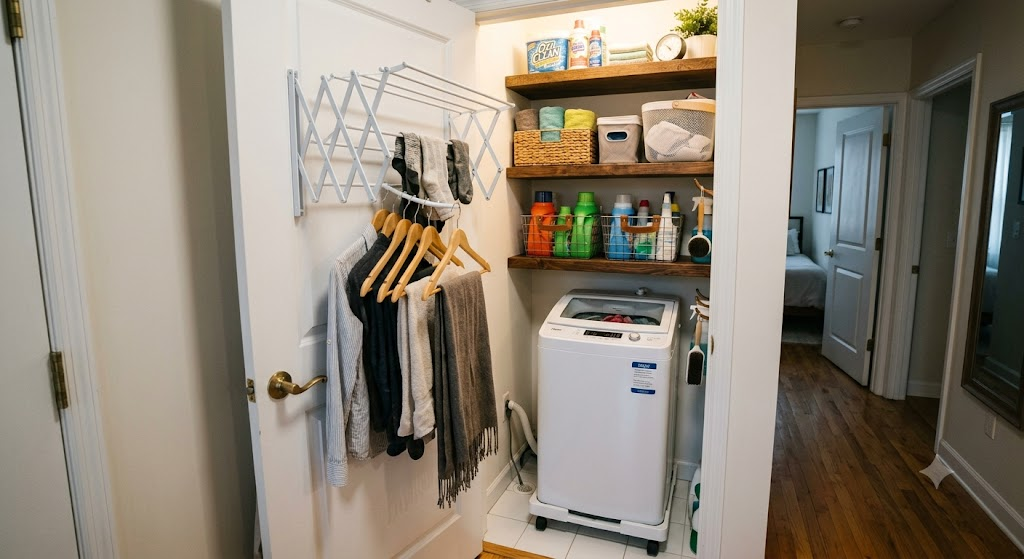
A closet can become one of the most useful small laundry spaces in an apartment. You don’t necessarily need a dedicated laundry room. If you have a deep enough closet near a bathroom or kitchen, you may be able to create a compact laundry station around a portable washer. Remove unnecessary storage, measure the floor carefully, and organize laundry supplies vertically.
Why it works:
- Uses existing space
- Keeps the washer out of the main living area
- Can be organized behind a door
- Works particularly well for renters
Example: Put the portable washer at floor level, install removable shelving above it, and use a narrow basket beside it for dirty clothes.
Important: Don’t install plumbing or electrical changes in a rental without permission.
2. Put the Portable Washer Beside the Kitchen Sink
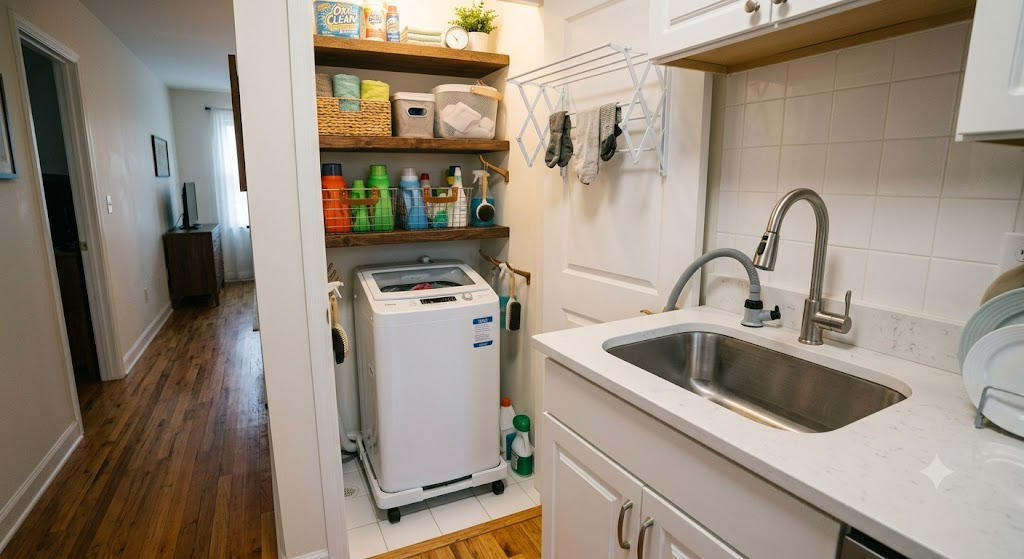
One of the easiest Small Laundry Room Ideas is to stop thinking of the kitchen as completely separate from laundry.
Some portable washers can connect temporarily to a compatible faucet and drain into an appropriate sink or drain. That makes a kitchen corner a potential laundry area. The important word is compatible.
Not every faucet works with every portable washer. Check the washer’s faucet adapter requirements, hose connection, water pressure requirements, and drainage instructions before buying.
Best for: Renters, studio apartments, and homes without dedicated washer hookups.
Benefit: You don’t need to create a new laundry room when an existing water source can do double duty.
3. Use a Narrow Rolling Cart Beside the Washer
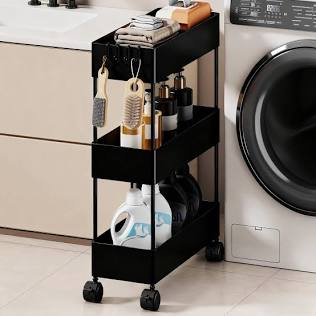
That annoying 6- to 10-inch gap beside an appliance doesn’t have to become wasted space.
A slim rolling cart can hold:
- Detergent
- Stain remover
- Dryer sheets
- Cleaning cloths
- Laundry bags
- Small accessories
The biggest advantage is that you can pull the cart out when you need something and push it back afterward. This is especially useful with portable washers because you’ll often need access to hoses and controls. Don’t pack the cart so tightly that you can’t reach the washer.
4. Install Shelves Above the Portable Washer
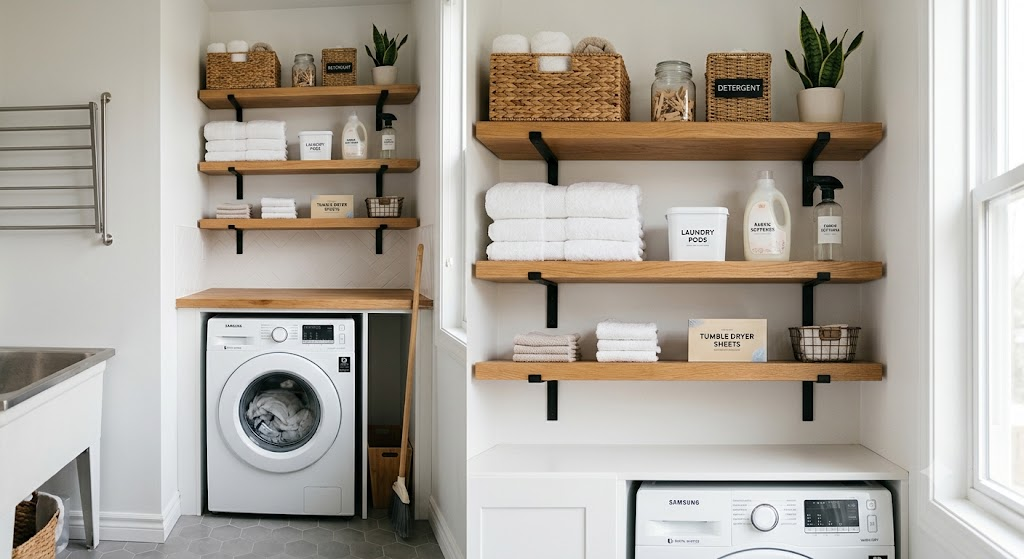
When floor space disappears, look up. Vertical shelving is one of the simplest ways to increase storage without making a tiny laundry area feel even smaller. Install one or two shelves above the washer for:
- Detergent
- Fabric-care products
- Laundry baskets
- Cleaning supplies
- Spare hoses
- Small drying accessories
Keep heavy containers low enough that you can safely lift them. If you’re renting, consider removable shelving or freestanding units rather than drilling into the wall.
Why it works: You’re using otherwise unused vertical space instead of consuming valuable floor area.
5. Create a Fold-Down Folding Station
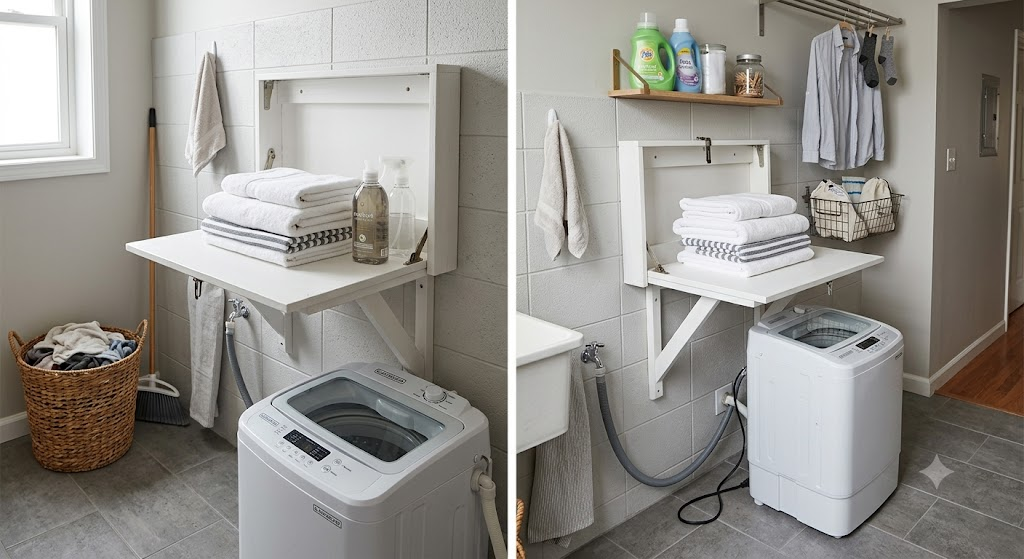
A permanent countertop is convenient, but it can be a terrible use of space in a tiny laundry room. A fold-down table gives you the same basic function without permanently occupying the floor. Fold it down when you’re sorting clothes and fold it back against the wall afterward.
This idea is particularly useful in:
- Laundry closets
- Hallway laundry areas
- Small bathrooms
- Studio apartments
A folding surface can also double as a temporary workspace for sorting clothes.
6. Put the Washer Under a Counter
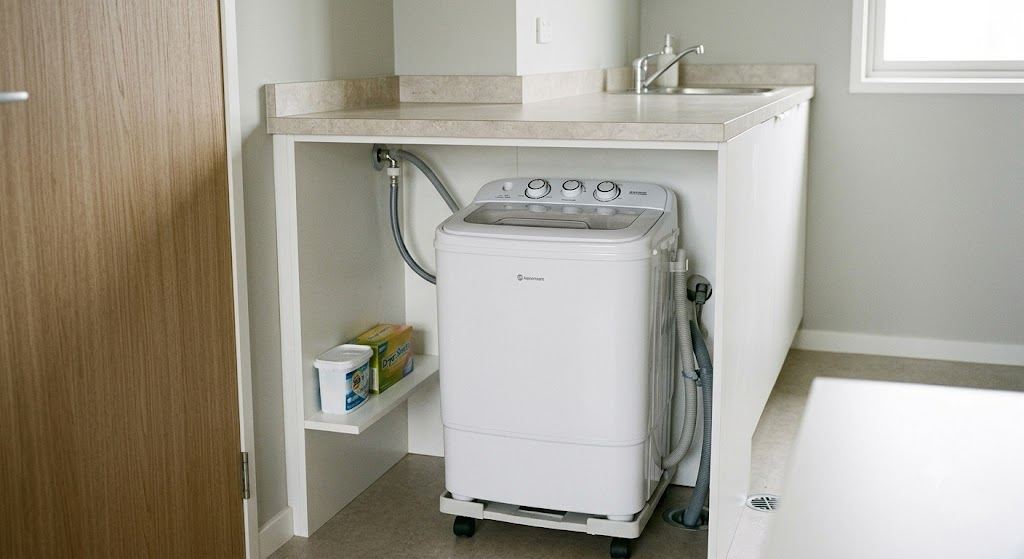
If you already have a countertop with usable clearance underneath, consider using the space below it. A compact portable washer can potentially sit underneath a counter if its dimensions and operating requirements allow it.
This creates a cleaner visual appearance and gives you a dedicated surface for folding. But don’t assume that a washer will fit just because the width looks right.
Measure:
- Width
- Depth
- Height
- Hose clearance
- Lid or control clearance
- Doorway access
For top-loading machines, remember that the lid needs room to open.
7. Use a Laundry Closet With a Curtain Instead of a Door
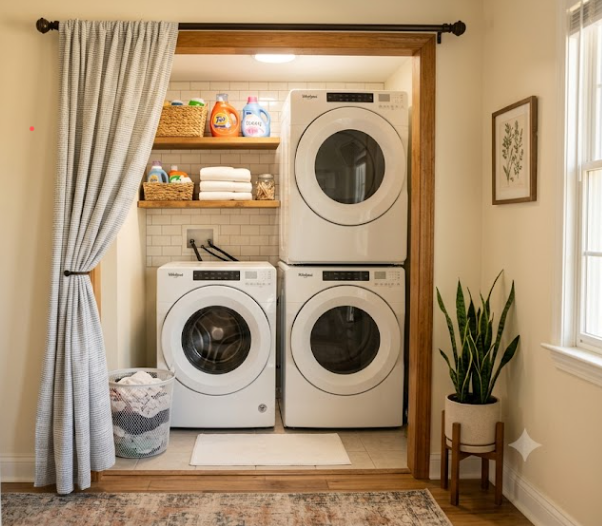
A traditional door takes up swing space. A curtain doesn’t. For a small laundry closet, a washable curtain can hide the washer while taking almost no usable floor space.
This can make the area feel less like an appliance storage zone and more like part of the room. It’s also easy to change if you want to update the look later.
Best for: Renters and people who want a low-cost visual upgrade.
Skip it if: The area requires a door for safety, ventilation, or building-code reasons. Follow the requirements for your particular installation.
8. Create a Bathroom Laundry Corner
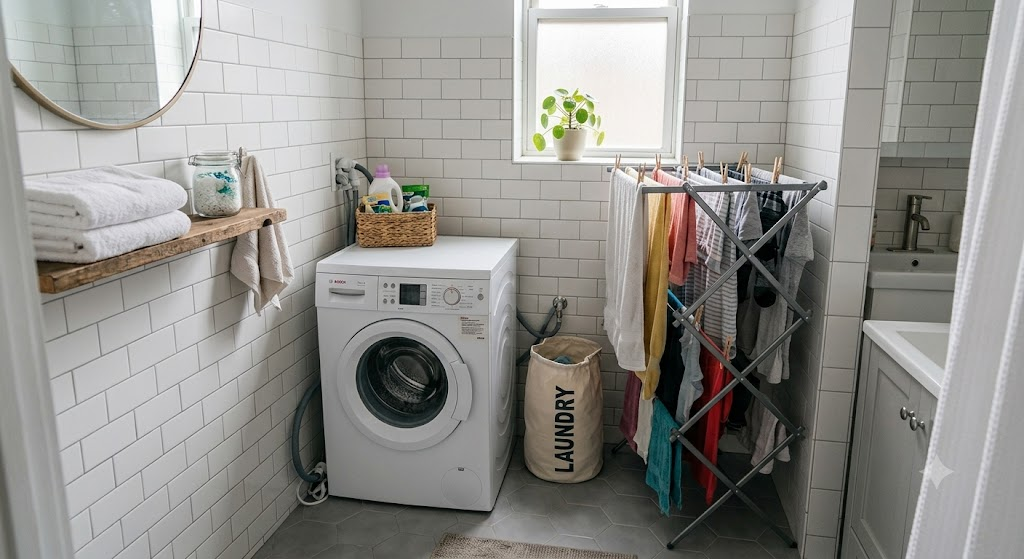
A bathroom may already have everything a portable washer needs nearby: water, drainage, and a hard floor. That makes an unused bathroom corner a potentially practical laundry zone.
For example:
Bathroom sink → portable washer → bathtub or suitable drain
The major advantage is that accidental splashes are generally easier to manage on appropriate bathroom surfaces than on carpet or hardwood.
However, water and electricity still need to be kept safely separated. Follow the washer manufacturer’s electrical and installation requirements. Don’t run extension cords through wet areas or improvise electrical connections.
9. Use a Portable Washer on a Mobile Cart
If you need to store your washer after every use, mobility becomes more important than appearance. A sturdy appliance cart can make moving a compact washer considerably easier.
This works well when the washer needs to move between:
- A closet and bathroom
- A kitchen and storage area
- An apartment laundry area and a utility space
Before using a cart, make sure it can safely support the washer and that the washer remains stable during operation.
Important: A cart isn’t a substitute for a stable operating surface. If the machine moves, shakes, or becomes unstable during a cycle, stop and correct the setup.
10. Create a Vertical Drying Wall
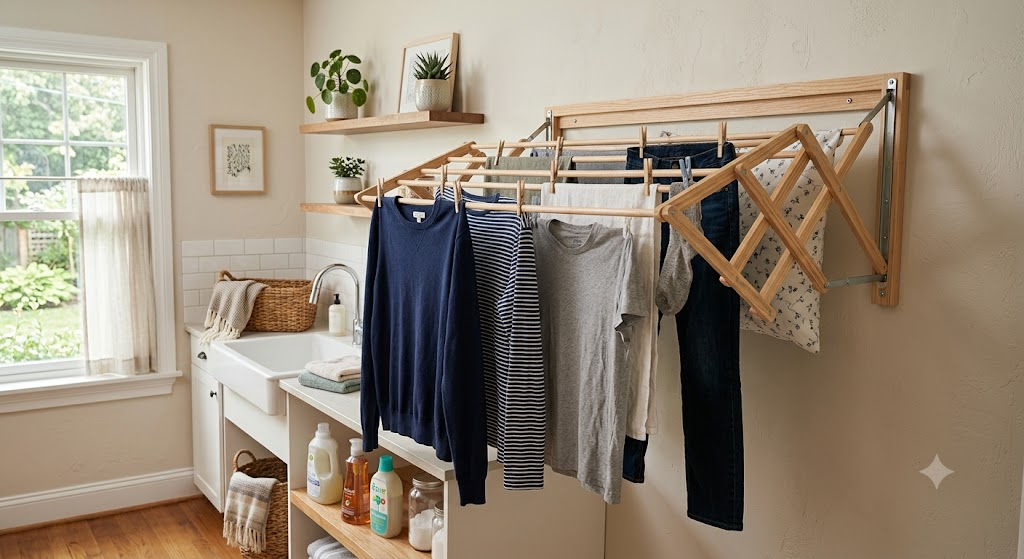
A tiny laundry room often has one major problem that nobody talks about enough: wet clothes need somewhere to go. A wall-mounted drying rack can solve that problem without stealing permanent floor space. Choose a rack that folds flat when not in use.
You can also use a wall-mounted rail for:
- Shirts
- Dresses
- Delicates
- Air-dry clothing
Leave enough space between garments for air to circulate. Air drying can also reduce reliance on a heated dryer. ENERGY STAR notes that air-drying clothes can save energy and may help clothing last longer.
11. Put a Slim Hamper Next to the Washer
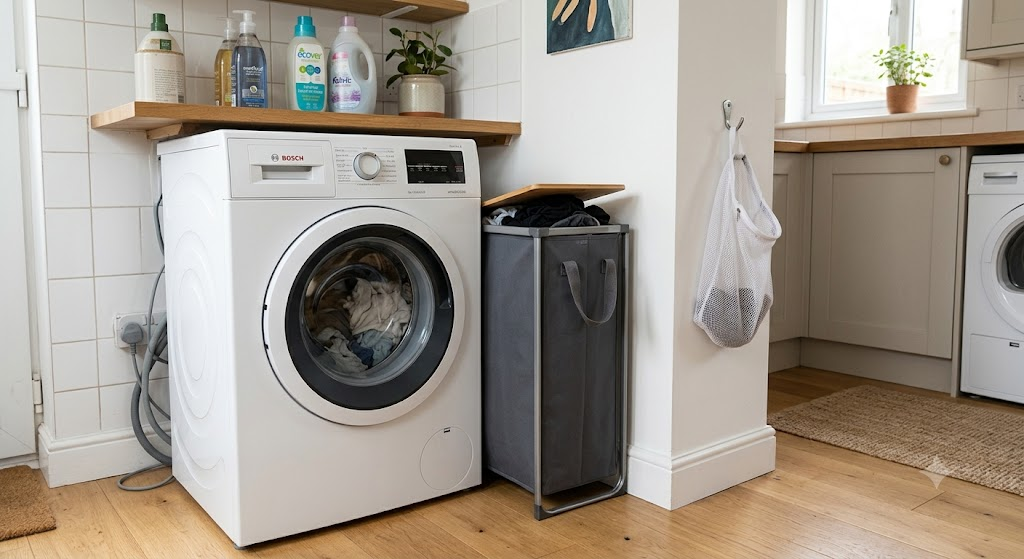
Don’t waste valuable floor space with a huge laundry basket. A tall, narrow hamper can hold dirty clothes while using a much smaller footprint. If several people share the laundry area, consider separate slim hampers for:
- Lights
- Darks
- Towels
- Delicates
But don’t over-organize a tiny room. If sorting four categories creates more clutter than it prevents, use fewer categories. The best laundry organization system is the one you’ll actually maintain.
12. Use the Space Behind the Door
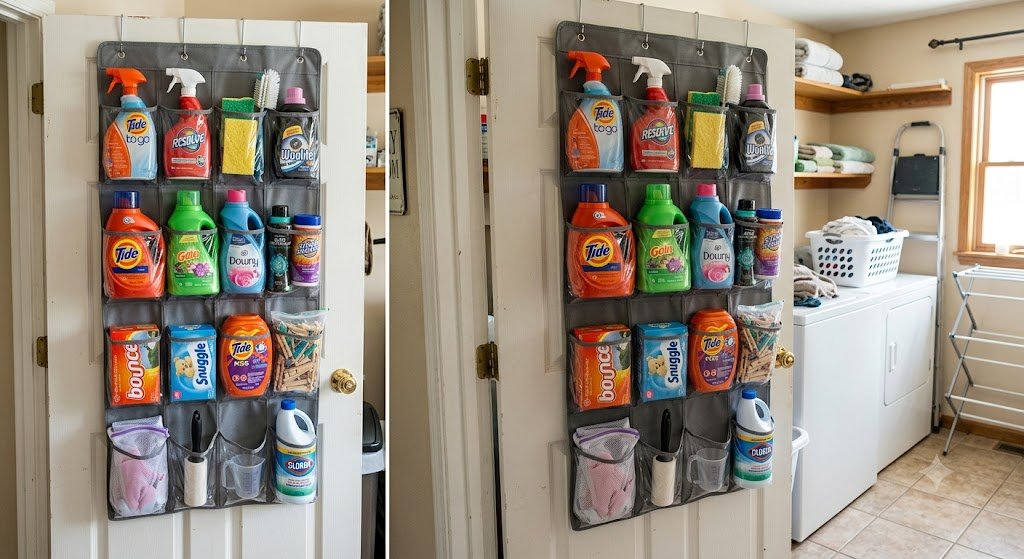
The back of a door is often forgotten real estate. A hanging organizer can hold lightweight laundry supplies without consuming floor space. Depending on the door and organizer, you can store:
- Mesh laundry bags
- Small brushes
- Stain-treatment products
- Cleaning cloths
- Hangers
- Gloves
Avoid putting too much weight on a door that isn’t designed to carry it.
Best for: Extremely narrow laundry closets where every inch matters.
13. Create a Hidden Laundry Station Under the Stairs
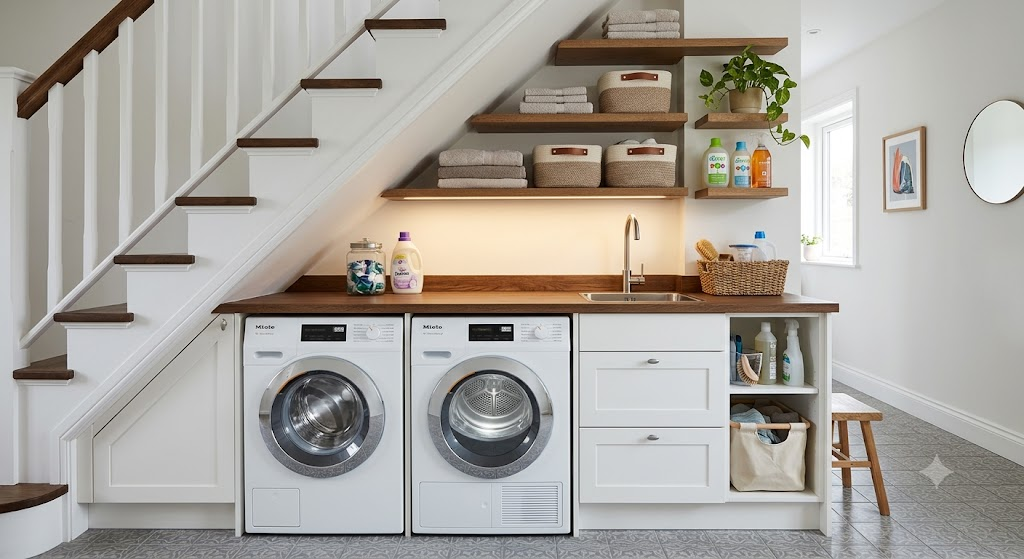
The space beneath stairs can be awkward for furniture but surprisingly useful for laundry. If there’s adequate clearance, you may be able to place a compact portable washer beneath the stairs and use nearby shelving for laundry supplies.
This setup can work particularly well in:
- Townhomes
- Tiny homes
- Small houses
- Basement apartments
The biggest challenge is access. Make sure you can comfortably reach the controls, connect hoses, remove the drain hose, and pull the machine out when needed. A beautiful laundry area that requires you to crawl under the stairs every time you wash three shirts isn’t a particularly good design.
14. Use a Pull-Out Laundry Basket
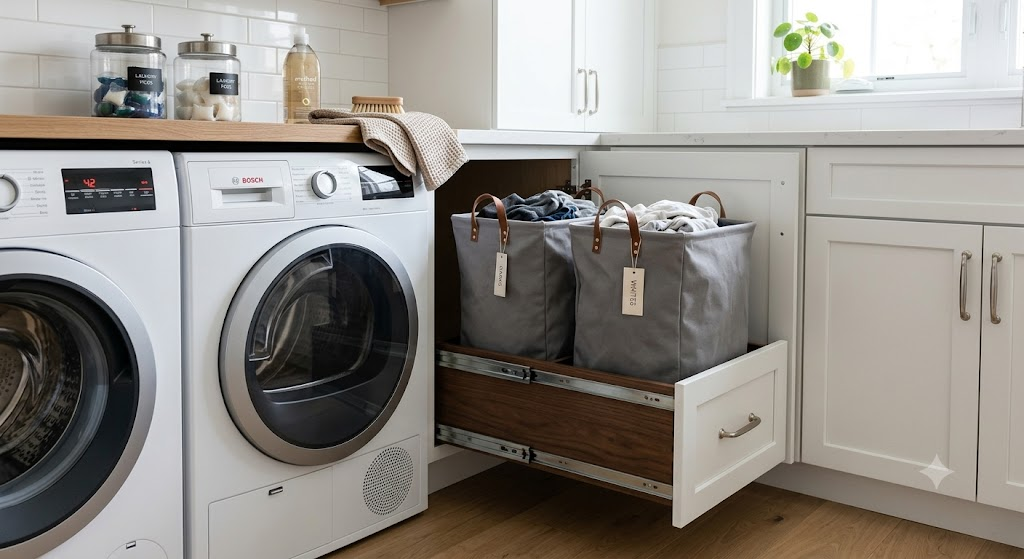
If you have a cabinet or shelving unit, add a pull-out basket instead of keeping a traditional hamper on the floor. This gives you hidden storage and keeps walking space clear.
You can create separate pull-out compartments for different laundry categories if you have enough cabinet space. For a truly tiny laundry room, though, one large pull-out hamper may be more practical than several small ones.
15. Create a Laundry Nook in a Hallway
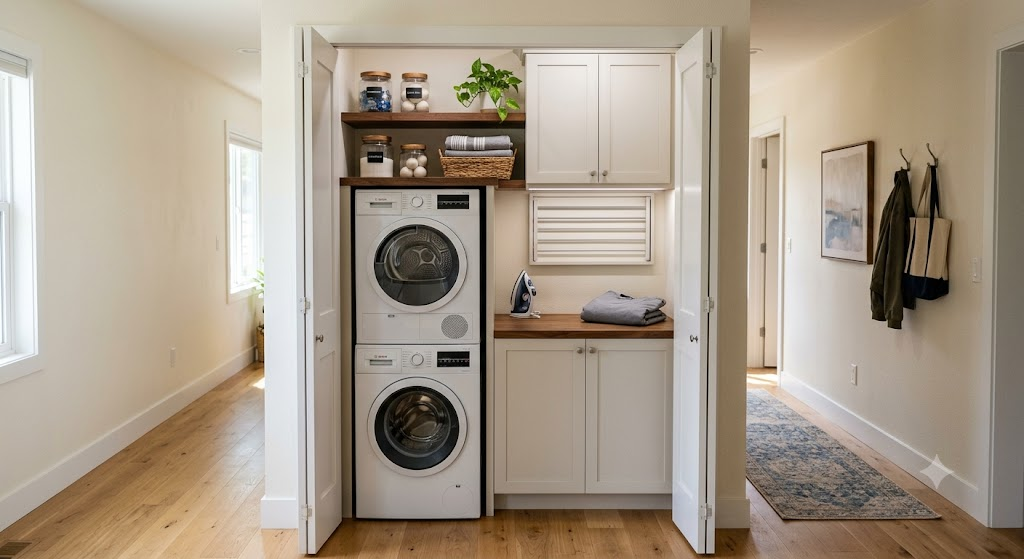
A hallway may sound like an unlikely laundry location, but an unused recessed section can sometimes become a compact laundry nook. The key is keeping the setup shallow and organized.
A good hallway laundry station might include:
- Compact portable washer
- Slim storage cabinet
- Fold-down drying rack
- Wall shelf
- Small hamper
The washer should never block an important walkway or emergency exit. Measure the remaining passage width and consider how much space you’ll need when loading and unloading the machine.
16. Combine the Laundry Area With a Mudroom
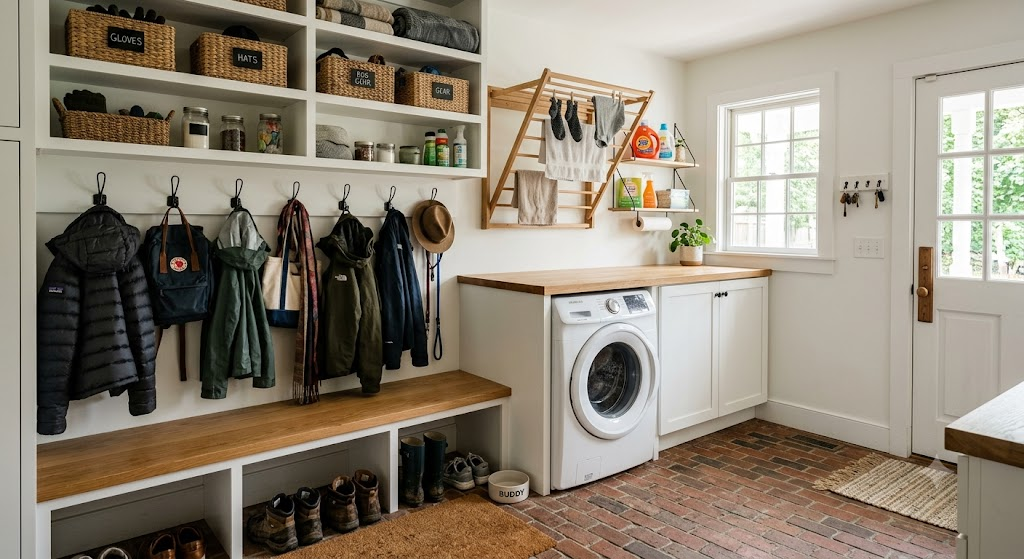
If your home has a small entry or mudroom, you may be able to combine functions.
One section can handle:
- Shoes
- Coats
- Cleaning supplies
- Laundry
- Drying clothes
A portable washer can be particularly useful because it doesn’t have to dominate the room permanently. Use hooks and vertical shelving to keep the floor open. This approach works best when you separate wet laundry from items that shouldn’t get splashed.
17. Make the Entire Laundry Setup Portable
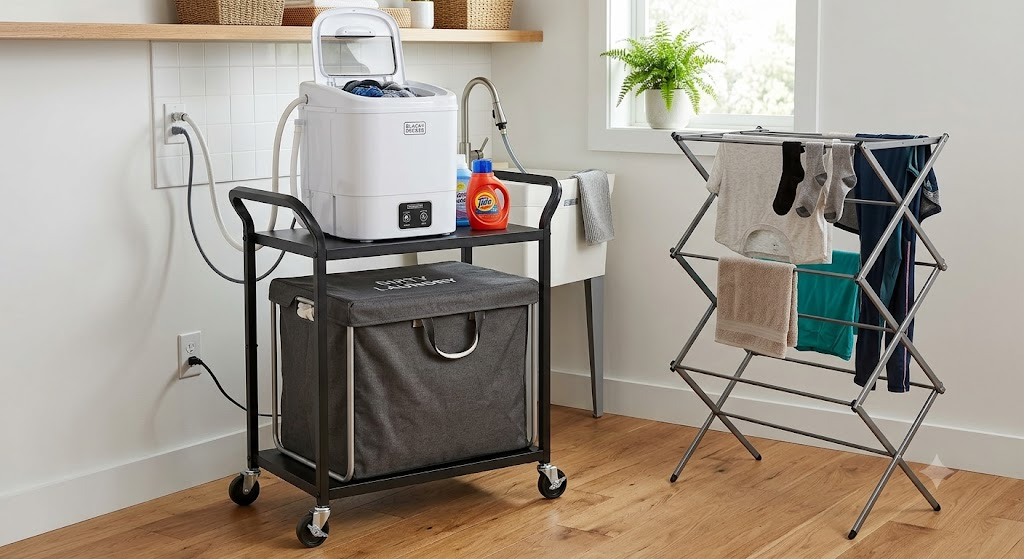
This is arguably the most flexible option. Instead of building a permanent laundry room, create a portable laundry station.
The setup might include:
- Portable washing machine
- Rolling cart
- Slim laundry hamper
- Foldable drying rack
- Small storage bin
- Temporary faucet adapter if required
- Drain hose storage
When laundry day arrives, move the washer into position, connect it according to the manufacturer’s instructions, wash your clothes, and store the equipment afterward if your particular setup allows it. This is especially useful for renters who don’t want to dedicate permanent floor space to laundry.
A few portable washer accessories can make a small setup easier to connect, move, organize, and protect.
Portable Washer Setup: What Actually Matters?
A portable washer isn’t simply a smaller traditional washing machine.
Different models can have very different requirements.
Some portable washers use temporary faucet connections. Others may allow manual filling. Some are fully automatic, while twin-tub models require you to move clothes between wash and spin compartments.
A portable washer guide from CompactHomeHub, for example, distinguishes between manual-fill, faucet-connected, and manual washers because “portable” doesn’t automatically mean “works anywhere.”
Before buying, answer these questions:
1. Where will the water come from?
Possible sources include:
- Kitchen faucet
- Bathroom faucet
- Manual filling
- Another approved water source
Never assume compatibility.
2. Where will wastewater go?
A portable washer still needs drainage.
Depending on the machine and your setup, wastewater may go to a suitable sink, bathtub, or drain.
3. Where will the washer sit?
The surface should be stable and appropriate for the machine.
A washer that rocks during operation isn’t something you should simply tolerate because it’s small.
4. Where will clothes dry?
This deserves as much planning as the washer itself.
Consider:
- Foldable drying rack
- Wall-mounted drying rack
- Indoor clothesline
- Shower rod for appropriate garments
- Separate compact dryer where permitted
Portable Washer Buying Checklist for a Small Laundry Room
Don’t buy based only on the word “compact.” Measure first.
| What to Check | Why It Matters |
|---|---|
| Width | Determines whether the washer physically fits |
| Depth | Prevents the machine from sticking too far into the room |
| Height | Important under counters or shelves |
| Lid clearance | Critical for top-loading machines |
| Water connection | Determines whether your faucet is compatible |
| Drain requirements | Determines where wastewater can go |
| Electrical requirements | Helps prevent unsafe setups |
| Washer capacity | Determines how many clothes you can wash |
| Weight | Matters if you’ll move the machine |
| Spin function | Affects how wet clothes are after washing |
| Storage needs | Important if the washer must be moved after use |
| Noise/vibration | Especially important in apartments |
ENERGY STAR also recommends considering washer size and typical load size when selecting a machine. Its guidance notes that certified washers come in different widths and capacities, including designs intended for smaller spaces.
What Washer Capacity Do You Need?
More capacity isn’t automatically better. If you’re one person living in a studio apartment, buying a very large portable washer may simply consume valuable floor space.
On the other hand, a tiny washer may force a family to run multiple loads every week. Think about your actual laundry habits.
| Household Size | Recommended Approach |
|---|---|
| Single person | A smaller portable washer can be a practical choice if you wash clothes frequently. It takes up less space and can handle everyday loads without dedicating an entire room to laundry. |
| Couple | A medium-capacity portable washer can offer a better balance between load size and floor space. It’s a good option if you do laundry a few times a week and don’t regularly wash bulky items. |
| Family | A portable washer may work for smaller, frequent loads, but don’t assume it can replace a full-size washer. If you regularly wash bedding, towels, jeans, or large family loads, the limited capacity can quickly become frustrating. |
A portable washer is often most useful when it matches your laundry habits rather than when it has the biggest advertised capacity.
Portable Washer vs. Full-Size Washer for Small Spaces
| Feature | Portable Washer | Full-Size Washer |
|---|---|---|
| Floor space | Usually lower | Higher |
| Permanent installation | Often not required | Usually required |
| Mobility | High | Low |
| Storage after use | Possible with some setups | Not practical |
| Typical capacity | Small to medium | Medium to large |
| Best for renters | Often a strong fit | Depends on property |
| Faucet compatibility | May be required | Dedicated connections are common |
| Drying | Often separate | Usually separate or paired |
| Large loads | Less practical | Better suited |
| Setup flexibility | High | Lower |
The trade-off is straightforward: portable washers save space and installation complexity, but you generally give up capacity and convenience compared with a conventional washer.
Small Laundry Room Ideas That Look Good but Can Backfire
Pinterest-style laundry rooms can be useful for inspiration, but don’t copy a design simply because it looks attractive. For example, a built-in countertop may look excellent but make it difficult to access a portable washer.
Similarly, closed cabinets may hide clutter but leave you with nowhere to store hoses or move the washer. The better approach is to start with function:
Water → washer → drainage → drying → storage
Then make it attractive. Lowes’ current small-laundry guidance similarly emphasizes maximizing vertical space, using shelves and cabinets, adding folding surfaces, and selecting space-efficient appliance configurations.
Common Small Laundry Room Mistakes
Buying the washer before measuring
This is probably the easiest mistake to avoid. Measure the space first. Then measure the washer and then check clearance.
- Forgetting the lid: A top-loading portable washer may fit perfectly under a shelf until you try to open it.
- Ignoring the drain hose: You can have a perfect water connection and still have nowhere sensible for wastewater to go.
- Using too much detergent: A tiny washer doesn’t necessarily need a large amount of detergent. Follow the detergent and washer instructions.
- Blocking ventilation: Don’t completely seal a laundry area if the equipment’s instructions require airflow.
- Forgetting vibration: A machine can look tiny and still move around during operation if the surface isn’t stable or the load is unbalanced.
- Assuming portable means lightweight: Some larger portable washers are not particularly easy to carry.
If you need to move the washer frequently, check its actual weight before buying.
How to Make a Tiny Laundry Room Feel Bigger
You don’t need a major renovation. Try these simple changes:
- Use light-colored walls and storage.
- Keep the floor as clear as possible.
- Choose slim shelving.
- Store detergent in compact containers where appropriate.
- Use matching baskets instead of several unrelated bins.
- Install folding drying racks.
- Keep hoses neatly secured when not in use.
- Use one storage zone rather than scattering supplies around the room.
- Avoid storing things that have nothing to do with laundry.
The goal isn’t to make a tiny laundry room look enormous.
It’s to make it feel easy to use.
Best Small Laundry Room Setup by Living Situation
| Best For | Recommended Setup |
|---|---|
| Studio apartment | Portable washer beside the kitchen or bathroom sink + slim rolling cart + folding drying rack. |
| Renter | Portable washer + temporary faucet connection + removable shelving + foldable drying rack. |
| Tiny home | Compact portable washer + vertical shelving + wall-mounted drying rail. |
| RV | RV-friendly portable washer + secure drainage setup + compact drying solution. |
| Family | Larger-capacity compact or portable washer may work, but compare the capacity with your actual weekly laundry needs. If you regularly wash bulky loads such as bedding and towels, a full-size washer may still be the more practical choice. |
FAQs
Can I put a portable washing machine in a small laundry closet?
Yes, provided the machine has adequate clearance and the closet provides safe access to water, drainage, electricity where required, and ventilation according to the manufacturer’s instructions.
Can I use a portable washer in an apartment?
Yes. Portable washers can be particularly useful in apartments without permanent laundry hookups. However, check your lease or building rules before using one. Some properties restrict portable washing machines because of potential water damage.
Can a portable washer go under a counter?
Some can, but only if the dimensions and operating requirements allow it. Pay particular attention to lid clearance on top-loading models.
Do portable washers need a drain?
Yes. They produce wastewater that must go somewhere. A permanent drain connection isn’t always necessary, but you need a safe and manufacturer-approved drainage arrangement.
Can I connect a portable washer to my kitchen sink?
Some models can connect to compatible faucets, but don’t assume yours will. Check the washer’s connection requirements and your faucet design before purchasing.
Is a portable washer enough for a family?
It depends on the machine and your laundry volume. A portable washer can work for smaller, frequent loads, but families with large amounts of towels, bedding, and clothing may find a full-size washer more practical.
Does a portable washer also dry clothes?
Usually, a portable washer’s “dryer” function refers to spinning excess water out of clothes rather than providing the same heated drying function as a conventional clothes dryer.
How much space do I need around a portable washer?
There isn’t one universal clearance number. Follow the manufacturer’s installation instructions for the exact model. You also need enough room to operate controls, open the lid, connect hoses, and safely move the machine if necessary.
Final Verdict
The best Small Laundry Room Ideas aren’t necessarily the most expensive or Instagram-worthy ones.
They’re the designs that make laundry easier without wasting precious space.
For most apartment renters, a practical setup is a compact portable washer positioned close to an existing faucet and suitable drain, with vertical shelving above it and a foldable drying rack nearby.
If you have slightly more room, add a slim rolling cart and a fold-down folding surface.
If you have almost no room, make the entire laundry station portable so you can move or store the washer after use.
The most important thing is to plan the complete laundry cycle not just where the washer will sit.
Where does the water come from?
Where does wastewater go?
Where do wet clothes dry?
Where will detergent and accessories live?
Can you safely move and operate the washer?
Answer those questions before buying anything, and even a surprisingly tiny corner can become a functional laundry area.
Recommended Reading:
- 10 Best Portable Washing Machine
- 20 Ways to Dry Your Laundry in a Small Apartment
- Can a Portable Washing Machine Wash Blankets & Sheets?
- 10 Best Portable Washing Machines and Dryers in 2026

Sourabh researches and writes about home appliances, kitchen gadgets, and common appliance problems to help readers make smarter buying decisions. He specializes in Portable washing machines and appliance troubleshooting guides.
At compactHomeHub, Sourabh focuses on creating easy-to-understand content that simplifies technical appliance issues into practical solutions. His goal is to help users save time, avoid costly mistakes, and choose the right appliances with confidence.
1 thought on “17 Small Laundry Room Ideas That Make Room for a Portable Washer”