You’ve probably already realized that a full-size washer isn’t practical if you’re renting an apartment, living in an RV, or simply short on floor space. The harder part is figuring out which portable washer actually fits your laundry habits, because capacity, hookups, drainage, spin performance, and portability vary dramatically between models.
A portable washing machine can solve that problem but buying one isn’t as simple as choosing the smallest or cheapest washer you can find.
Portable washers vary substantially in capacity, automation, spin performance, faucet compatibility, drainage, noise, vibration, weight, portability, water use, electrical requirements, and price. A compact 0.9-cu.-ft. automatic washer may be excellent for one person but frustrating for a couple. A 17.6-lb twin-tub machine may handle more laundry while requiring substantially more hands-on work.
Our Top Picks
- Best for very small spaces: COMFEE’ 0.9 Cu. Ft. Portable Washer
- Best large-capacity portable: GE 2.8 Cu. Ft. Portable Washer
- Best for apartments with heavier laundry loads: COMFEE’ 1.6 Cu. Ft.
- Best twin-tub: Giantex 17.6-lb. Twin-Tub Washer
- Best compact full-automatic: Giantex 7.7-lb. Full-Automatic Washer
- Best for one person: BLACK+DECKER 0.9 Cu. Ft. or COMFEE’ 0.9 Cu. Ft.
- Best for RVs: BLACK+DECKER 1.6 Cu. Ft. or COMFEE’ 0.9 Cu. Ft.
Best Portable Washing Machines at a Glance
| Product | Best For | Capacity | Type | Dimensions | Check Price |
|---|---|---|---|---|---|
| BLACK+DECKER BPWM16W | Best overall | 1.6 cu. ft. / 11 lb | Fully automatic | 21.3 × 21.7 × 36.6 in | Check Price |
| COMFEE’ CLV09N1AMG | Small spaces | 0.9 cu. ft. | Fully automatic | 18.1 × 17.7 × 31.5 in | Check Price |
| COMFEE’ CLV16N2AMG | Apartments | 1.6 cu. ft. / 11 lb | Fully automatic | 20.3 × 20.7 × 36.6 in | Check Price |
| GE GNW128PSMWW | Large capacity | 2.8 cu. ft. | Fully automatic | 24 × 24.5 × 37.4 in | Check Price |
| Giantex 7.7-lb Full Automatic | Compact automatic | 7.7 lb | Fully automatic | 16 × 16.5 × 29.5 in | Check Price |
| Panda PAN6320W | Compact automatic | 1.34 cu. ft. / up to 10 lb | Fully automatic | Approx. 20 × 20 × 33.6 in* | Check Price |
| Giantex 17.6-lb Twin Tub | Twin-tub buyers | 11-lb wash / 6.6-lb spin | Semi-automatic | 24.8 × 15 × 28.5 in | Check Price |
| BLACK+DECKER BPWM09W | One person | 0.9 cu. ft. | Fully automatic | Approx. 17.7 × 17.3 × 31.1 in* | Check Price |
| COSTWAY Portable Washing Machine | Compact automatic | 3.5 kg | Fully automatic | 17″D x 17″W x 29.5″H | Check Price |
| Auertech 28 lbs Portable Washer | Compact automatic | 28 pounds | Fully automatic | 23″D x 23″W x 36″H | Check Price |
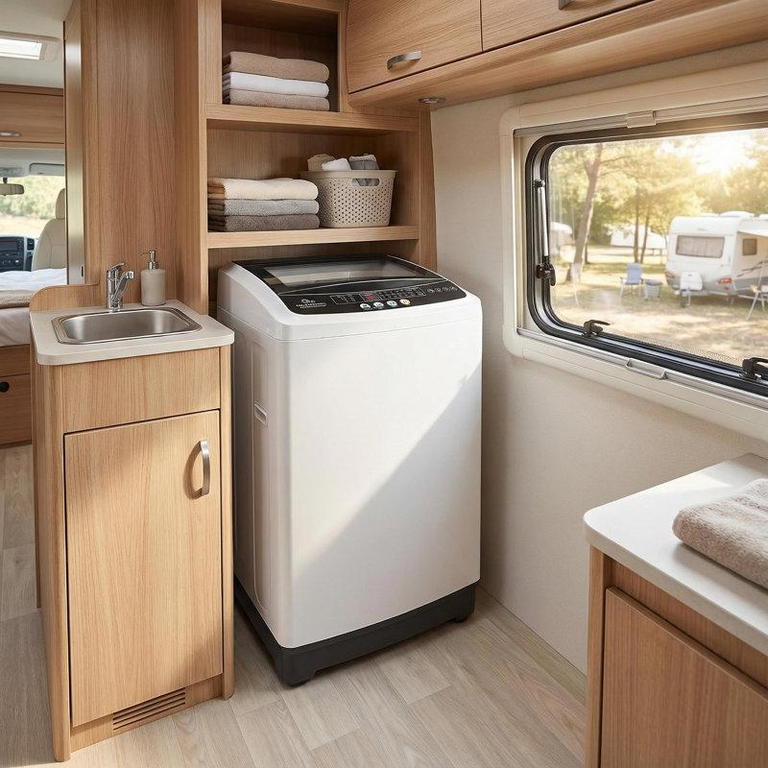
What Is a Portable Washing Machine?
A portable washing machine is a compact clothes washer designed to be moved or used without the permanent installation normally required by a full-size washer.
Portable washers come in several forms, including fully automatic machines, semi-automatic twin-tub washers, compact single-tub machines, and manual washers.
Portable washers generally solve a specific problem: If you need laundry at home but don’t have the space or plumbing for a conventional washer.
Why Does a Portable Washing Machine Matter for Small-Space Laundry?
A portable washing machine matters because it can provide at-home laundry without requiring the footprint and permanent setup of a traditional washer.
- It is convenient. If you currently use a laundromat, every load requires transportation, waiting, payment, and planning. A portable washer lets you handle smaller loads when they actually need washing.
- Portable washers can make sense when your home cannot accommodate a standard laundry pair.
- Portable washing machines can be useful in situations where permanent plumbing is unavailable or undesirable.
Who Should Buy a Portable Washing Machine?
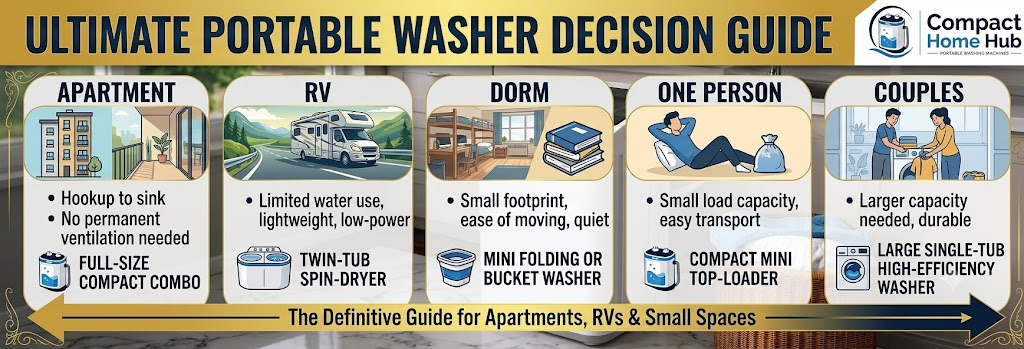
Portable washers make the most sense when a normal washing machine is impractical.
| Best For | Why a Portable Washing Machine Makes Sense |
|---|---|
| Apartment renters | Ideal when there’s no washer or permanent laundry hookup. Check your lease first, as some landlords prohibit portable washers because of potential water damage. |
| RV owners | Compact models are convenient when campground laundry facilities are inconvenient or expensive. Smaller washers are also easier to store in limited RV space. |
| Dorm students | A small automatic washer can be useful if permitted by the dorm and you have access to a suitable sink or water source. |
| One-person households | A 0.9-cu.-ft. washer can handle everyday laundry such as shirts, underwear, lightweight pants, and towels without taking up much space. |
| Couples | A 1.3–1.6-cu.-ft. washer is more practical for two people because it reduces the number of loads compared with ultra-compact models. |
| Tiny homes | Portable and easy-to-store designs work well when floor and storage space are limited. |
| People without permanent hookups | Models with faucet connections or manual-fill designs can work even when conventional plumbing isn’t available. |
| People trying to reduce laundromat visits | A portable washer can handle much of your everyday laundry, although bulky items such as large bedding may still require a laundromat or full-size machine. |
Who Shouldn’t Buy One?
A portable washer probably isn’t the right solution if:
- You have a large family.
- You frequently wash king-size bedding or bulky comforters.
- You need large loads every day.
- You want completely hands-off washing and drying.
- You don’t have a safe place to drain wastewater.
- Your lease prohibits portable washers.
- You already have convenient access to a full-size washer.
The biggest mistake is buying a small portable washer and expecting it to behave like a full-size machine.
10 Best Portable Washing Machines
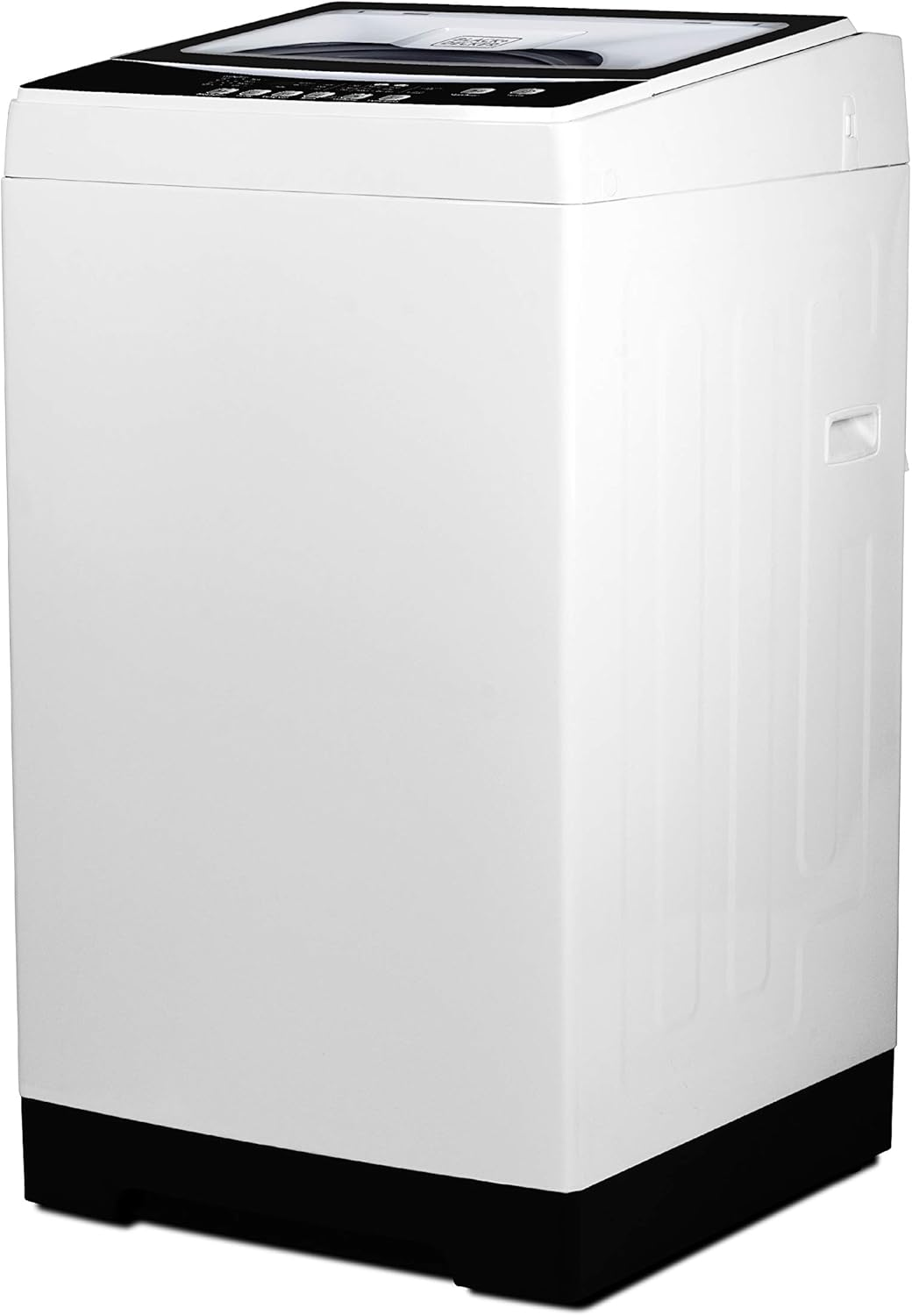
1. BLACK+DECKER Portable Washer BPWM16W — Best Overall
Best for: Apartment renters, RV owners, couples and small households that want automatic washing.
Skip it if: You regularly wash bulky comforters or need a machine you can easily carry up stairs.
The BLACK+DECKER BPWM16W is one of the better-balanced options in this category. It provides 1.6 cu. ft. of capacity and an 11-lb. laundry capacity, while remaining considerably smaller than a conventional washer.
BLACK+DECKER says the machine connects to a sink and includes a drain hose and sink adapter. It has six programs—Normal, Heavy, Delicate, Quick, Bulky and Spin Only and three water settings.
The machine measures 21.3 × 21.7 × 36.6 inches and weighs 70.5 lb, so calling it “portable” needs some qualification. It has two side handles and two rollers, but this is a machine you move around rather than casually carry from room to room.
Why it stands out
The 1.6-cu.-ft. capacity is the important part. It sits in a useful middle ground: substantially more practical than tiny 0.9-cu.-ft. machines but still small enough for many apartments and RV applications.
| Pros | Cons |
|---|---|
| 1.6-cu.-ft. capacity | Heavy at about 70.5 lb. |
| Up to 11 lb. of laundry | Takes considerably more floor space than ultra-compact washers |
| Fully automatic operation | Not a replacement for a full-size washer for large households |
| Six wash programs | |
| Three water settings | |
| Sink connection | |
| Wheels and side handles | |
| 120V operation | |
| One-year limited warranty |
Customer feedback
Owner discussions generally describe BLACK+DECKER portable washers as useful for apartments and small loads, although vibration during spin is a recurring issue with portable machines generally. Recent discussion of the 0.9-cu.-ft. model, for example, describes noticeable but manageable vibration when properly leveled.
Our verdict: The BPWM16W is the best choice here for buyers who prioritize automatic operation plus useful capacity rather than minimum size.
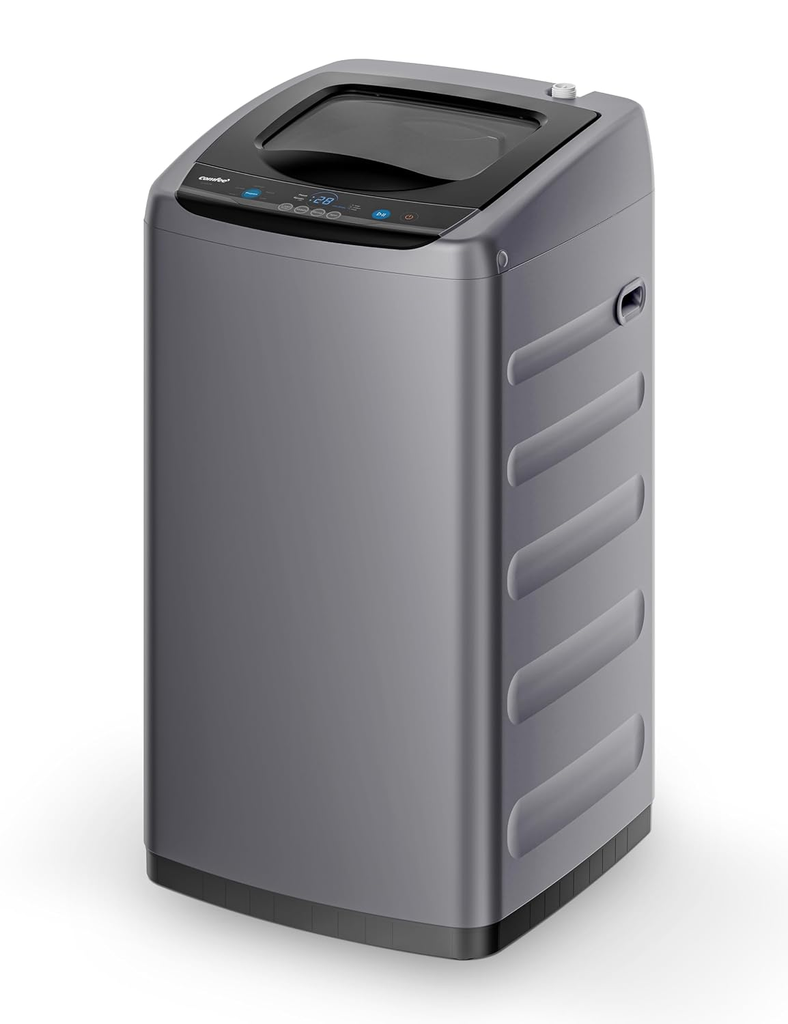
2. COMFEE’ Portable Washing Machine CLV09N1AMG — Best Compact Portable Washer
Best for: One person, dorms, RVs and extremely limited spaces.
Skip it if: You regularly wash towels, bedding or large weekly loads.
The COMFEE’ CLV09N1AMG has a 0.9-cu.-ft. capacity and measures approximately 18.1 × 17.7 × 31.5 inches. COMFEE’ lists a weight of 44.1 lb. and a one-year warranty.
It is fully automatic, has wheels, and includes automatic unbalance detection. A specification sheet lists a maximum spin speed of 930 RPM, although other listings report different figures, so verify the current model documentation before using RPM as a buying criterion.
Why it stands out
Its small footprint is the main reason to buy it. At roughly 18 inches wide, it is much easier to accommodate than a 2-cu.-ft.-plus machine.
Pros
- Very compact
- Fully automatic
- Stainless-steel tub
- Wheels
- Five wash programs
- Automatic unbalance detection
- 120V operation
- One-year warranty
Cons
- 0.9-cu.-ft. capacity limits load size
- Not ideal for couples doing large weekly loads
- Bedding capacity is limited
- Spin specifications vary between listings
Customer feedback
Current owner-feedback aggregation shows strong satisfaction, while recurring practical concerns around small portable machines include vibration, hose positioning and setup. The important point is that its compact size is also its biggest limitation.
Our verdict: One of the better choices if your priority is fitting a washer into a genuinely small space.
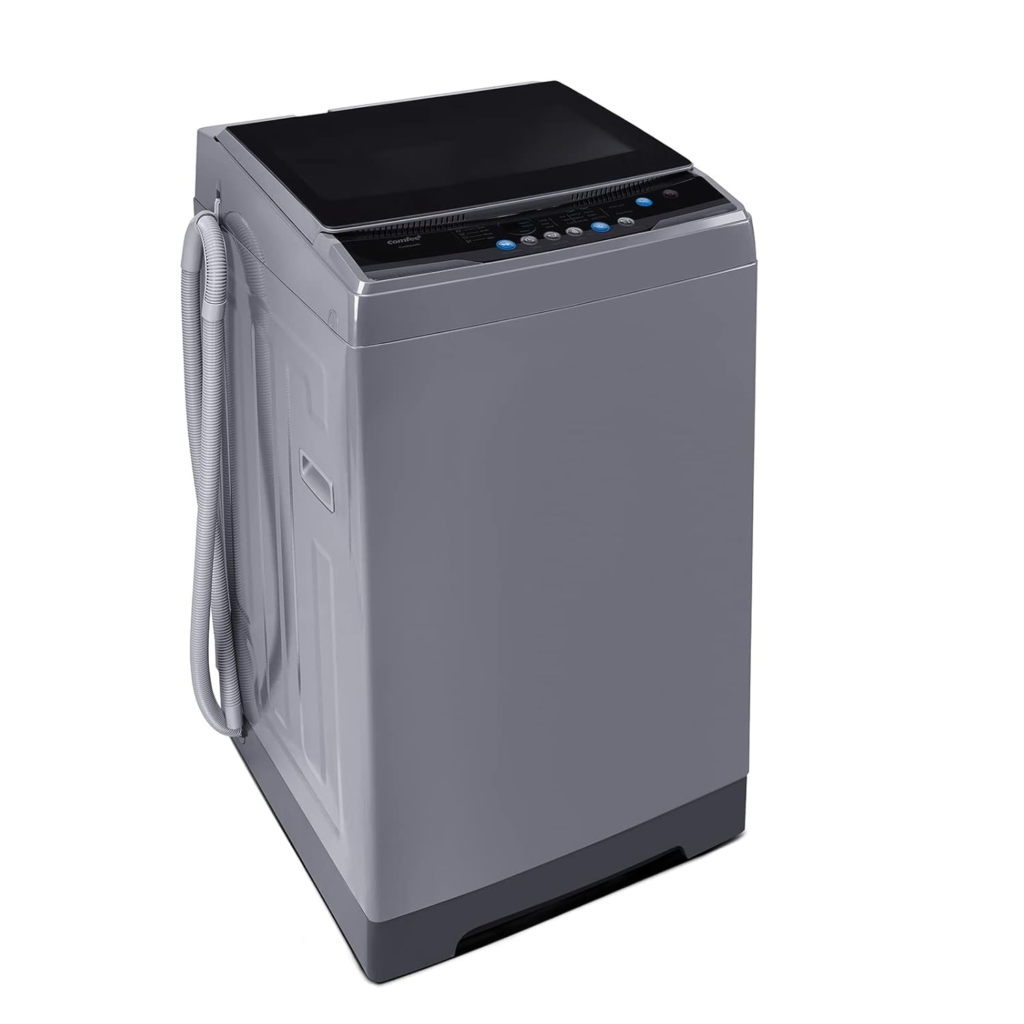
#3. COMFEE’ CLV16N2AMG — Best for Apartments
Best for: Apartment renters and couples wanting a larger automatic washer.
Skip it if: You need something light enough to move frequently.
The CLV16N2AMG increases capacity to 1.6 cu. ft., with dimensions of approximately 20.3 × 20.7 × 36.6 inches. COMFEE’ lists hot, warm and cold temperature selections and a 70.1-lb. weight.
It provides preset programs and customizable wash, rinse and spin times. The machine also has wheels and automatic unbalance detection.
| Pros | Cons |
|---|---|
| 1.6-cu.-ft. capacity | About 70 lb. |
| Fully automatic operation | Taller and deeper than ultra-compact machines |
| Multiple temperature selections | Not particularly convenient to carry |
| Wheels for easier movement | Customer reports include occasional setup and shipping concerns |
| Automatic unbalance detection | |
| Child lock | |
| Delay start | |
| Stainless-steel inner tub |
Why it stands out
For an apartment renter, 1.6 cu. ft. is a much more practical size than many tiny portable washers.
Retailer feedback describes the machine as functional and compact, with some customers specifically praising quiet operation, while others reported shipping damage.
Our verdict: A good apartment option when you want more capacity without moving to a full-size washer.
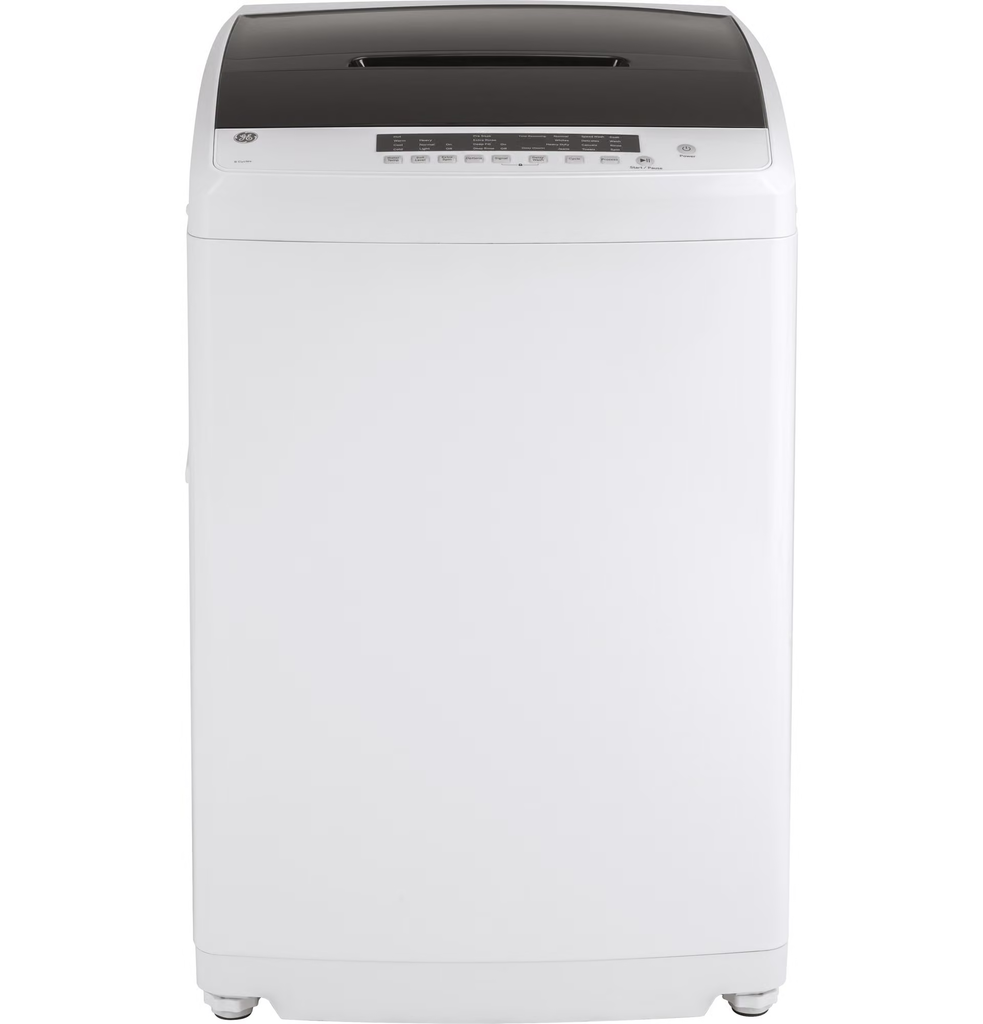
4. GE GNW128PSMWW — Best Large-Capacity Portable Washer
Best for: Households that want the largest capacity practical in this portable category.
Skip it if: You need a genuinely lightweight machine or have extremely limited floor space.
The GE GNW128PSMWW is unusual because its 2.8-cu.-ft. capacity approaches the capacity of many compact permanent washers. GE lists dimensions of 24 × 24.5 × 37.4 inches, an electronic control system, stainless-steel basket, eight cycles and a maximum spin speed of 750 RPM. It includes caster wheels and a unicoupler designed to connect to a standard kitchen or bathroom sink.
Why it stands out
Capacity. If you’re tired of running multiple loads through a tiny portable washer, this is the model in this group that makes the most sense.
| Pros | Cons |
|---|---|
| 2.8-cu.-ft. capacity | Much heavier and larger than most portable washers |
| Stainless-steel basket | More expensive |
| Eight wash cycles | 750-RPM maximum spin is less aggressive than some smaller machines |
| Four wash temperatures | Requires considerably more floor space |
| Caster wheels | |
| Sink connection system | |
| Electronic controls | |
| Delay wash | |
| Child lock | |
| Extra rinse and extra spin options |
Our verdict: If capacity matters more than portability, the GE is the strongest option in this lineup.
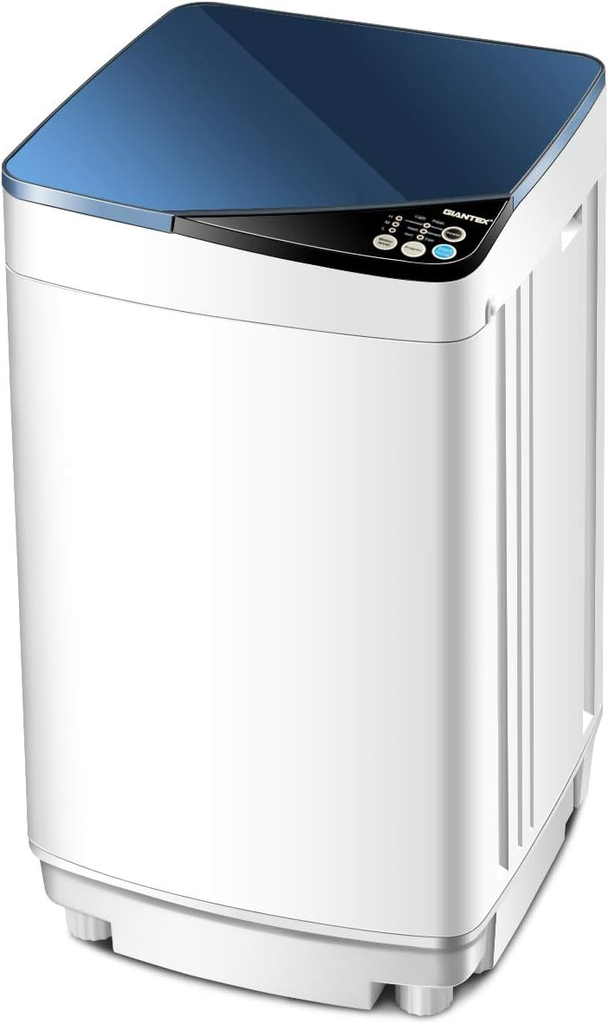
5. Giantex 7.7-Lb. Full-Automatic Washer — Best Compact Automatic
Best for: One person, dorms, RVs and small apartments.
Skip it if: You regularly wash bedding or large loads.
Giantex’s 7.7-lb. full-automatic model has a 0.8-cu.-ft. tub, measures 16.5 × 16 × 29.5 inches, and weighs about 40 lb. The manufacturer lists 120V/60Hz operation, 240W wash input power and 210W spin input power.
It also has a built-in drain pump and drainage tube.
Why it stands out
Its footprint is exceptionally small. At only 16 inches wide, it is easier to store than most automatic portable washers.
| Pros | Cons |
|---|---|
| Very small footprint | Limited capacity |
| Fully automatic operation | Not suitable for large bedding |
| 7.7-lb. capacity | Smaller drum means more frequent loads |
| Stainless-steel inner tub | Manufacturer’s product-review sample is relatively small |
| Built-in drain pump | |
| 40-lb. weight | |
| Suitable for apartments, RVs, and dorms |
Our verdict: Choose this over a larger machine when floor space is the deciding factor.
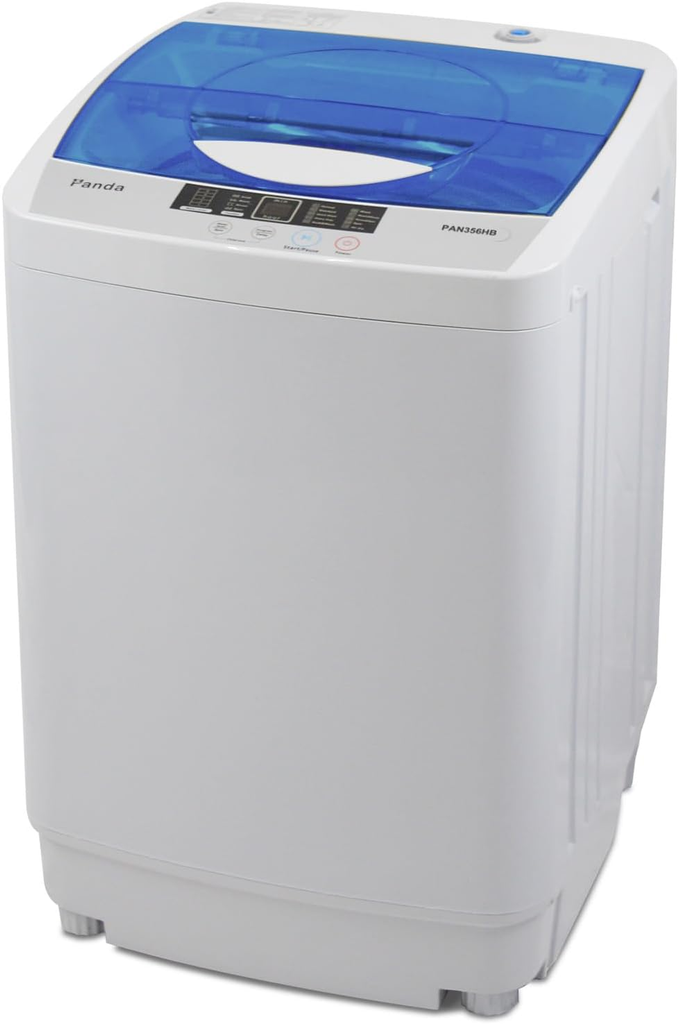
6. Panda 1.34 Cu.Ft. Portable Washing Machine— Best Compact Automatic Washer
Best for: Buyers who want a compact automatic machine with more capacity than the smallest washers.
Skip it if: You prioritize a large established service network or need a very lightweight machine.
Panda’s PAN6320W is a fully automatic portable washer. Current documentation identifies it as a 1.34-cu.-ft. model with a capacity of up to about 10 lb. One current U.S. listing describes it as suitable for apartments, RVs, vacation homes and dorms.
The documentation lists approximately 20 × 20 × 33.6 inches and a 49-lb. weight. The manual also identifies a 110–120V, 60Hz electrical requirement and includes a drainpipe, water inlet hose and quick adapter.
Why it stands out
It provides a useful compromise between ultra-small washers and larger 1.6-cu.-ft. machines.
| Pros | Cons |
|---|---|
| 1.34-cu.-ft. capacity | Less capacity than 1.6-cu.-ft. competitors |
| Fully automatic operation | Brand/service availability should be checked before purchase |
| Stainless-steel drum | Customer questions include drainage and water-fill issues |
| Multiple wash programs | |
| Multiple water levels | |
| Wheels for easier movement | |
| Compact dimensions | |
| 110–120V operation |
The current manual contains troubleshooting procedures for inlet leaks, drainage and other common problems, which is useful when evaluating long-term ownership.
Our verdict: A reasonable middle-ground portable washer if the current price is competitive.
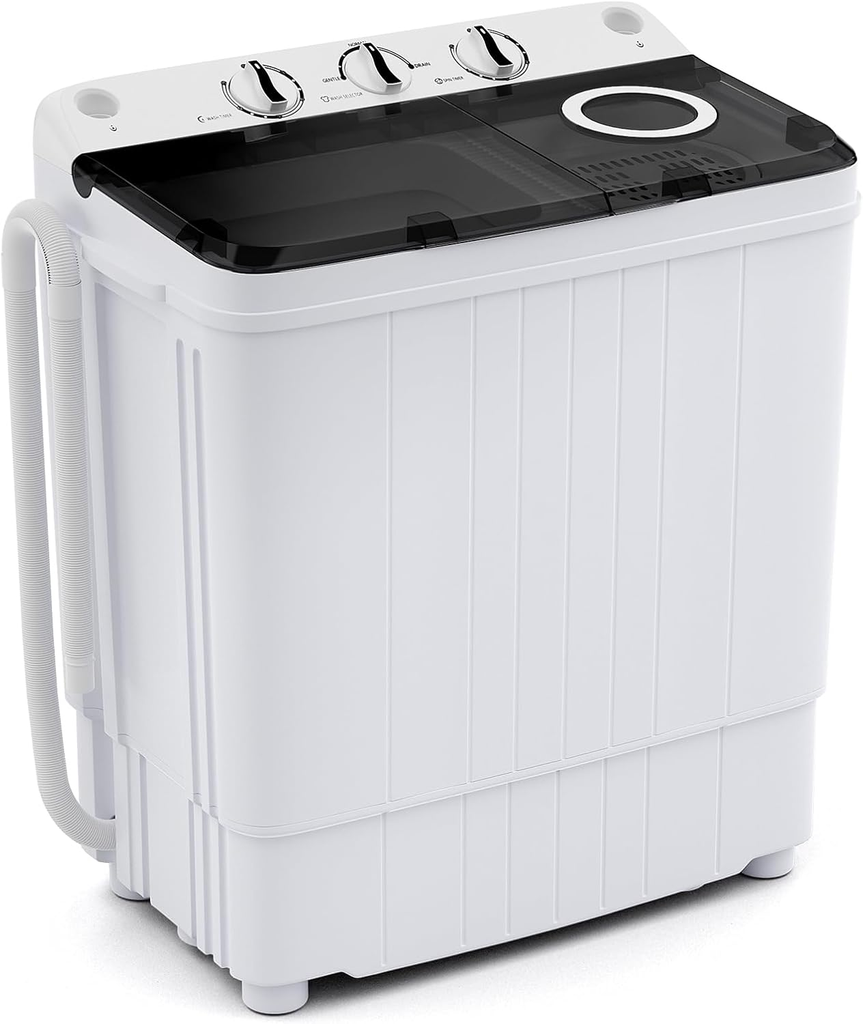
7. Giantex 17.6-Lb. Twin-Tub Washer — Best Twin-Tub
Best for: Buyers who don’t mind manual intervention and want washing plus dedicated spinning.
Skip it if: You want one-button automatic laundry.
This Giantex model is a different proposition from the automatic machines above. It has separate wash and spin tubs, with 11 lb. wash capacity and 6.6 lb. spin capacity. The machine measures 24.8 × 15 × 28.5 inches, weighs about 29.3 lb., and operates at 120V/60Hz.
The manufacturer lists 260W washing power and 140W spinner power.
Why it stands out
The separate spinner allows you to move a washed load directly into the spin tub while another load is being washed. That workflow can be considerably faster than waiting through a fully automatic wash cycle.
But you have to do the work.
| Pros | Cons |
|---|---|
| 11-lb. washing capacity | Semi-automatic operation |
| 6.6-lb. spinner capacity | Requires transferring clothes between tubs |
| Separate wash and spin tubs | Spin tub holds less than the wash tub |
| Lightweight at about 29 lb. | Gravity drainage |
| Narrow 15-inch depth | Requires more user involvement |
| Short wash and spin timers | |
| Good option for RVs and small spaces |
Giantex’s current product page has only a small number of reviews, so we would not treat its current 5-star displayed rating as strong evidence of long-term reliability.
Our verdict: The best option in this list if you value simple construction, low weight and separate spin drying more than automation.
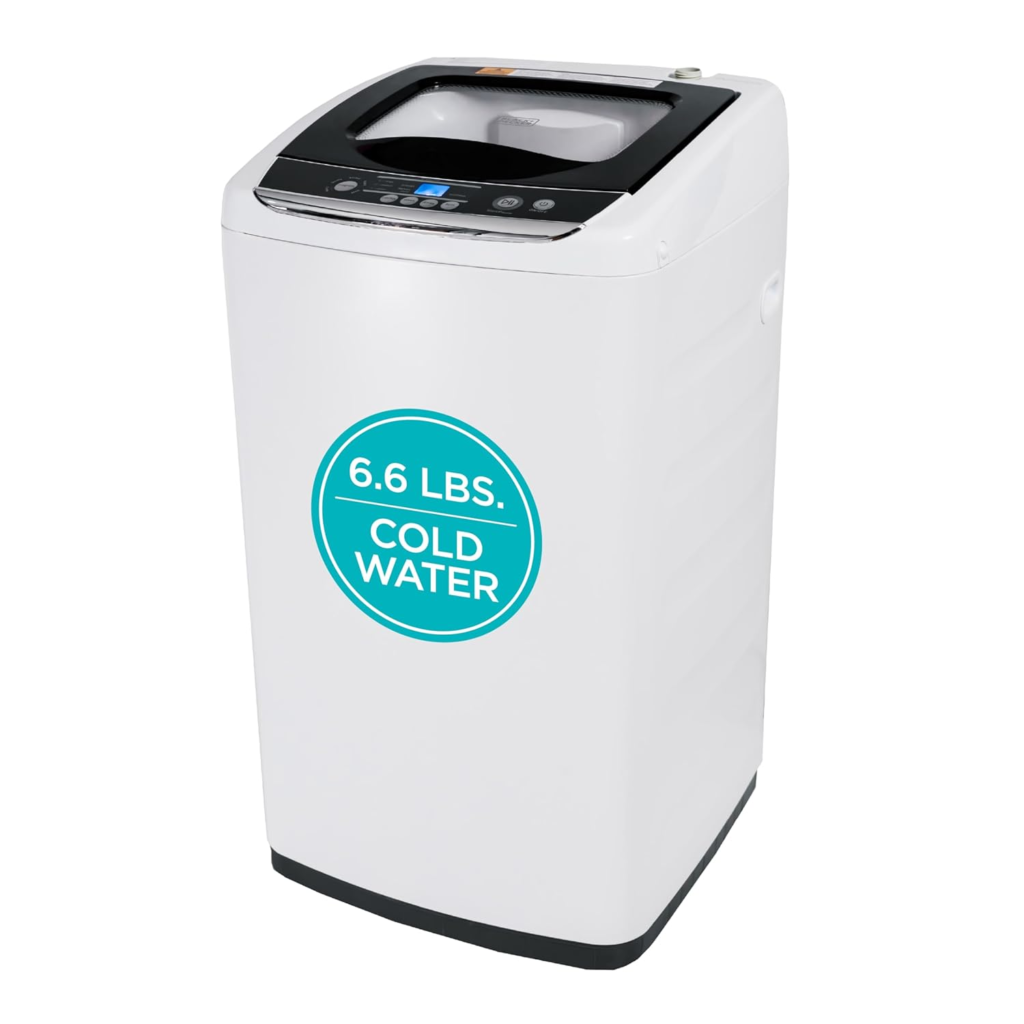
8. BLACK+DECKER 0.9 Cu. Ft. Portable Washer — Best for One Person
Best for: Solo renters who want automatic washing but have very little space.
Skip it if: You wash large loads or want to reduce the number of cycles as much as possible.
The BPWM09W is a 0.9-cu.-ft. portable washer. Its small footprint makes it attractive for one-person households.
Retailer specifications currently list five wash cycles and a maximum spin speed around 983 RPM, although specifications can vary by listing, so confirm the current model documentation before purchasing.
Why it stands out
This is a better fit for someone who washes small loads frequently rather than someone who saves laundry for one large weekly load.
Recent owner discussions include users reporting years of satisfactory use from BLACK+DECKER portable washers, including the ability to wash individual sheets and pillowcases in regular weekly laundry.
| Pros | Cons |
|---|---|
| Compact design | Small capacity |
| Fully automatic operation | Not ideal for couples |
| Suitable for one person | Limited bedding capacity |
| Easy to store | Portable-machine vibration can still be a consideration |
| Stainless-steel tub | |
| Automatic spin function |
Our verdict: A sensible choice for solo living when space matters more than capacity.
9. COSTWAY Portable Washing Machine
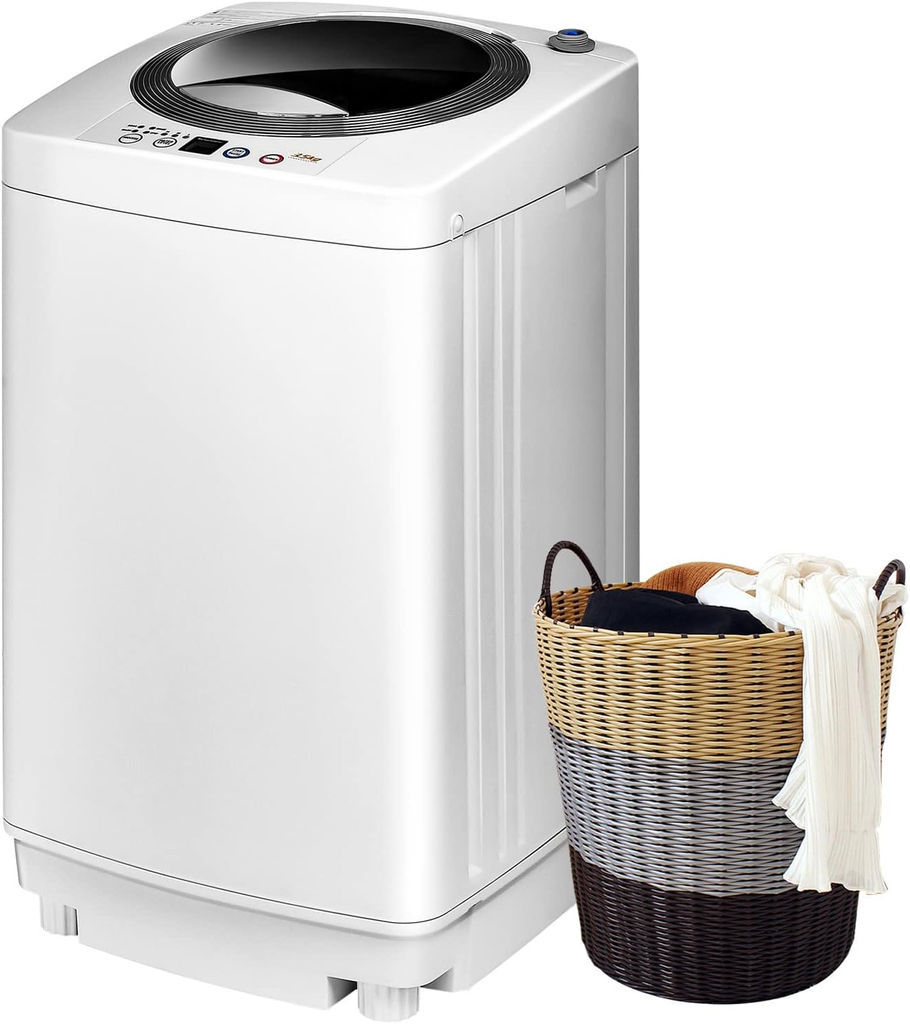
Best for: Singles, couples, apartment renters, dorm rooms, RVs, and anyone who needs a compact fully automatic washer for small everyday loads.
Skip it if: You regularly wash bulky bedding, large towels, or family-sized loads, or if you need a lightweight washer that is easy to carry frequently.
The COSTWAY 8-lb. portable washing machine is a compact fully automatic washer designed for small-space laundry. It combines an 8-lb. wash capacity with six wash programs, adjustable water levels, automatic operation, and a built-in drain pump. Its compact footprint makes it suitable for apartments, dorms, RVs, and other locations without a full-size washer. However, its relatively small capacity limits it to smaller laundry loads.
Why it stands out: Six wash programs and fully automatic operation make this COSTWAY more convenient than basic semi-automatic portable washers.
| Pros | Cons |
|---|---|
| Fully automatic operation | 8-lb. capacity is limited for larger households |
| Six wash programs | Not ideal for bulky bedding |
| Multiple water-level settings | Faucet adapter may need to be purchased separately |
| Built-in drain pump | Can be noisy during the spin cycle |
| Compact design | Some customer complaints about leaks and water connections |
| Stainless-steel inner tub | Relatively heavy for a portable washer |
| Suitable for apartments, dorms, and RVs |
Customer Feedback
Customer feedback is generally positive, particularly from users who value the washer’s compact size, automatic operation, and cleaning performance. However, the experience isn’t completely consistent. Some customers have reported noise during spinning, water leaks, connection problems, and difficulties with the faucet adapter. The small capacity is another recurring limitation for people trying to handle larger loads.
Our Verdict
The COSTWAY 8-Lb. Portable Washing Machine is a solid choice for small households and limited-space living. Its fully automatic operation is the biggest advantage because you don’t need to manually transfer clothes between wash and spin tubs.
10. Auertech 28 lbs Portable Washing Machine Review
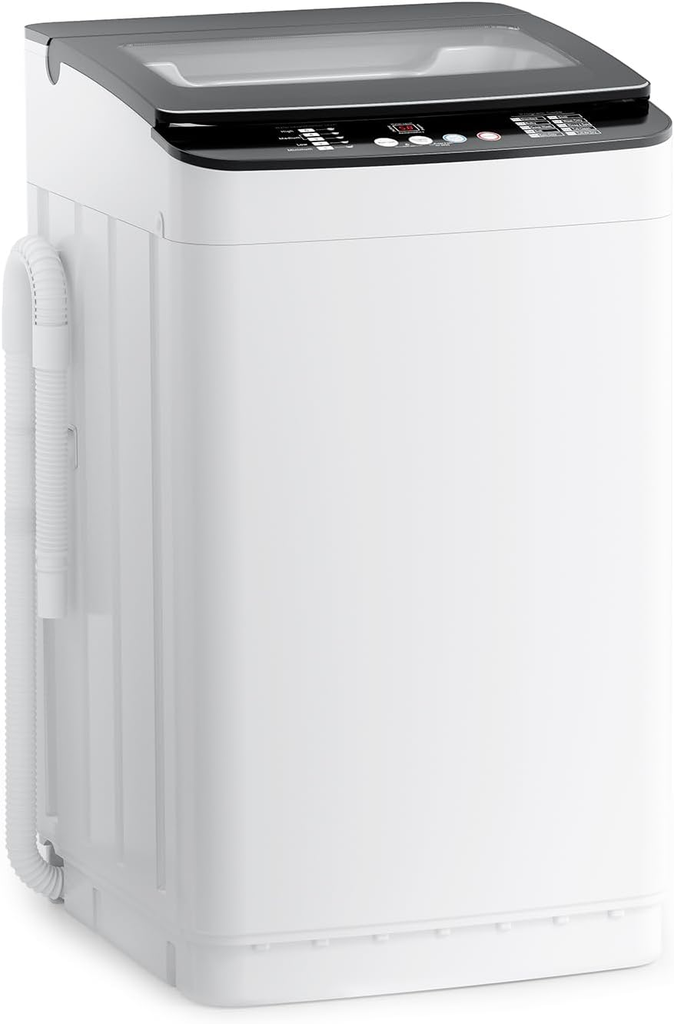
Best for: Large households, frequent laundry loads, RVs, apartments, and users who want a portable washer with substantially more capacity than typical compact models.
Skip it if: You need a lightweight washer that is easy to carry, have very limited storage space, or prefer a fully automatic machine with minimal manual involvement.
The Auertech 28-lb. Portable Washing Machine is a large-capacity semi-automatic twin-tub washer designed for handling significantly more laundry than typical portable machines. Its separate washing and spinning tubs let you wash and spin simultaneously, while the powerful motor helps handle everyday clothing and heavier loads.
The large capacity is useful for families, but its bigger footprint, manual operation, and need to transfer clothes between tubs reduce convenience.
Why it stands out: Its 28-lb. capacity and twin-tub design make it one of the better options for users who need portable washing capacity closer to a full-size machine.
Pros and Cons
| Pros | Cons |
|---|---|
| Large 28-lb. total capacity | Semi-automatic operation |
| Separate wash and spin tubs | Requires manually transferring clothes |
| Can wash and spin simultaneously | Large and relatively heavy |
| Suitable for larger laundry loads | Requires more user involvement |
| Useful for families and frequent laundry | Takes more storage space than compact models |
| Portable design | Spin capacity is lower than total wash capacity |
| Suitable for apartments and RVs | Water filling and drainage require setup |
Customer Feedback
Customer feedback tends to focus on the large capacity, cleaning performance, and convenience of having separate wash and spin tubs. Users who do frequent laundry particularly appreciate being able to wash one load while another is spinning.
Our Verdict
The Auertech 28-lb. Portable Washing Machine makes the most sense if capacity is your priority. A 28-lb. machine gives you considerably more room than the 8–12-lb. portable washers typically aimed at singles and couples.
How We Evaluate Portable Washing Machines
We use a research-based evaluation rather than pretending that specifications alone tell the entire story. We consider:
- Manufacturer specifications
- Owner manuals
- Warranty information
- Retailer listings
- Product dimensions
- Faucet compatibility
- Drain design
- Electrical requirements
- Available accessories
- Customer-review patterns
- Recurring complaints
- Parts/service information
We do not treat marketing claims such as “super quiet,” “powerful cleaning,” or “energy saving” as proof of superior real-world performance. These recommendations are not based on hands-on testing by our team
Types of Portable Washing Machines
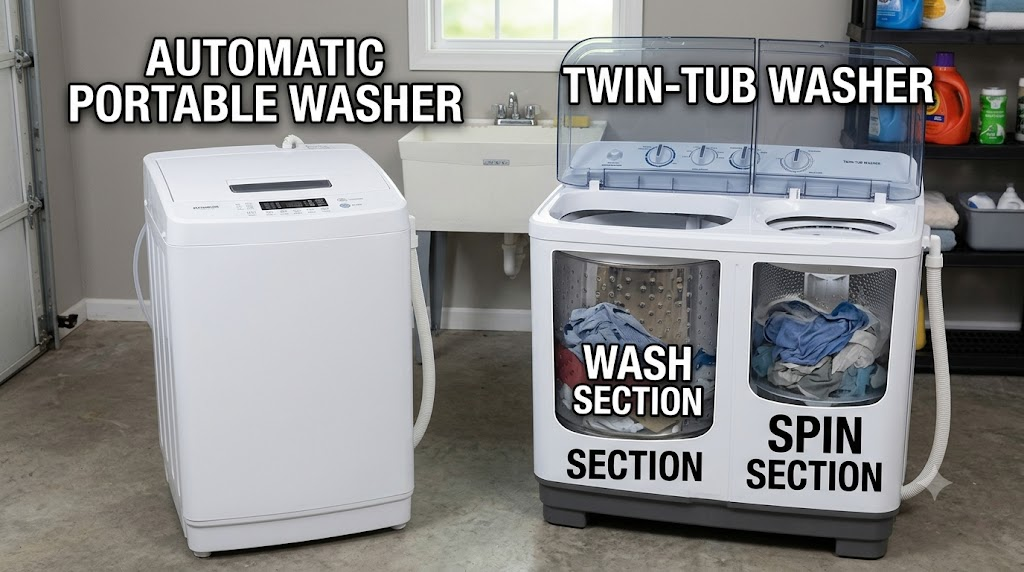
1. Fully Automatic Portable Washers
These machines handle washing, rinsing and spinning with minimal intervention. They’re the easiest choice for apartment renters who want the portable experience to feel somewhat similar to a conventional washer.
Best for: Convenience.
2. Semi-Automatic Portable Washers
These require more involvement, particularly with moving laundry between wash and spin stages.
Best for: Buyers who prioritize price, simplicity or low weight.
3. Twin-Tub Portable Washers
Twin-tub machines have separate wash and spin compartments. The big advantage is workflow: you can wash one load while spinning another.
Best for: Couples, RV owners and buyers who don’t mind manual operation.
4. Compact Single-Tub Washers
These occupy less space and generally simplify operation.
Best for: Dorms, one-person households and extremely small apartments.
5. Manual Portable Washing Machines
Manual washers don’t depend on the same plumbing and electrical setup as conventional portable washers.
Best for: Camping, off-grid living and emergency laundry situations.
Portable Washer vs. Compact Washer vs. Washer-Dryer Combo
| Feature | Portable Washer | Compact Washer | Washer-Dryer Combo |
|---|---|---|---|
| Portability | High | Low | Low |
| Permanent hookup | Usually not required | Usually required | Usually required |
| Capacity | Small–medium | Medium | Medium |
| Drying | Usually spin only | Usually separate | Built-in |
| Best for | Renters/small spaces | Small laundry rooms | Complete laundry solution |
The key distinction is installation. A portable washer makes sense when you cannot or don’t want to install a conventional laundry appliance.
If you already have proper washer hookups and enough room, a compact conventional washer may offer a better long-term experience.
What Size Portable Washing Machine Do You Need?
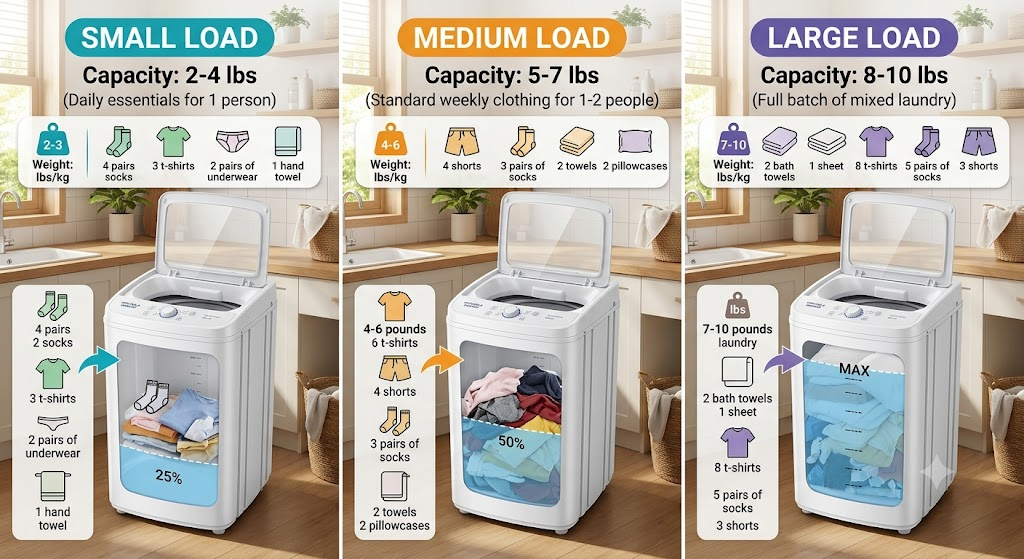
Don’t choose capacity only by the advertised number. Think about the laundry you actually wash.
1. Small Portable Washers
Generally around 0.8–0.9 cu. ft.
Best for:
- One person
- T-shirts
- Underwear
- Lightweight pants
- Small towel loads
- Frequent small loads
2. Medium Portable Washers
Around 1.3–1.6 cu. ft.
Best for:
- Couples
- Jeans
- Towels
- Regular weekly laundry
- Larger clothing loads
3. Larger Portable Washers
Around 2 cu. ft. and above.
Best for:
- Larger households
- More laundry per cycle
- People trying to reduce cycle count
What Can You Wash in a Portable Washer?
| Laundry Type | Key Consideration |
|---|---|
| T-shirts | Most portable washers can handle T-shirts, provided you don’t overload the tub. |
| Jeans | Medium-size washers are preferable because denim becomes heavier when wet. |
| Towels | Small washers can wash towels, but they quickly use up available capacity because towels absorb water and become bulky. |
| Sheets | Capacity matters. A small 0.9-cu.-ft. machine may handle individual sheets better than a complete bedding set. |
| Blankets | Don’t rely only on advertised pound capacity. Bulky blankets and comforters also require enough drum volume. |
| Baby Clothes | Small portable washers are well suited to frequent, small loads of baby clothing. |
| Pet Bedding | Check the manufacturer’s capacity guidance and the bedding’s care instructions. Clean the lint filter regularly to manage pet hair. |
Can a Portable Washer Wash Bed Sheets?
Yes, but whether it can wash an entire sheet set comfortably depends on drum size.A 1.6-cu.-ft. machine is more suitable than a 0.8-cu.-ft. model for larger bedding loads.
Can It Wash Blankets?
Sometimes. A lightweight blanket may fit, while a bulky comforter may not. If frequent bedding washing is a major requirement, consider a larger compact washer instead.
Can It Wash Towels?
Yes, but don’t overload a small drum with several thick towels. The wet weight and bulk can also increase imbalance during spin.
How Does a Portable Washing Machine Connect to a Faucet?
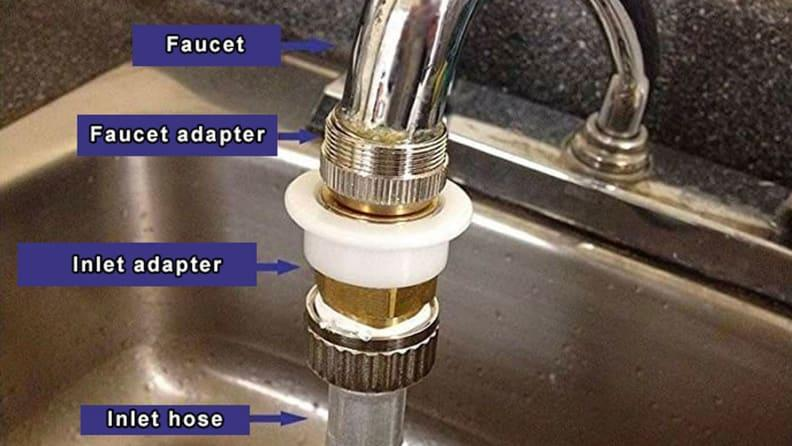
A portable washing machine typically connects to a suitable faucet through an inlet hose and faucet adapter or quick-connect system.
- Many apartment-friendly models are designed around kitchen or bathroom sink connections.
- Faucet design matters. A threaded faucet may accept an adapter more easily than a pull-down or proprietary faucet.
- Never force an adapter onto a faucet simply because it appears close to the correct size.
Check these items before buying:
- Faucet thread type
- Faucet aerator design
- Included adapter
- Inlet hose connection
- Water pressure requirements
- Hot/cold water requirements
- Sink clearance
- Drain location
What If Your Faucet Isn’t Compatible?
You have three choices:
- Use a compatible faucet adapter.
- Install a dedicated washer hookup.
- Choose a machine designed for manual filling.
Never force an incompatible adapter onto a faucet. A leak at the faucet can cause far more damage than the washer costs.
Where Does a Portable Washing Machine Drain?
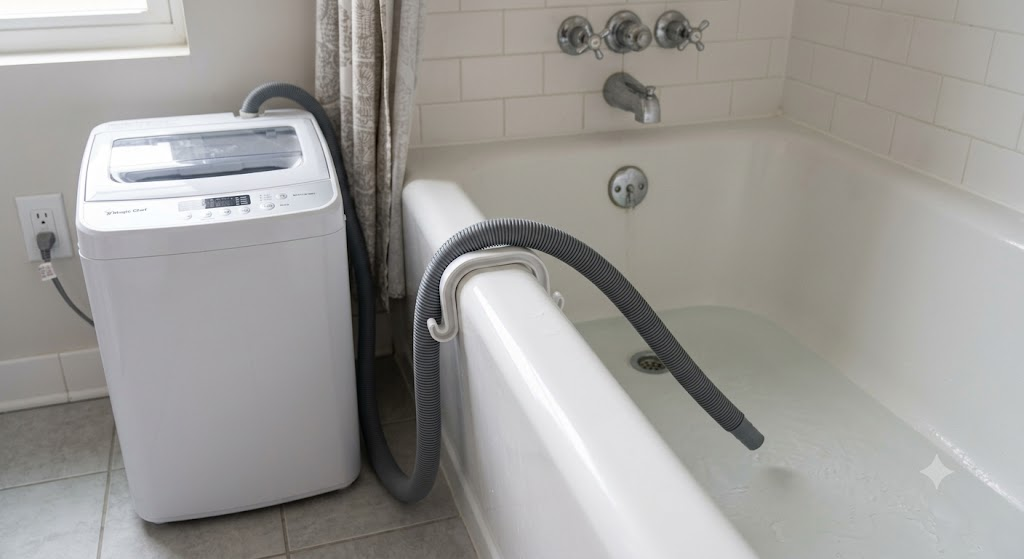
A portable washer needs somewhere to send wastewater. Possible locations include:
- Kitchen sink
- Bathroom sink
- Bathtub
- Utility sink
- Appropriate floor drain
- Dedicated standpipe
The drain hose should be secured so that water doesn’t jump out of the sink during draining.
Check:
- Hose length
- Hose position
- Drain opening
- Sink capacity
- Drain flow
- Whether the machine uses a pump or gravity drainage
How Well Does a Portable Washer Spin-Dry Clothes?
Most portable washing machines do not have a true heated tumble dryer, but many include a spin-dry function that removes excess water. It does not heat and evaporate moisture the way a clothes dryer does.
- A spin cycle uses centrifugal force to push water out of clothing. It does not heat the clothes and evaporate the remaining moisture like a conventional electric dryer.
- win-tub washers commonly include a separate spinner. Current product guides specifically identify separate wash and spin tubs as one of the defining features of this category.
- After spinning, clothes usually need to air dry unless you have a separate dryer.
Typical workflow:
Wash → Drain → Rinse → Spin → Air dry
If you’re specifically looking for a portable washer and dryer, don’t assume a washer with a spin basket qualifies as a dryer.
How Loud Are Portable Washing Machines?
Noise isn’t just about the motor. The bigger problem is often vibration. A portable washer can be perfectly acceptable during washing but become noticeably louder during high-speed spinning.
This matters if you:
- Live upstairs
- Have hardwood floors
- Have downstairs neighbors
- Run laundry at night
- Place the machine on tile
- Have an uneven floor
How to reduce vibration
- Level the machine.
- Distribute clothes evenly.
- Don’t overload the tub.
- Use an appropriate anti-vibration mat if permitted.
- Don’t operate the machine on an unstable surface.
Owner discussions about portable washers frequently mention vibration during spin, even when the machine isn’t actually malfunctioning. Don’t blindly trust a manufacturer’s “quiet” label. Real-world noise depends heavily on the floor and load.
What Electrical Setup Does a Portable Washer Need?
A portable washer needs a safe electrical connection that matches the manufacturer’s voltage, grounding, and power requirements.
- Never assume that a small machine can safely run from any extension cord or power strip.
- Manufacturer specifications can differ substantially. For example, GE lists the GNW128PSMWW at 120 volts, 60 Hz, and 1,200 watts, with a 15- or 20-amp circuit requirement.
- Some much smaller portable machines consume considerably less power. The difference matters for RVs, generators, and solar setups.
Always follow the electrical instructions for your exact model. Do not assume a portable washer can safely share a power strip with other appliances.
How Much Does a Portable Washing Machine Cost?
Prices change constantly, particularly on Amazon and during seasonal sales. A useful general framework is:
| Price Range | Typical Position |
|---|---|
| Under $100 | Basic manual/very small machines |
| $100–$150 | Entry-level portable washers |
| $150–$250 | Better compact machines and twin tubs |
| $250+ | Larger automatic portable/compact models |
However, don’t use price alone to judge value.
A $100 washer that lasts a year and has poor parts availability may be worse value than a $250 machine supported by a manufacturer with accessible documentation and replacement parts.
How Much Does a Portable Washer Cost to Run?
Running cost depends on:
- Electricity consumption
- Water consumption
- Detergent
- Number of loads
- Drying method
- Local utility rates
The washer itself may use relatively little electricity compared with a heated clothes dryer, but drying can dominate laundry energy costs. Before buying, it’s also worth checking the Portable Washer Installation Cost to understand the potential setup expenses.
Air drying after the spin cycle can reduce energy use considerably compared with electric tumble drying.
For a meaningful comparison, calculate:
Cost per load = electricity + water + detergent + drying
Then compare that with your local laundromat cost. If running cost matters, see how much electricity a portable washing machine uses and what affects the cost per load.
Portable Washing Machines for Different Situations
- Best Portable Washer for Apartments: BLACK+DECKER BPWM16W
- Best Portable Washer for RVs: BLACK+DECKER BPWM16W or COMFEE’ 0.9 Cu. Ft.
- Best Portable Washer for Dorms: COMFEE’ 0.9 Cu. Ft.
- Best Portable Washer for One Person: COMFEE’ 0.9 Cu. Ft.
- Best Portable Washer for Couples: BLACK+DECKER BPWM16W or COMFEE’ 0.9 Cu. Ft.
- Best Portable Washer for Tiny Homes: Giantex 7.7-lb. Full Automatic
- Best Portable Washer for Small Spaces: COMFEE’ 0.9 Cu. Ft.
- Best Portable Washer for Off-Grid Living: Manual washer
Read next: Best Portable Washing Machine for Apartments
Portable Washing Machine vs. Full-Size Washer
| Feature | Portable Washer | Full-Size Washer |
|---|---|---|
| Capacity | Small–medium | Large |
| Installation | Usually simpler | Permanent |
| Portability | High | Very low |
| Space | Low–medium | High |
| Large bedding | Limited | Much better |
| Convenience | Good to moderate | Excellent |
| Laundry volume | Small–medium | Medium–large |
| Storage | Possible | Usually permanent |
| Best for | Renters/small spaces | Families |
Choose Portable If…
- You rent.
- You have limited space.
- You lack permanent hookups.
- You wash relatively small loads.
- You live in an RV.
- You want to avoid frequent laundromat trips.
Choose Full-Size If…
- You have a large family.
- You frequently wash bulky bedding.
- You want fewer loads.
- You want maximum automation.
- You already have appropriate hookups.
Are Portable Washing Machines Worth It?
For the right person, absolutely. But they’re not universally better.
Worth It If:
- You’re an apartment renter.
- Laundromat trips are expensive or inconvenient.
- You have limited space.
- You wash small loads.
- You live in an RV.
- You don’t have permanent washer hookups.
- You can safely connect and drain the machine.
Probably Not Worth It If:
- You have a large household.
- You frequently wash comforters.
- You need large loads.
- You want built-in tumble drying.
- You already have convenient laundry access.
The biggest benefit isn’t necessarily lower electricity use.
It’s convenience. Being able to wash five shirts at home instead of carrying them to a laundromat can be more valuable than saving a few cents on electricity.
If you’re still deciding whether one is right for you, read our guide on Are Portable Washing Machines Worth It?
How to Install a Portable Washing Machine
Before connecting your machine, follow our detailed portable washing machine installation guide. The exact installation varies by model, but the basic process is:
- Choose a stable, level location.
- Check your faucet connection.
- Connect the inlet hose.
- Attach the appropriate faucet adapter.
- Position the drain hose securely.
- Connect the washer to a suitable grounded outlet.
- Turn on the water.
- Check every connection for leaks.
- Run an empty test cycle.
Don’t skip the leak test. A portable washer that leaks for five minutes while unattended can cause far more damage than the machine’s purchase price.
How to Use a Portable Washing Machine
The basic workflow is:
Load → Add detergent → Fill → Wash → Drain → Spin → Dry
Fully automatic models handle most of those stages themselves. Twin-tub machines require more intervention:
Load wash tub → Wash → Transfer clothes → Spin → Air dry
Always follow the manual for detergent quantity, load size and water level.
Portable Washing Machine Maintenance
A portable washer still needs maintenance.
- Clean the tub: Residue and moisture can produce odors.
- Clean the lint filter: A clogged filter can affect drainage and leave lint on clothes.
- Inspect hoses: Check inlet and drain hoses for cracks, loose connections and deterioration.
- Remove detergent residue: Using too much detergent can create buildup.
- Prevent mold: Leave the lid open after use where the manufacturer’s instructions permit it.
- Keep the machine dry: If you’re storing the machine, drain remaining water and allow it to dry.
Common Portable Washing Machine Problems
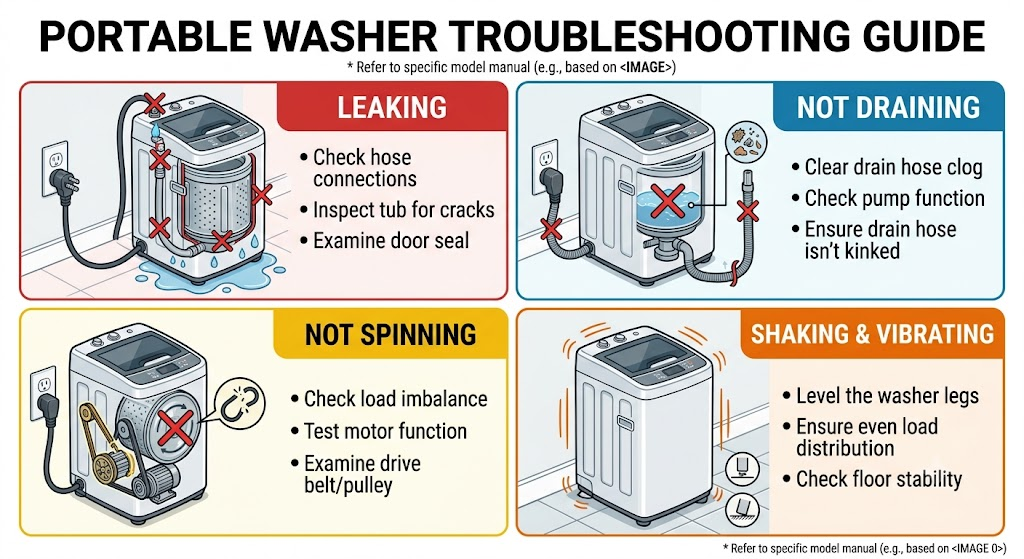
| Problem | Likely Cause | Detailed Guide |
|---|---|---|
| Not filling | Water supply or inlet hose | Portable Washer Not Filling With Water |
| Not draining | Blocked/kinked drain hose or pump | Portable Washer Not Draining |
| Not spinning | Unbalanced/overloaded load | Portable Washer Not Spinning |
| Leaking | Hose, adapter or internal leak | Portable Washer Leaking Water |
| Shaking | Uneven load or floor | Portable Washer Shaking |
| Loud noise | Load imbalance/vibration | Portable Washer Making Noise |
| Stops mid-cycle | Overload, electrical or control issue | Portable Washer Stops Mid-Cycle |
| Bad smell | Moisture or residue | How to Clean a Portable Washer |
Many of these problems are not unique to one brand. For example, COMFEE’s manuals identify unbalanced loads, blocked drain hoses and hose connections as common troubleshooting points.
What to Check Before Buying an Unknown Portable Washer Brand
This is where bargain hunting can go wrong. Before buying an unfamiliar machine, check:
- Manufacturer identity
- U.S. customer support
- Warranty
- Return policy
- Owner’s manual
- Replacement hoses
- Drain pumps
- Filters
- Faucet adapters
- Replacement parts
- Long-term customer complaints
A cheap washer isn’t cheap if a minor hose or pump failure means throwing the entire machine away.
Portable Washing Machine Buying Checklist
Before ordering, check all of these:
- Measure available space
- Measure storage space
- Check faucet compatibility
- Check drain location
- Check drain-hose length
- Check electrical requirements
- Choose automatic or twin-tub
- Choose capacity
- Check spin performance
- Consider noise and vibration
- Check warranty
- Check replacement parts
- Check apartment/RV restrictions
- Decide how you’ll dry clothes
The drying plan is particularly important.
Buying a washer without knowing where wet clothes will go is an incomplete laundry solution. You may also need a faucet adapter, drain-hose support or anti-vibration mat; see our portable washer accessories guide.
Which Portable Washing Machine Should You Buy?
Use this decision process:
Do you want automatic operation?
→ YES: Choose a fully automatic washer.
→ NO: Consider a twin-tub or manual washer.
Do you have a compatible faucet?
→ YES: Use a standard faucet connection.
→ NO: Look for a manual-fill model or install a suitable hookup.
How much laundry do you wash?
→ Small: 0.8–0.9 cu. ft.
→ Medium: 1.3–1.6 cu. ft.
→ Large: 2.0+ cu. ft.
How much space do you have?
→ Extremely limited: Giantex 7.7-lb. or COMFEE’ 0.9 cu. ft.
→ Moderate: BLACK+DECKER 1.6 cu. ft. or COMFEE’ 1.6 cu. ft.
→ More space: GE 2.8 cu. ft.
Do you want a separate spinner?
→ YES: Giantex twin-tub.
→ NO: Choose a fully automatic machine.
FAQs
Are portable washing machines worth buying?
Yes, if you live in a small space, rent, use an RV, lack permanent hookups or want to reduce laundromat trips. They are less attractive for large households or people who regularly wash bulky bedding.
Do portable washers need hookups?
Many use a temporary faucet connection, but the exact requirement depends on the model. Some can be manually filled.
Can a portable washer connect to a kitchen sink?
Often yes. GE, BLACK+DECKER and COMFEE’ all offer portable models designed around sink or temporary connections.
Your faucet still needs to be compatible.
Can you use a portable washer without hookups?
Some models allow manual filling, while others require an inlet connection. Check the individual model.
Can portable washers wash blankets?
Some can wash lightweight blankets, but small portable machines are generally poor choices for bulky comforters. Check the manufacturer’s load guidance.
Can portable washers wash sheets?
Yes. The larger the drum, the easier it is to wash a complete sheet set without overloading.
Do portable washing machines have dryers?
Most have spin drying, not heated tumble drying.
A twin-tub machine may have a dedicated spinner. A few product packages combine a washer with a separate portable clothes dryer.
How long do portable washing machines last?
There is no reliable universal lifespan because quality varies dramatically between manufacturers and models.
Maintenance, load size, frequency of use, water quality, storage and product construction all matter.
How much electricity does a portable washer use?
It depends on the model, cycle, water temperature and usage pattern. Check the manufacturer’s electrical specifications rather than relying on generic “energy saving” claims.
Are portable washing machines allowed in apartments?
Not necessarily.
Check your lease and building rules before purchasing. Water damage is one reason landlords may restrict them.
Do portable washers need hot water?
Not always. Some models are designed for cold-water operation, while others provide hot/warm/cold temperature selections.
The COMFEE’ CLV09N1AMG manual specifically instructs users connecting to a single faucet to run cold-water washes.
Can you leave a portable washer connected to a faucet?
Don’t assume you should.
Follow the manufacturer’s instructions and your building’s plumbing requirements. If the connection is temporary, many users disconnect and store the hose after use.
Are portable washing machines safe to use?
They can be, provided they are installed and operated according to the manufacturer’s instructions. The major practical risks are water leaks, improper drainage, electrical misuse, unstable placement and overloaded loads.
Final Verdict
There isn’t one universally best portable washing machine. The right choice depends on space, laundry volume, hookup situation, portability requirements and how you plan to dry clothes.
Best Overall: BLACK+DECKER BPWM16W
The 1.6-cu.-ft. capacity, automatic operation, six programs, sink connection and mobility features make it the strongest all-around choice for many apartment and RV users.
Best Compact: COMFEE’ CLV09N1AMG
Choose it when floor space is your biggest constraint.
Best Apartment: BLACK+DECKER BPWM16W
Its capacity is a better fit for regular apartment laundry than most ultra-compact machines.
Best Large Capacity: GE GNW128PSMWW
Choose it if your priority is minimizing the number of loads rather than minimizing machine size. Its 2.8-cu.-ft. capacity is the standout feature.
Best Twin-Tub: Giantex 17.6-Lb.
A good option for buyers willing to manually transfer laundry between wash and spin tubs.
Best for One Person: COMFEE’ 0.9 Cu. Ft.
Its compact footprint makes more sense for frequent small loads than for large weekly laundry sessions.
Best Compact Automatic: Giantex 7.7-Lb.
A useful choice when every inch matters.
The most important lesson is simple: don’t buy a portable washer based only on capacity or price.
Before you order, answer five questions:
- Where will the washer sit?
- How will you connect the water?
- Where will wastewater drain?
- How much laundry will you wash per load?
- Where will the clothes dry afterward?
If those five questions have good answers, a portable washing machine can be a genuinely useful alternative to laundromat trips. If they don’t, even the highest-rated portable washer can become an expensive headache.
Recommended Reading:
- 10 Best Portable Washing Machines Under $100 in 2026
- Best Portable Washing Machine Under $200 (2026)
- 9 Best Portable Washer for Small Spaces (2026)
- 10 Best Portable Washing Machine for Camping
- 10 Best Portable Washer for Dorm Rooms in 2026

Sourabh researches and writes about home appliances, kitchen gadgets, and common appliance problems to help readers make smarter buying decisions. He specializes in Portable washing machines and appliance troubleshooting guides.
At compactHomeHub, Sourabh focuses on creating easy-to-understand content that simplifies technical appliance issues into practical solutions. His goal is to help users save time, avoid costly mistakes, and choose the right appliances with confidence.
1 thought on “10 Best Portable Washing Machine: The Definitive Guide to the Best Washers for Apartments, RVs & Small Spaces”
Comments are closed.