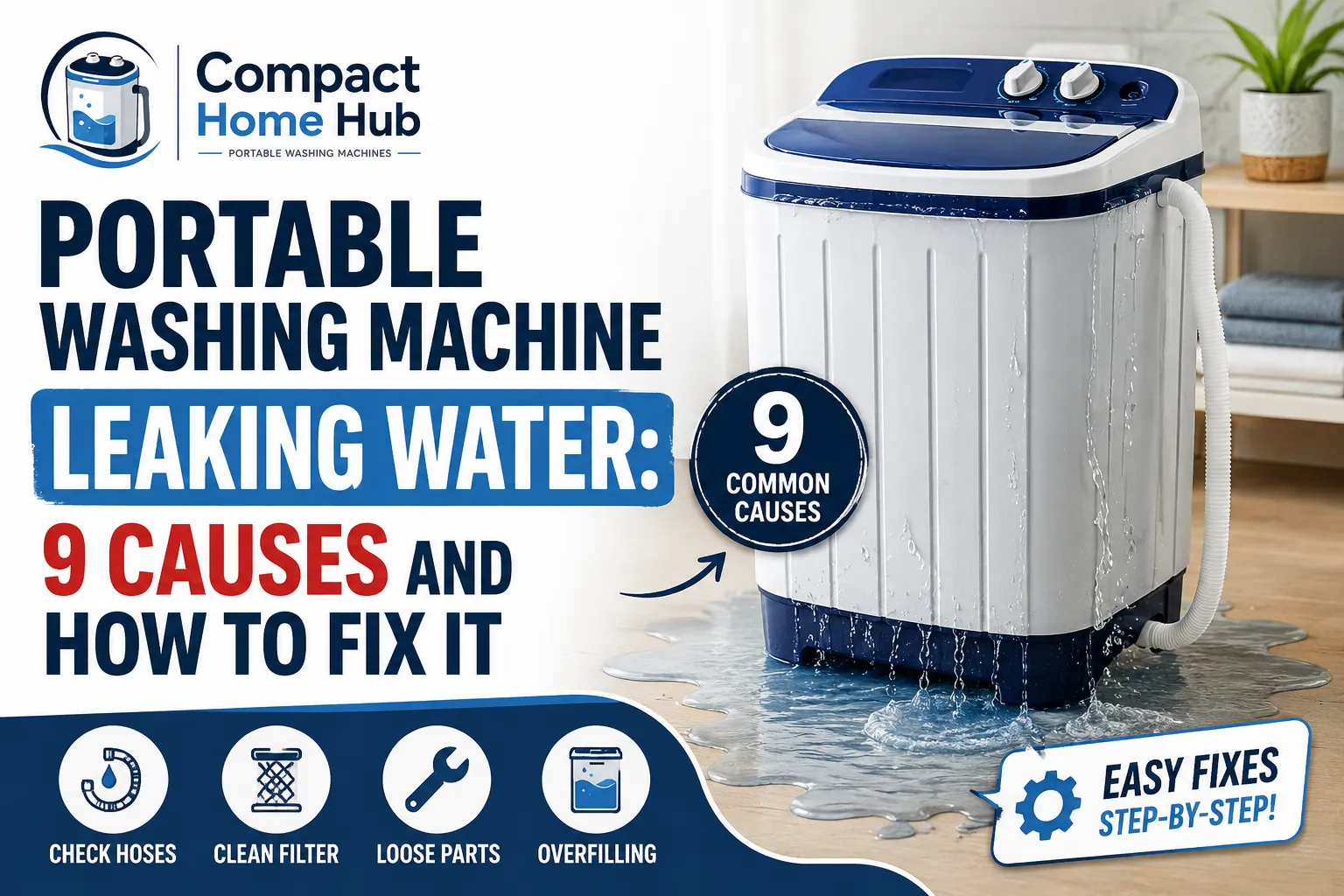
A portable washing machine can save space, money, and a trip to the laundromat. But when you find a puddle under it, the convenience disappears pretty quickly. The good news is that a leaking portable washer doesn’t automatically mean the machine is ruined. In many cases, the problem is a loose hose, poor drain setup, too much detergent, an overloaded tub, or a washer that’s sitting unevenly.
In this guide, you’ll learn how to find where the water is coming from, what the timing of the leak tells you, which problems you can safely fix yourself, and when it’s smarter to stop troubleshooting and call for service.
Why Is My Portable Washing Machine Leaking Water?
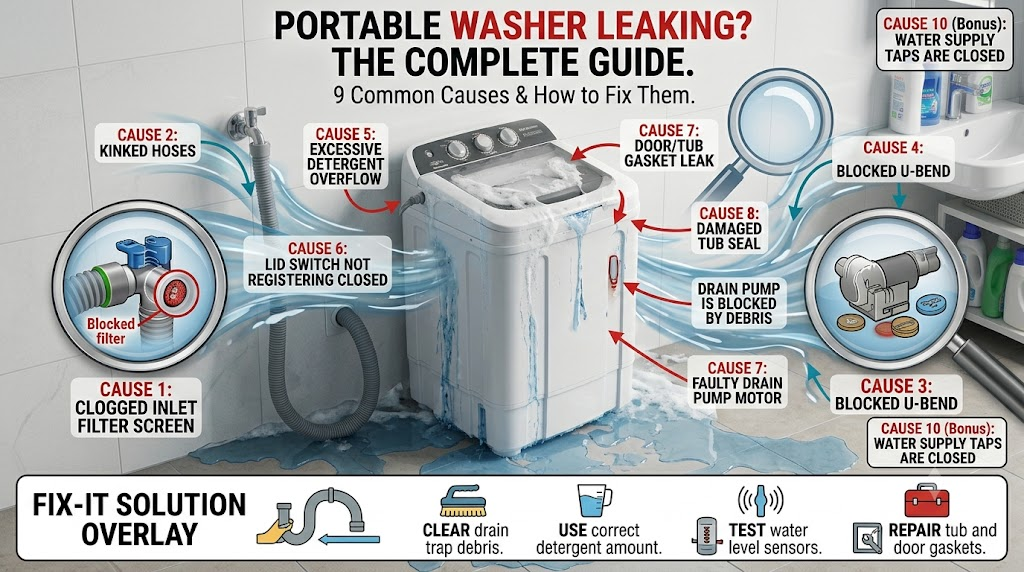
A portable washing machine leaking water is usually caused by one of these problems:
- A loose or damaged water inlet hose
- A drain hose that’s loose, kinked, cracked, clogged, or incorrectly positioned
- A clogged household sink or drain
- Too much detergent or the wrong detergent
- An overloaded or uneven load
- The washer isn’t level and vibrates excessively
- Water splashing over the tub because of bulky clothing
- A leaking internal hose, drain pump, or tub seal
- An inlet valve that continues allowing water into the machine when it’s turned off
The fastest way to identify the cause is to note when the leak happens. If water appears as soon as you turn on the faucet, check the inlet connection. If it appears when the machine drains, start with the drain hose and household drain. If it leaks only during spin, vibration, an unbalanced load, or an internal hose problem becomes more likely.
Before checking anything, stop the washer, unplug it, turn off the water supply, and clean up standing water. Don’t reach around electrical connections while the floor or machine is wet.
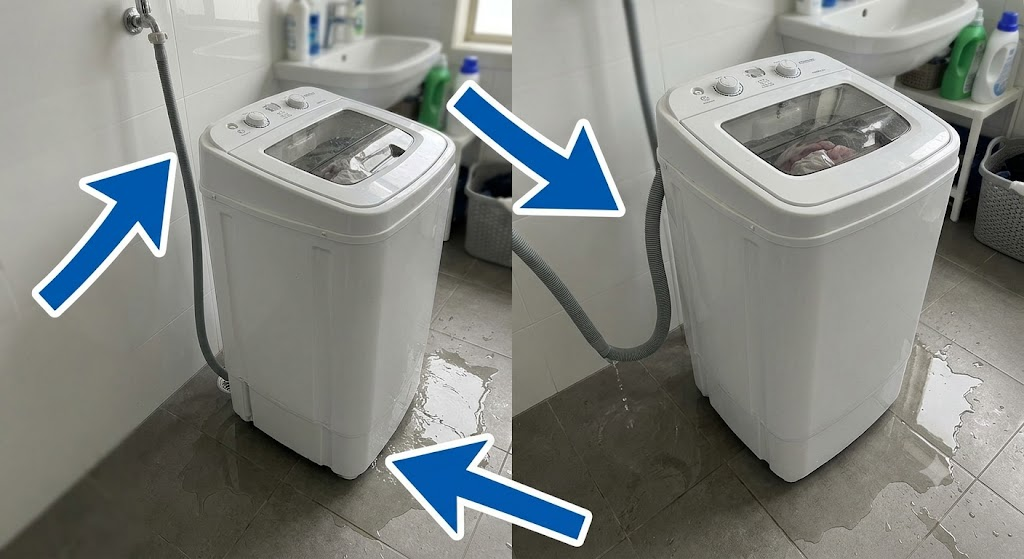
Portable Washing Machine Leaking Water
Here are the 9 different reason why Portable Washing Machine Leaking Water:
1. Start by Finding Where the Water Is Coming From
Don’t immediately assume the washer itself is leaking. Portable washers usually sit close to a kitchen or bathroom sink, so water from the faucet connection, drain hose, sink, or plumbing can end up underneath the machine and make the washer look guilty.
Dry the floor and the outside of the machine completely. Then reconnect everything carefully and run a short test with no clothes.
Watch these areas:
- At the faucet: suspect the inlet hose or faucet adapter.
- Behind the washer: inspect the drain hose and connections.
- Inside or around the tub: look for splashing or excessive suds.
- Under the washer: suspect an internal hose, pump, seal, or water that has traveled down from above.
- Near the sink drain: check whether the household drain is backing up.
This simple test can save you from replacing a perfectly good portable washer.
2. Check the Water Inlet Hose and Faucet Adapter
The inlet connection is one of the first things to inspect, especially if water starts leaking immediately after you turn on the faucet. Check both ends of the hose.
Look for:
- A loose connection
- A damaged rubber washer or gasket
- A cracked hose
- A poorly fitted faucet adapter
- Cross-threading
- Water dripping from the faucet connection itself
Don’t solve every leak by simply tightening the connection as hard as possible. That’s a good way to damage plastic threads or a gasket.
Disconnect the hose, inspect the rubber washer, make sure it sits flat, and reconnect it according to your washer’s instructions.
Some portable washers use different connectors at the faucet and machine ends. Haier specifically warns that reversing its hose connectors can cause a leak.
Quick test: Turn the faucet on while the washer is off. If water starts dripping before the wash cycle begins, the inlet connection or washer’s water inlet system deserves your attention.
3. Inspect the Drain Hose: Especially If It Leaks During Draining
If the portable washing machine leaks water when it starts pumping out dirty water, the drain system should be your first suspect.
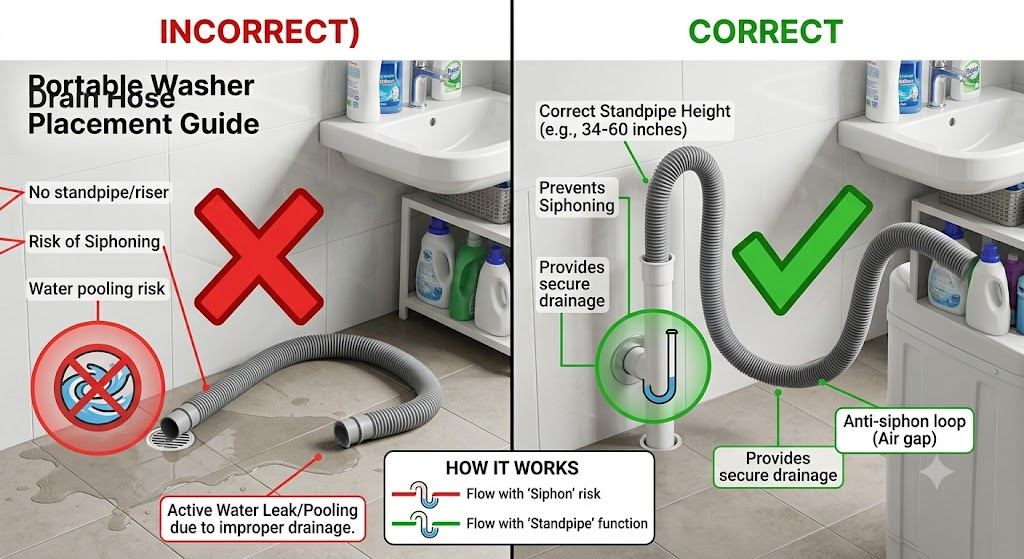
The washer can pump out a surprising amount of water in a short time. If the drain hose is loose or the household drain can’t accept the flow quickly enough, water can end up on the floor. Check whether the drain hose is:
- Fully inserted or secured according to the manual
- Kinked
- Crushed behind the machine
- Cracked or split
- Loose at the washer connection
- Falling out of the sink or drain
- Connected to an obstructed drain
LG notes that a loose drain hose or clogged drainpipe can cause water to overflow during draining. If you’re unsure whether your current hose and drain setup is correct, our guide on how to use a portable washing machine walks through the setup process.
Don’t ignore the household drain
Here’s a common mistake: you see water on the floor and assume the washer is leaking. It might actually be your sink or drain backing up.
Try pouring water into the drain separately. If the drain backs up or drains unusually slowly, the portable washer may simply be exposing a plumbing problem that was already there.
Example: Your washer drains 5 gallons of water quickly, but the kitchen drain can only handle a much slower flow because of a partial clog. The water rises and spills onto the counter or floor. The washer gets blamed even though the plumbing is the real problem.
4. Too Much Detergent Can Cause a Leak
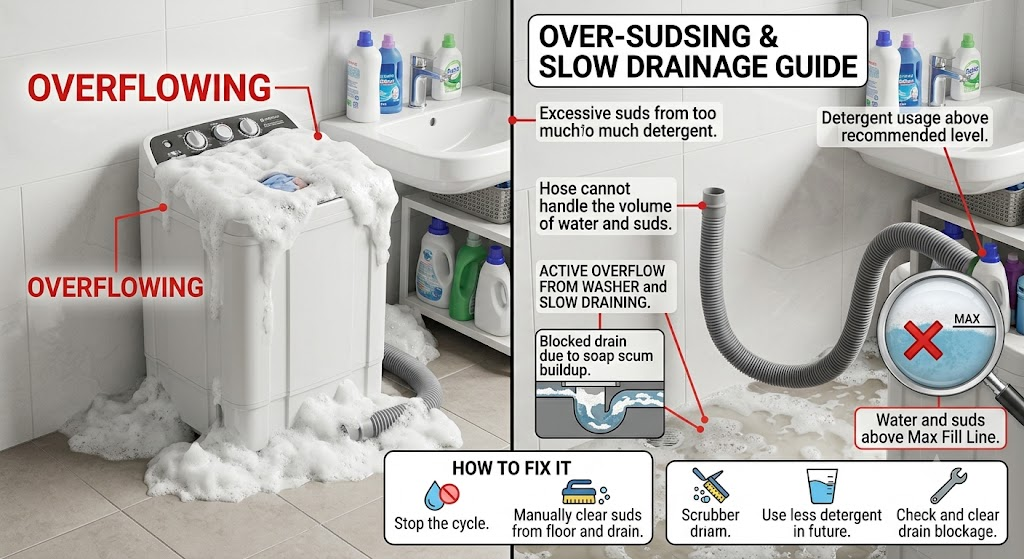
More detergent doesn’t necessarily mean cleaner clothes. In a small portable washer, excessive detergent can create a mountain of suds. Those suds can rise, splash, or escape around areas that normally wouldn’t see much water.
Haier recommends HE detergent for portable washers and warns that excessive detergent can create excessive sudsing and leaks. TCL similarly recommends low-sudsing, high-efficiency detergent and warns that regular detergent can create excessive suds.
Use the detergent type and amount specified in your washer’s manual.
If your floor is covered in soapy water rather than plain water, excessive suds should move much higher on your suspect list.
5. Don’t Overload the Portable Washer
Portable washers have smaller tubs than full-size machines. That means a load that looks perfectly reasonable beside a full-size washer may be too much for your portable unit. Bulky items are especially problematic.
Examples include:
- Comforters
- Heavy blankets
- Large towels
- Thick hoodies
- Multiple pairs of heavy jeans
An overloaded tub can cause clothes to move poorly, create excessive splashing, and produce an unbalanced spin. Haier specifically advises against overloading its portable washers and warns against washing large bulky items such as comforters.
A simple test
Run the machine empty.
If it doesn’t leak empty but leaks when you add a particular load, the problem may be related to load size, balance, or splashing rather than a broken water line. That’s a much better clue than randomly replacing parts.
6. Make Sure the Washer Is Level
A portable washing machine doesn’t need to look like a precision laboratory instrument, but it shouldn’t wobble around like one either. An uneven machine can move excessively during the spin cycle. That movement can:
- Pull on hose connections
- Move the drain hose
- Increase splashing
- Shift the machine away from its normal position
- Make an already loose connection leak
Haier also lists leveling as one of the basic checks for a leaking portable washer. Put the machine on a firm, stable surface and check whether it rocks when you gently push opposite corners. If it moves, correct the setup according to the manufacturer’s instructions.
7. Portable Washing Machine Leaking Only During the Spin Cycle
This symptom is particularly useful. If the washer fills normally and washes normally but starts leaking during spin, don’t automatically assume the tub has a hole. Start with the simple possibilities:
- Stop the machine and check whether the load is badly unbalanced.
- Reduce the load.
- Check whether the washer is level.
- Inspect the drain hose and connections.
- Check whether vibration has moved the drain hose.
- Look for water coming from underneath rather than from the tub.
- If the leak continues with an empty load, consider an internal hose, pump, or seal problem.
A leak that appears only under heavy vibration is a strong reason to inspect connections and the machine’s stability before taking it apart.
8. What If the Portable Washer Leaks From the Bottom?
Water under the machine is the most annoying type of leak because you can’t immediately see the source. Don’t start opening the cabinet just because the puddle is underneath.
Water can travel from a higher point and collect at the bottom, making the actual source appear somewhere else. If the machine is leaking from underneath, check the following in order:
First: inlet and drain hose connections.
Second: household drain overflow.
Third: excessive suds or water splashing from the tub.
Fourth: signs of an internal hose or pump leak.
Fifth: a possible tub or internal seal problem.
Whirlpool identifies damaged pumps, cracked or loose drain pipes, and faulty tub seals as possible causes of leaks from the bottom of a washer. Those components are generally inside the appliance and may require professional service.
For a portable washer, the exact construction varies significantly by model, so don’t assume every machine has the same internal parts or access points.
9. Is Your Portable Washing Machine Leaking Because It Isn’t Draining?
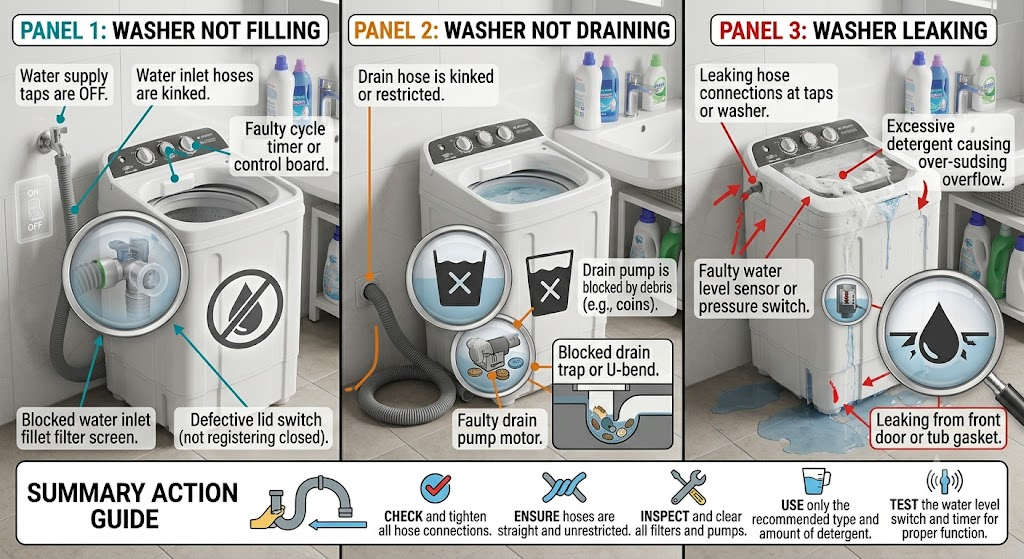
There’s an important connection between leaking and draining problems. If your washer isn’t removing water properly, you may also notice:
- Water remaining in the tub
- A slow drain
- Water coming back out of the drain connection
- The pump running but little water leaving the hose
- A leak that becomes worse during the drain cycle
This is where Portable Washing Machine Not Filling with Water can become a related troubleshooting topic, but don’t confuse the two problems.
If your machine isn’t filling, investigate the faucet, inlet hose, water supply, inlet filter, and water inlet system. If it fills but won’t drain, investigate the drain hose, drain connection, pump, and possible blockage. If it drains but leaks, focus on the drain hose, drain connection, household plumbing, and internal leaks. Keeping those symptoms separate makes troubleshooting much faster.
If your portable washer fills normally but won’t remove the water, start with this guide to troubleshoot a portable washing machine that isn’t draining.
10. What If It Leaks When the Washer Is Turned Off?
This is an important clue. If water continues entering the washer even when the wash cycle isn’t running, don’t treat it as a normal hose leak.
A washing machine’s inlet valve controls water entering the tub. Whirlpool notes that water dripping into a washer while it is turned off can indicate an issue with the inlet valve. For a portable washer, the safest immediate action is to turn off the faucet supplying the machine.
If water continues appearing inside the tub with the washer off and the faucet on, contact the manufacturer or a qualified appliance technician rather than repeatedly running the machine.
11. Check for a Clogged Drain or Filter
A restriction in the drain system can cause water to back up. Depending on the portable washer model, there may be a lint filter, drain filter, or other removable component that needs cleaning.
Look for:
- Lint
- Hair
- Small pieces of fabric
- Coins
- Paper
- Other objects left in pockets
Don’t blindly remove a filter while the machine is full of water. Have towels and a container ready, and follow the manufacturer’s instructions for draining residual water. A blocked filter can cause leaks during draining on washing machines, according to Whirlpool’s troubleshooting guidance.
12. A Quick 10-Minute Leak Test
If you’re still unsure what’s happening, don’t guess. Run a controlled test.
- Empty the washer: Remove all clothes.
- Dry everything: Dry the floor, hoses, and outside of the machine.
- Check the inlet: Turn on the faucet without starting the washer. Look carefully for drips.
- Run a short wash: Use no detergent and no clothes. Watch the machine while it fills.
- Watch the drain: Stay beside the machine when it begins draining. Look at the drain hose and household drain.
- Watch the spin: If there’s no leak during filling or draining, observe the spin cycle.
- Check the floor: After the cycle, inspect underneath the washer and around the hose connections. This test gives you something much more valuable than a random list of possible causes: a pattern.
When Should You Stop DIY Troubleshooting?
Some leaks aren’t worth chasing with a screwdriver.Stop using the machine and seek professional help if:
- Water is reaching electrical components.
- You smell burning or overheated plastic.
- The machine trips a circuit breaker.
- Water is coming from inside the cabinet.
- The tub or internal hose appears damaged.
- The washer makes grinding or unusual mechanical noises.
- The leak continues after external hoses and drainage have been checked.
- The machine is still under warranty.
Don’t open a new portable washer and start replacing internal parts before checking the warranty. You could turn a warranty claim into an unnecessary repair bill.
Portable Washing Machine Leaking Water: Quick Diagnosis Table
| When it leaks | Most likely causes | What to check first |
|---|---|---|
| Immediately after faucet is turned on | Inlet hose, faucet adapter, gasket | Both hose connections |
| During filling | Inlet connection, excessive water, splashing | Faucet, hose, tub |
| During washing | Suds, overload, splashing | Detergent and load |
| During draining | Drain hose, clogged drain, pump | Drain hose and household drain |
| During spin only | Unbalanced load, vibration, loose connection | Load balance and leveling |
| From underneath | Internal hose, pump, tub/seal, water traveling from above | External connections first |
| When washer is turned off | Inlet valve or hose connection | Turn off faucet and inspect inlet |
| Only with bulky clothes | Overloading or splashing | Reduce load |
How to Prevent Your Portable Washer From Leaking Again
Once you’ve fixed the problem, prevention is much easier than dealing with another puddle.
- Use the correct detergent
- Don’t stuff the tub
- Inspect hoses regularly
- Keep the drain hose secure
- Keep the machine level
- Don’t ignore small drips
- Turn off the water supply when appropriate
For apartment users, proper hose and drain setup matters even more because a small leak can quickly damage flooring or cabinets.
FAQs
Q. Why is my portable washing machine leaking from the bottom?
The water may be coming from a drain hose connection, internal hose, pump, tub seal, or water that has traveled down from a higher point. Check the external hoses and drain first before assuming an internal failure.
Q. Why does my portable washer leak when draining?
The drain hose may be loose, kinked, damaged, or incorrectly positioned. Your household drain may also be partially clogged and unable to handle the washer’s discharge rate.
Q. Can too much detergent make a portable washer leak?
Yes. Excessive detergent can create too many suds, which may cause water or sudsy foam to escape from the wash area. HE or low-sudsing detergent is commonly recommended for compatible machines.
Q. Can an overloaded portable washer leak?
Yes. An overloaded or bulky load can increase splashing and create an unbalanced spin. Try an empty cycle or a smaller load to see whether the leak disappears.
Q. Why is my portable washer leaking only during spin?
An unbalanced load or excessive vibration is a good place to start. Check the load, level the machine, and inspect the drain and inlet connections for movement or looseness.
Q. Why is my portable washer leaking even when it’s turned off?
If water is entering the tub while the machine isn’t running, the water inlet system may have a problem. Turn off the faucet and consult the owner’s manual or manufacturer support.
Q. Should I keep using a portable washer that leaks?
No, not until you know where the water is coming from. A small hose leak is one thing; an internal leak near electrical components is another. Continuing to run a leaking appliance can turn a minor repair into water or electrical damage.
Final Takeaway
A portable washing machine leaking water isn’t automatically a sign that you need a new washer.
Start with the boring stuff because the boring stuff is often the answer: check the inlet hose, drain hose, household drain, detergent, load size, and leveling.
Then use the timing of the leak to narrow things down. Leaks during filling point toward the water supply. Leaks during draining point toward the drain system. Leaks during spin point toward load balance, vibration, or a connection that can’t handle the movement.
If the machine still leaks after those checks, especially from inside the cabinet or around electrical components, stop using it and get professional help.
The goal isn’t to replace parts until something works. It’s to identify the actual source of the water first.
If your current machine keeps giving you problems and you’re considering a replacement, compare the best portable washers for small spaces before buying another one.
Recommended Reading:
- How to Fix Portable Washing Machine Vibration
- Portable Washing Machine Not Draining? 10 Ways to Fix It
- Portable Washing Machine Not Filling with Water? 10 Causes and Easy Fixes
- Portable Washing Machine Not Spinning? 10 Causes & Easy Fixes

Sourabh researches and writes about home appliances, kitchen gadgets, and common appliance problems to help readers make smarter buying decisions. He specializes in Portable washing machines and appliance troubleshooting guides.
At compactHomeHub, Sourabh focuses on creating easy-to-understand content that simplifies technical appliance issues into practical solutions. His goal is to help users save time, avoid costly mistakes, and choose the right appliances with confidence.