

A portable washing machine shouldn’t sound like it’s trying to escape your apartment.
A little movement during washing or spinning is normal, especially with lightweight portable washers. But if your machine is banging, rattling, walking across the floor, hitting the wall, or vibrating so hard that you can feel it through the floor, something needs attention.
The good news is that most portable washing machine vibration problems are caused by simple issues such as an uneven load, an unstable surface, incorrect positioning, or an overloaded spin tub. You usually don’t need to take the machine apart to fix them.
How to Fix Portable Washing Machine Vibration
Here are some common solutions to fix vibration problem in portable washing machine:
- Stop the washer when it starts shaking badly.
- Redistribute the clothes evenly inside the tub.
- Remove heavy items if they have clumped together.
- Reduce the load if the washer is overloaded.
- Place the washer on a hard, level floor.
- Check the washer feet and make sure they touch the floor firmly.
- Adjust the leveling feet if your model has them.
- Check shipping restraints if the washer is new.
- Remove packing material only as instructed in the manual.
- For a twin-tub washer, spread clothes evenly in the spin basket.
- Do not overload the spin basket.
- Make sure the washer doesn’t touch a wall, cabinet, sink, or furniture.
- Listen for grinding, scraping, squealing, or loud knocking.
- These sounds may indicate a damaged bearing, motor, or loose internal part.
- Call a repair professional if strong vibration continues after basic checks.
- An anti-vibration mat can reduce noise, but it won’t fix an unbalanced load or mechanical problem.
What Does the Vibration Look or Sound Like?
Before trying random fixes, pay attention to when and how the portable washer vibrates. The symptom often tells you where to look first.
1. The washer shakes only during the spin cycle
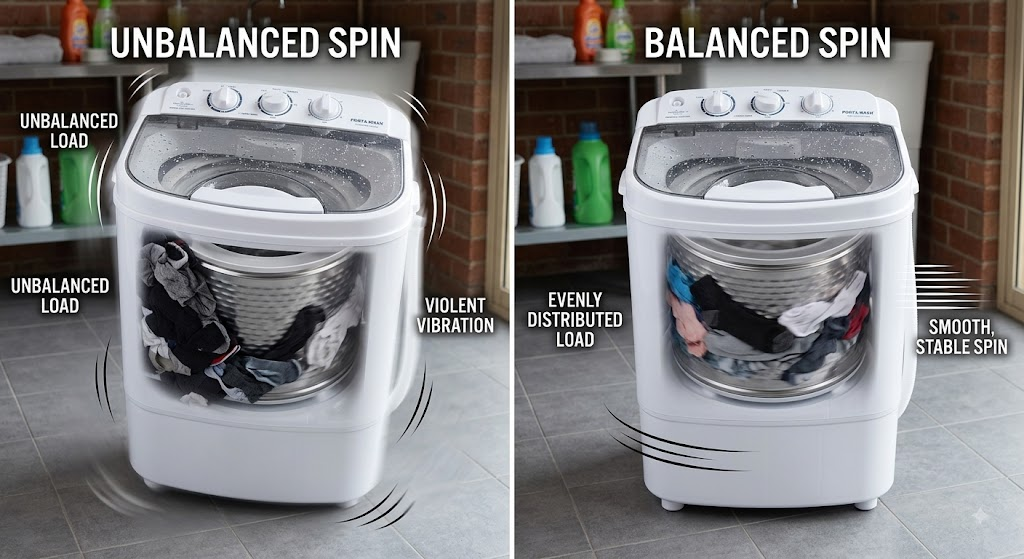
Likely cause: Unbalanced clothing, overloaded spin basket, or unstable placement.
Exact fix: Stop the washer, redistribute the clothes evenly, remove some items, and make sure the machine is sitting firmly on the floor.
A small amount of movement during a high-speed spin can be normal. However, a portable washer shouldn’t repeatedly slam against the floor or move several inches.
Whirlpool similarly identifies unbalanced loads, overloading, and leveling problems as common causes of excessive washer movement.
2. The washer makes a loud “bang-bang-bang”
Likely cause: Clothes have collected on one side of the tub.
This is particularly common with heavy towels, jeans, bath mats, blankets, and other absorbent items. Once these items become soaked, they can become much heavier and form one large lump.
Exact fix:
- Stop the washer.
- Wait until the tub or basket completely stops.
- Open the lid.
- Pull apart tangled clothes.
- Spread the clothes around the tub.
- Remove some heavy items if necessary.
- Restart the spin cycle.
Don’t keep running the washer while it’s violently banging. You’re turning a simple loading problem into unnecessary stress on the motor and other components.
3. The portable washer “walks” across the floor
Likely cause: The machine isn’t stable.
Portable washers are lighter than full-size washing machines. That’s convenient when you need to move one into a closet or apartment, but the lower weight also means the machine has less mass holding it in place during a fast spin.
Exact fix: Put the washer on a solid, level surface and make sure every foot or contact point sits firmly on the floor.
Avoid placing the washer on:
- Thick carpet
- Soft foam
- Uneven flooring
- A wobbly wooden platform
- An unstable rolling cart
- A surface that flexes when you stand on it
A hard, flat surface is usually the better choice.
Aosom’s portable washer installation guidance also recommends a stable, level surface and suggests anti-vibration mats as a way to reduce movement and noise.
4. The machine vibrates even when it’s empty
Likely cause: The problem probably isn’t the laundry load.
An empty washer that shakes badly deserves more attention because there are no clothes inside to create an imbalance.
Exact fix:
Check the following:
- Is the washer level?
- Are all feet firmly touching the floor?
- Is the cabinet rocking when you push it?
- Is anything underneath the washer?
- Is the washer touching a wall?
- Does the tub or spin basket wobble when turned by hand?
- Do you hear grinding or scraping?
If the tub itself appears loose or wobbles excessively, stop using the machine until you’ve checked the owner’s manual or contacted the manufacturer.
5. The washer vibrates when washing, not just spinning
Likely cause: Unstable placement, a loose component, or a problem with the agitator or wash mechanism.
Wash cycles generally create less movement than high-speed spin cycles. So if your portable washer shakes significantly while slowly agitating clothes, don’t automatically blame the laundry load.
Exact fix: Run the machine briefly with no clothes, if your owner’s manual permits an empty test cycle.
Watch the tub and listen carefully. If the machine remains stable when empty but vibrates with clothes, focus on loading and weight distribution. If it vibrates while empty, investigate the machine’s stability or mechanical components.
Why Portable Washing Machines Vibrate More Easily
A portable washer has a different design from a full-size residential washer. Many portable models are designed to be lightweight, compact, and easy to move. Some are twin-tub machines with separate wash and spin compartments, while others use a single tub. That creates a practical trade-off.
Less weight and a smaller footprint make the machine easier to store and move, but they also give it less resistance against movement during high-speed spinning.
That’s why correct placement matters so much. The goal isn’t necessarily to make the machine completely motionless. The goal is to prevent violent, repeated movement.
How to Fix an Unbalanced Load
This is the first thing I’d check because it’s cheap, fast, and extremely common.
Don’t wash one heavy item by itself
A single heavy bath towel can create a surprisingly bad imbalance.
For example, imagine putting one soaked bath towel into the washer. During the spin cycle, the towel may bunch into one heavy mass instead of remaining evenly distributed.
Instead of rotating smoothly, the basket becomes heavier on one side.
The result?
Thump. Thump. THUMP.
What to do
Stop the machine and redistribute the load.
For heavy items, combine them with several smaller items when the manufacturer’s instructions allow it. The goal is to prevent one giant wet object from sitting on one side of the tub.
Don’t blindly follow the idea that adding more clothes always fixes an imbalance. If the washer is already near its capacity, adding more laundry can make the problem worse.
Don’t Overload the Portable Washer
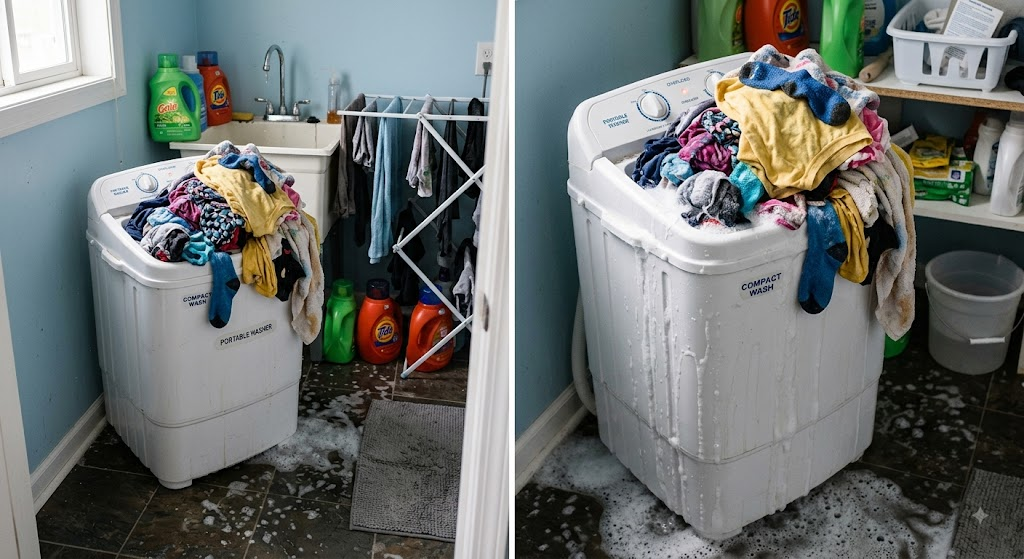
Portable washers have relatively small tubs, and it’s easy to overestimate how much laundry they can handle.
A load that looks manageable when dry can become much heavier after absorbing water.
Signs you’ve overloaded it
You may notice:
- Strong vibration during spin
- Clothes staying very wet
- The motor sounding strained
- The tub struggling to reach full spin speed
- The washer moving around
- Longer-than-normal draining or spinning
- Clothes forming one large tangled mass
The better approach
Use smaller loads. If you’re unsure, leave some room instead of packing every available inch of the tub.
Your owner’s manual should always take priority over generic load-size advice because portable washers differ substantially in capacity and design. Aosom also warns that overloading portable washers can contribute to poor cleaning, unbalanced loads, and motor strain.
Check Whether the Portable Washer Is Level
A washer can look level while actually rocking slightly. Put a small bubble level on top of the machine.
Check it:
- From left to right
- From front to back
If your portable washer has adjustable feet, adjust them according to the manufacturer’s instructions. After adjustment, push gently on opposite corners of the machine. If it rocks like a chair with one short leg, it’s not stable.
Why leveling matters
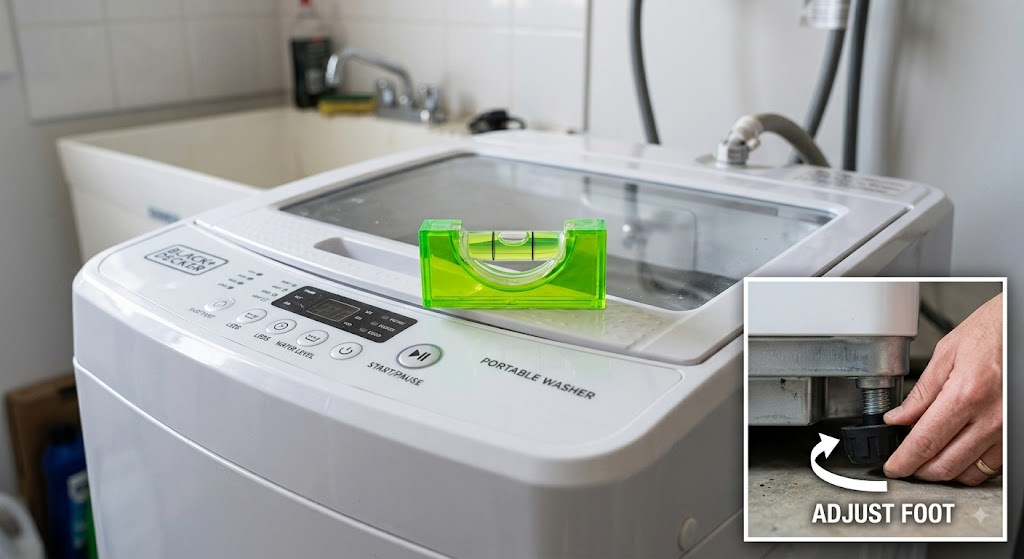
During a high-speed spin, even a small instability can become much more noticeable. Think about a shopping cart wheel. A tiny wobble becomes much more obvious when the wheel moves faster.
The same basic principle applies to a spinning washer.
Make Sure the Washer Isn’t Touching Anything
This sounds obvious, but it’s easy to miss in a small apartment. A portable washer may be positioned next to:
- A wall
- Kitchen cabinets
- A sink
- A bathroom vanity
- A dryer
- A storage shelf
- A utility-room door
When the washer vibrates, it can hit one of these objects and turn a normal mechanical sound into an extremely loud rattle.
The fix
Move the machine away from surrounding objects and run another test cycle. Don’t rely on the wall to “hold” the washer in place. If the washer needs to lean against a wall to stop moving, you’ve got a stability problem that needs to be fixed.
Check the Floor, Not Just the Washer
Sometimes the washing machine isn’t the real problem. If your portable washer sits on a weak or flexible surface, vibration can become much worse. For example, a washer placed on a flexible wooden platform may transmit movement differently than one sitting directly on a solid floor.
Better surfaces include
- Concrete
- Tile
- Solid vinyl flooring
- A firm, level utility-room floor
If you must use a platform, make sure it is rigid, level, properly supported, and designed to safely carry the washer. Don’t improvise with unstable furniture.
Should You Use an Anti-Vibration Mat or Anti-vibration pad?
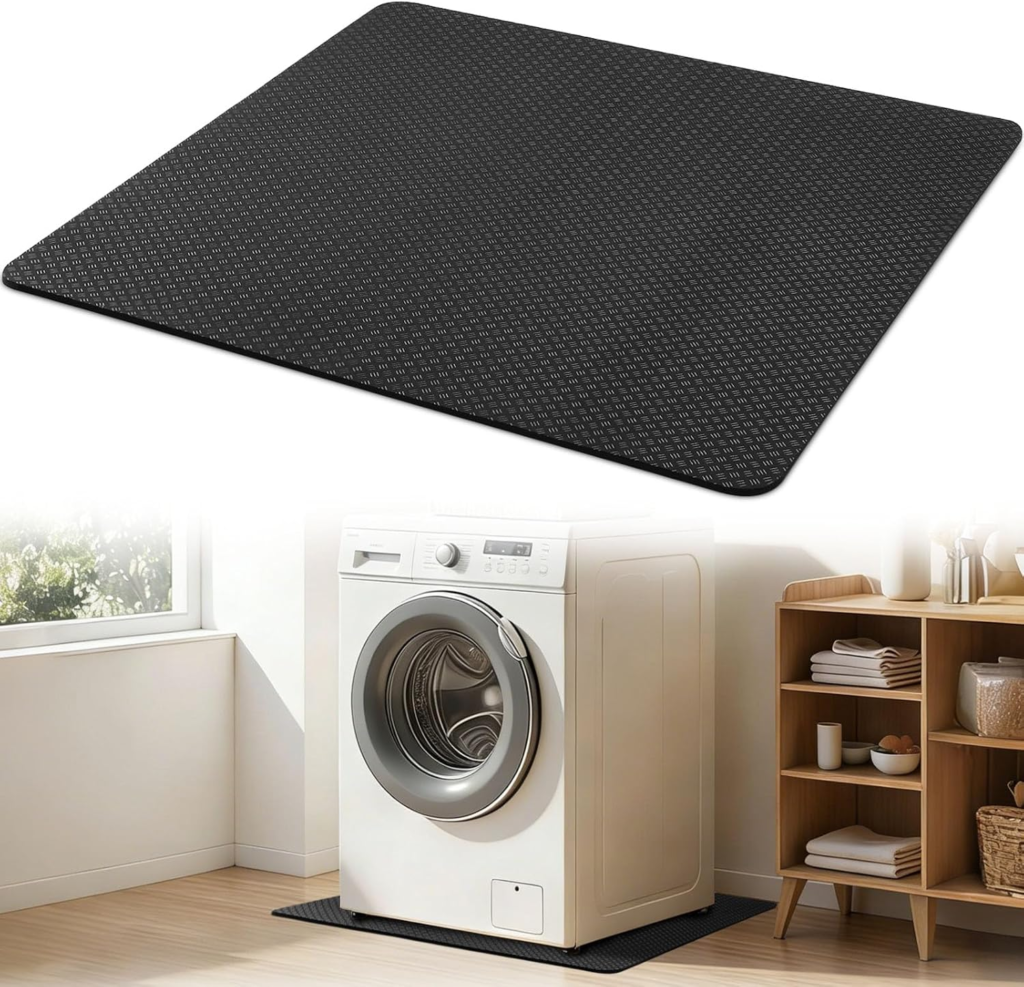
Yes, but understand what it can and cannot do. An anti-vibration mat can help reduce:
- Floor vibration
- Noise transmission
- Minor sliding
- Scratching
- Contact noise
But it cannot fix a seriously unbalanced washer.
If your portable washing machine is jumping around because a heavy blanket is stuck on one side, putting a rubber mat underneath it doesn’t solve the actual problem.
Fix the cause first. Then use a mat if you still want additional noise and movement reduction. This is an important distinction that many generic washing-machine guides miss.
Check for Shipping Material on a New Portable Washer
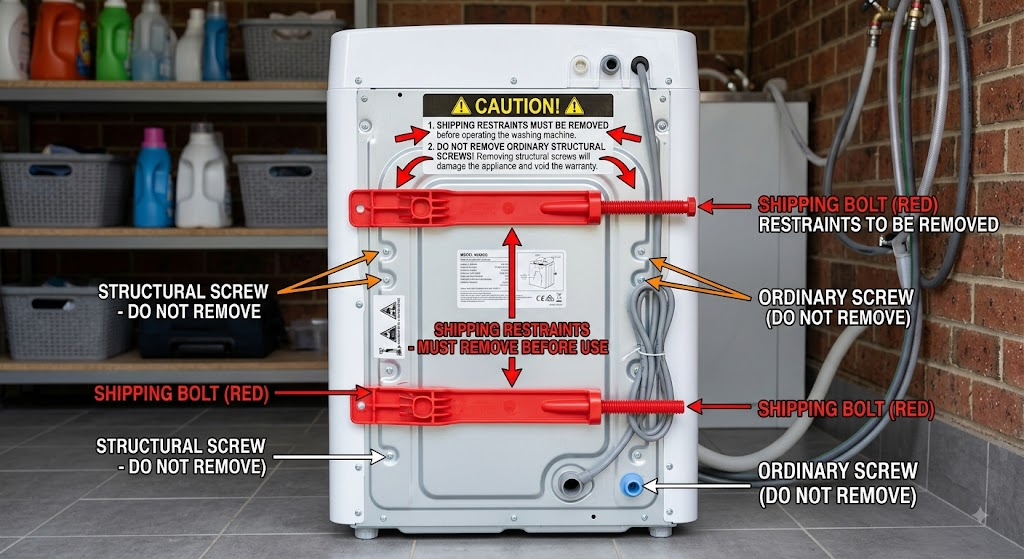
If your portable washer is brand new and vibrates violently from the first cycle, don’t assume it’s defective. Check the installation instructions.
Some washing machines use shipping or transportation restraints to keep internal components secure during delivery. Manufacturer guidance commonly warns that these restraints must be removed before normal operation. Whirlpool and Beko both highlight transportation restraints as an installation-related cause of excessive vibration.
However, portable washer designs vary, and not every compact washer uses the same type of shipping hardware.
Don’t start removing random bolts from the back of the machine. Check your specific model’s manual first.
If you’re unsure whether a bolt is a shipping restraint, leave it alone until you’ve confirmed its purpose.
Check the Spin Basket on a Twin-Tub Portable Washer
This is one area where portable washers deserve different troubleshooting advice from standard full-size washers. If you have a twin-tub portable washer, the spin side may have a separate basket. If the vibration happens specifically in the spin tub:
- Stop the spin cycle.
- Remove the clothes.
- Check that nothing is trapped around the basket.
- Inspect the basket for obvious damage.
- Reload the clothes evenly.
- Make sure the basket isn’t overloaded.
- Close the lid properly.
- Test the spin cycle again.
If the basket itself appears to wobble significantly while empty, that’s more concerning than clothes simply being unbalanced.
Check the Drain Hose and Drainage
Drainage isn’t always the direct cause of vibration, but a drainage problem can create confusing symptoms during the spin process. A kinked or restricted hose can prevent proper drainage on models that rely on a pump. TCL includes blocked filters and drain-pump problems among possible causes of shaking or vibration.
Check for:
- Kinks in the drain hose
- Crushed hose sections
- Blockages
- Poor hose positioning
- A clogged filter, if your model has one
- Water remaining when the washer should have drained
Don’t assume every portable washer has a serviceable drain filter. Some models use different drainage designs. Follow the manual for your exact washer.
Check for Foreign Objects
Coins, hair clips, screws, small toys, and other objects can get trapped in or around washing-machine components.
A foreign object can create:
- Rattling
- Clicking
- Scraping
- Metallic knocking
- Intermittent vibration
Empty pockets before washing, and inspect the tub if you hear a new noise. If the object is stuck somewhere you can’t safely reach, don’t start dismantling the washer just because a YouTube video makes it look easy. Unplug the machine and consult the manual or a qualified repair professional.
When Vibration Means a Mechanical Problem
If you’ve corrected the load, leveled the machine, checked the floor, and confirmed proper installation but the vibration continues, it’s time to consider an internal problem.
Grinding or rumbling
Possible cause: Worn bearing or another rotating component.
A persistent grinding or rumbling sound that changes with the speed of the drum is not something I’d ignore.
High-pitched squealing
Possible cause: Belt, motor, or another moving component.
Portable washers that use belts can develop belt-related problems, although the exact design varies by model.
Metallic scraping
Possible cause: Foreign object, damaged basket, or internal component.
Stop using the washer until you identify the source.
Loud knocking with an empty tub
Possible cause: Mechanical looseness or damaged internal components.
An empty washer shouldn’t behave like it’s carrying a load of bricks.
Tub or basket feels unusually loose
Possible cause: Worn or damaged support components.
Don’t keep running repeated cycles to “see if it gets better.” Mechanical problems generally don’t repair themselves through optimism.
Whirlpool notes that worn drum bearings and other internal components can contribute to excessive shaking and may require professional service. Haier likewise identifies worn bearings, suspension components, and other internal parts as potential sources of excessive vibration.
When Should You Call a Repair Technician?
You can safely handle basic troubleshooting such as redistributing clothes, reducing the load, checking the floor, and cleaning accessible filters or hoses.
Call for professional help if:
- The washer vibrates violently while empty.
- The tub or basket appears damaged.
- You hear grinding or metallic scraping.
- The motor smells burned.
- The electrical cord is damaged.
- The machine repeatedly trips the circuit breaker.
- Water is leaking from inside the cabinet.
- A component appears loose inside the machine.
- The vibration continues after proper leveling and load adjustment.
- You need to open the electrical or motor compartment.
- You aren’t confident working around electrical components.
Unplug the washer before inspecting anything that requires you to reach inside the appliance. Never bypass a lid or safety switch just to make the machine run. Those safety systems exist for a reason.
A Simple 5-Minute Portable Washer Vibration Test
If you want to troubleshoot the problem without guessing, use this sequence.
Test 1: Empty the washer
Remove all clothing.
Run the appropriate short test cycle according to the owner’s manual.
Still vibrating? Move to the next test.
Test 2: Check stability
Push gently on each corner.
If the washer rocks, correct the feet or placement.
Test 3: Check the floor
Make sure the washer sits on a hard, stable surface.
Remove unstable mats, platforms, or improvised supports.
Test 4: Add a small, balanced load
Use a normal small load rather than one heavy item.
If the washer is now stable, the original problem was probably load distribution or overloading.
Test 5: Listen
Pay attention to the sound.
Thumping: Load imbalance.
Rattling: Loose object or contact with nearby furniture.
Grinding: Possible bearing or mechanical problem.
Squealing: Possible belt or motor-related issue.
Violent movement with no clothes: Stability or internal mechanical problem.
This symptom-first approach is much faster than replacing parts randomly.
What Not to Do When Your Portable Washer Vibrates
Some common “fixes” can actually make the situation worse.
Don’t keep running a violently shaking washer
If it’s moving several inches or repeatedly banging against something, stop it.
Don’t overload it to “balance” one heavy item
Adding more laundry isn’t a universal solution. You can turn a small imbalance into an overloaded machine.
Don’t wedge the washer against a wall
The wall shouldn’t be used as a stabilizer.
Don’t put it on thick, soft material
Soft foam can sometimes make a lightweight portable washer less stable.
Don’t remove random screws
Only remove shipping hardware or service components identified by your model’s instructions.
Don’t bypass safety switches
Never defeat a lid or door safety mechanism to test the machine.
How to Prevent Portable Washing Machine Vibration
Once you’ve fixed the problem, a few habits can keep it from returning.
Use smaller loads
Portable washers work best when you respect their capacity.
Mix laundry sensibly
Avoid washing one extremely heavy item by itself unless the manufacturer specifically allows it.
Keep the washer level
Check the machine after moving it.
Don’t drag the washer around unnecessarily
Moving a portable washer can change its position or loosen connections.
Inspect hoses regularly
Look for kinks, cracks, and loose connections.
Clean accessible filters
If your model has a filter, follow the manufacturer’s cleaning schedule.
Keep the area around the washer clear
Give the machine enough room that normal movement doesn’t cause it to hit a wall, cabinet, or other object.
Final Verdict
If you’re wondering How to fix portable washing machine vibration, don’t start by buying replacement parts.
Start with the boring stuff because the boring stuff is usually the answer.
Stop the cycle → redistribute the clothes → reduce the load → check the spin basket → level the machine → inspect the floor → make sure nothing is touching the washer → check installation materials → test it empty.
If the washer becomes stable after these steps, you’ve probably solved the problem.
If it still shakes violently while empty, produces grinding or metallic sounds, has a visibly loose basket, smells like overheated electronics, or repeatedly trips the breaker, stop using it and arrange a repair.
The biggest mistake is treating every vibration problem as an “anti-vibration mat” problem. A mat can reduce minor movement and noise, but it won’t repair a damaged bearing, fix an unbalanced load, stabilize a badly positioned washer, or repair a failing motor.
For most portable washer owners in apartments, RVs, dorms, and small homes, proper loading and a genuinely stable floor are the two things worth checking first.
FAQs
Q. Is some vibration normal in a portable washing machine?
Yes. Some movement can be normal, particularly during high-speed spinning. The concern is excessive movement, repeated banging, walking across the floor, or unusually loud mechanical noise.
Q.Why does my portable washing machine shake only when spinning?
The spin cycle is when the washer rotates fastest, so an uneven load becomes much more noticeable. Heavy towels, blankets, jeans, and other absorbent items can bunch together and make the spin basket unbalanced.
Q.Will an anti-vibration mat stop my portable washer from shaking?
It may reduce minor movement and floor noise, but it won’t solve the underlying cause of severe vibration. Fix the load, leveling, and placement problem first.
Q.Why is my portable washing machine moving across the floor?
Portable washers are relatively lightweight, so an unbalanced load combined with an uneven or slippery surface can make them move. Check the load, floor, feet, and surrounding clearance.
Q.Why does my portable washer vibrate when it’s empty?
If an empty washer vibrates severely, the problem is less likely to be caused by laundry. Check whether the machine is level and stable. If it still vibrates or makes grinding or scraping sounds, an internal mechanical problem may be responsible.
Q.Should I put a portable washing machine on carpet?
It’s generally better to place the washer on a hard, stable, level surface. Carpet can make a lightweight portable washer less stable, particularly during high-speed spinning.
Q.Why does my portable washer make a loud banging noise?
The most common reason is an unbalanced load. Stop the washer, redistribute the clothing, and reduce the load if necessary. If the banging continues with an empty machine, investigate for a mechanical or installation problem.
Q.Can an overloaded portable washing machine cause vibration?
Yes. Too much laundry can make the load difficult to balance and can place additional strain on the washer. Follow the capacity and loading instructions for your specific model.
Q.How do I know if my portable washer has a bad bearing?
Persistent grinding or rumbling that occurs as the basket rotates can be a warning sign. A loose or unusually wobbly basket can also indicate a mechanical problem. Bearing repairs can be complicated, so professional diagnosis is usually the safer choice.
Q.Should I repair or replace a vibrating portable washing machine?
Start by determining the cause. A load imbalance or leveling problem costs little or nothing to fix. A serious motor, bearing, control-board, or structural problem may be harder to justify on an inexpensive portable washer. Compare the repair cost with the price and age of the machine before making the decision.
Q.What is the fastest way to stop a portable washer from vibrating?
Stop the cycle, redistribute the clothes evenly, remove excess laundry, and make sure the washer sits firmly on a level surface. If it continues vibrating badly when empty, don’t keep running it; investigate the machine itself.
Recommended Reading:
- 10 Best Portable Washing Machine for Camping
- Portable Washing Machine Not Draining? 10 Ways to Fix It
- Portable Washer vs Full-Size Washer: Which One Is Better for Your Home?
- Portable Washing Machine Not Spinning? 10 Causes & Easy Fixes

Sourabh researches and writes about home appliances, kitchen gadgets, and common appliance problems to help readers make smarter buying decisions. He specializes in Portable washing machines and appliance troubleshooting guides.
At compactHomeHub, Sourabh focuses on creating easy-to-understand content that simplifies technical appliance issues into practical solutions. His goal is to help users save time, avoid costly mistakes, and choose the right appliances with confidence.