
If you live in an apartment, RV, dorm, tiny home, or another small space, a portable washing machine can make laundry much easier. But there’s one question that comes up sooner or later: Can a portable washing machine wash blankets and bed sheets?
The short answer is yes for many sheets and lightweight blankets, but not every portable washer can handle every type of bedding.
Before buying one for your apartment, it’s also worth checking the typical portable washer installation cost and what you’ll need for the water connection.
Can a Portable Washing Machine Wash Blankets & Sheets?
Yes, a portable washing machine can wash bed sheets and some blankets, but the size and weight of the bedding must be appropriate for the washer.
Most portable washers can handle sheets more easily than bulky blankets. A lightweight twin blanket may be perfectly reasonable for a larger portable washer, while a thick queen or king-size comforter may be too bulky.
The most important rule is simple:
Don’t judge the load only by whether you can physically squeeze it into the tub. The bedding needs enough room to move, absorb water, rinse properly, and spin without creating a badly unbalanced load.
A blanket that technically fits inside the tub may become extremely heavy after absorbing water. If the washer is too small, the bedding can stay bunched together instead of getting properly cleaned.
Can a Portable Washing Machine Wash Blankets & Sheets?
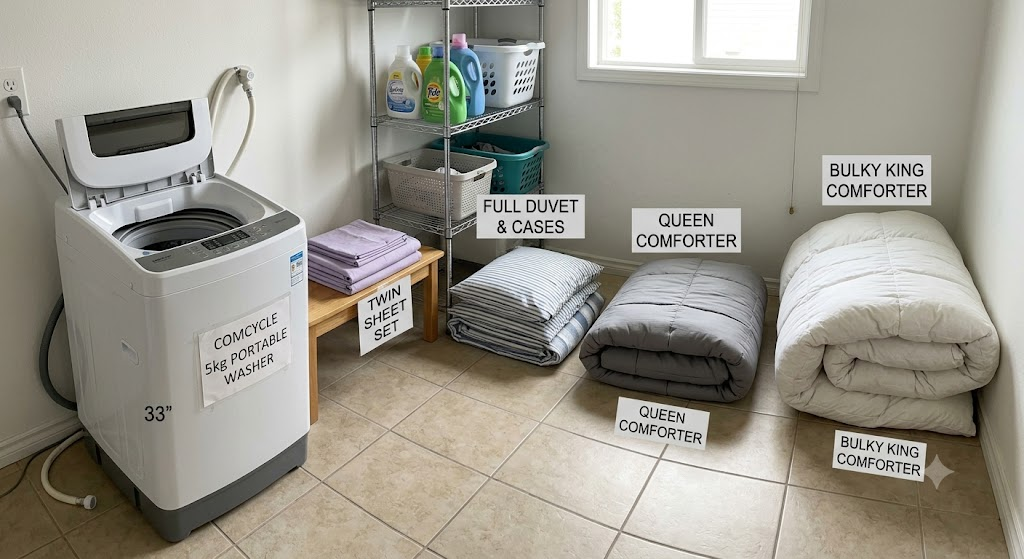
| Bedding | Portable washer suitability | What to know |
|---|---|---|
| Twin sheets | Excellent | Usually easy for medium-size portable washers |
| Full-size sheets | Good | Better in a larger portable washer |
| Queen sheets | Usually good | Wash alone if the washer is small |
| King sheets | Depends on washer | Large portable models are preferable |
| Thin throw blanket | Good | Usually manageable if the care label allows machine washing |
| Lightweight twin blanket | Good | Check the washer’s capacity first |
| Thick queen blanket | Questionable | May be too bulky for many portable machines |
| King comforter | Usually no | A full-size or commercial washer is often safer |
| Heavy quilt | Often no | Water weight can overwhelm a small washer |
| Electric/heated blanket | Special case | Follow the blanket manufacturer’s care instructions exactly |
Why Sheets Are Easier Than Blankets
Sheets look large when they’re spread across a bed, but they’re relatively thin and flexible. Once they’re inside the washer, they can fold, tumble and move around the wash basket.
Blankets are different. A thick blanket can take up much of the available space before the wash even starts. Once it absorbs water, its weight increases dramatically. That’s why a portable washer that handles a normal clothing load easily may struggle with a bulky blanket.
The problem isn’t simply the dry weight. It’s volume plus water absorption plus available drum space.
A washer needs enough space for the bedding to move through the water. If the blanket is packed tightly into the tub, cleaning and rinsing can suffer.
What Size Portable Washer Do You Need for Sheets?
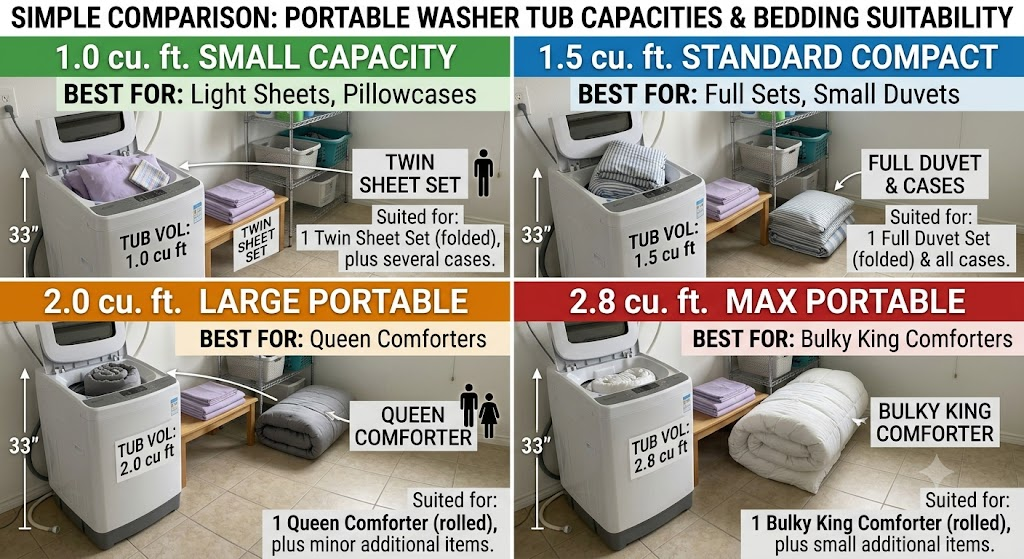
For sheets, capacity requirements aren’t as extreme as they are for comforters. A smaller portable washer may handle a twin sheet set, particularly if you wash the fitted sheet, flat sheet and pillowcases without adding a pile of towels or clothing.
As the bedding gets larger, the washer should also get larger. A useful practical approach is:
1. Small portable washers: around 0.8–1.2 cu. ft.
These machines are best suited to:
- Small clothing loads
- Underwear and socks
- T-shirts
- Lightweight towels
- Some twin bedding
- Thin sheets
They’re generally not the first choice for bulky blankets.
2. Medium portable washers: around 1.3–2.0 cu. ft.
These offer more flexibility.
Depending on the model, you may be able to wash:
- Twin sheets
- Full-size sheets
- Queen sheets
- Lightweight blankets
- Small comforters
But you still need to check the manufacturer’s instructions.
3. Larger portable washers: around 2.5–3.0 cu. ft.
These are much more suitable for people who regularly want to wash bedding at home. For perspective, GE’s GNW128PSMWW portable washer has a 2.8-cu.-ft. basket and includes cycles such as Heavy Duty, Towels, Delicates and Extra Spin. Its maximum spin speed is 750 RPM.
That doesn’t mean every 2.8-cu.-ft. portable washer can automatically wash every king comforter. It means the machine has substantially more usable space than many compact mini washers.
And there’s an important catch: capacity numbers aren’t permission slips. Always check the current owner’s manual and the bedding’s care label.
If you’ve never connected a portable washer to a sink, see our guide on how to install a portable washing machine before starting your first load.
Can a Portable Washing Machine Wash a Queen Sheet Set?
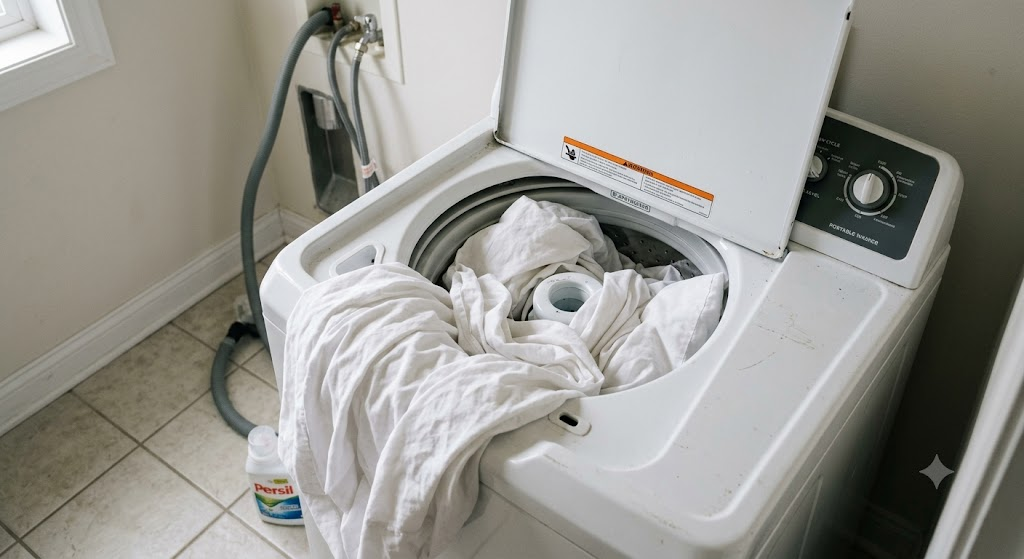
Usually, yes, provided the portable washer is large enough and you don’t overload it. For a smaller washer, it’s better to wash the queen sheet set by itself.
That means:
- Fitted sheet
- Flat sheet
- Pillowcases
Avoid adding jeans, towels or a large pile of clothes just because there appears to be room. Sheets can wrap around other laundry and create a tangled load. More importantly, stuffing additional laundry into the tub reduces the space available for the sheets to move.
What about a king-size sheet set?
That’s more difficult. King sheets are considerably larger and can overwhelm a compact washer. A larger portable washer may handle them, but you should not assume that it will.
If the fitted sheet fills most of the wash basket, that’s your warning sign. If the bedding is tightly packed before the cycle even begins, the washer is probably too small for that load.
Can a Portable Washing Machine Wash a Blanket?
Sometimes.
A thin fleece blanket, lightweight summer blanket or small throw may work well in a suitably sized portable washer.
A thick winter blanket is another story.
The material matters because different fabrics absorb different amounts of water and occupy different amounts of space.
For example:
- Thin microfiber blanket → easier
- Lightweight fleece blanket → often manageable
- Cotton blanket → potentially heavier when wet
- Thick quilt → difficult for small machines
- Down comforter → usually needs much more space
- Heavy king comforter → generally better in a full-size or commercial machine
The blanket’s care label should come first. If the label says dry clean only, don’t put it in your portable washer simply because it physically fits.
The Most Important Test: Can the Blanket Move?
Here’s a better way to think about bedding capacity.
Don’t ask:
“Can I fit this blanket inside?”
Ask:
“Can this blanket move freely inside the washer after it gets wet?”
That’s the real test.
A blanket needs room to circulate through the wash water. If it’s compressed against the sides of the tub, cleaning becomes less effective.
Overloading can also create an unbalanced load during spin.
Whirlpool specifically recommends using a large-capacity washer for bulky blankets and warns against balling them up because that can contribute to an unbalanced load.
A practical loading check
Before starting the washer:
- Put the dry bedding loosely into the tub.
- Don’t force it downward.
- Check whether there’s visible free space around the load.
- Make sure the lid closes without compressing the bedding.
- Confirm the manufacturer’s maximum load instructions.
- If the bedding completely fills the tub, use a larger machine.
The exact amount of empty space varies by washer design, so don’t treat a universal “two-thirds full” rule as an official specification.
Why the Spin Cycle Matters So Much
Washing is only half the problem. Bedding can hold a lot of water after rinsing, and that makes the spin cycle extremely important.
A portable washer may clean a blanket reasonably well but still leave it very wet. That’s especially important with twin-tub machines.
Many inexpensive portable washers have separate wash and spin tubs. The wash tub might appear large enough for a blanket, but the smaller spin basket may not be able to accommodate the same item comfortably.
That creates an easily overlooked problem:
The washer can wash it, but the spinner can’t properly spin it.
Customer feedback on portable twin-tub machines illustrates this issue. Some users report that larger sheets or blankets are difficult to balance in small spin baskets, even when the wash tub itself has enough room.
This is one reason a fully automatic portable washer can be more convenient for bedding than a tiny twin-tub machine.
Should You Wash Blankets Alone?
Usually, yes. If you’re washing a blanket, there’s little benefit in stuffing additional clothes into the tub. Washing the blanket by itself can help with:
- Better movement
- Better detergent circulation
- Easier balancing
- Better rinsing
- Easier removal from the washer
For sheets, you can often wash a complete sheet set together if the washer has enough capacity.
For blankets, treat the blanket as the main load.
How to Wash Sheets in a Portable Washing Machine
Washing sheets is relatively straightforward.
Step 1: Check the care label
Look for the recommended:
- Water temperature
- Wash cycle
- Drying instructions
- Bleach restrictions
- Special care instructions
Don’t assume every sheet set can tolerate hot water.
Step 2: Shake out the sheets
Give the sheets a quick shake before putting them into the washer. This helps remove loose hair, dust and debris. If you have pets, this step becomes even more useful.
Step 3: Load loosely
Don’t twist the sheets into a tight ball. Spread and loosely place them into the tub.
Step 4: Use the appropriate amount of detergent
More detergent doesn’t automatically mean cleaner sheets. Too much detergent can leave residue and create unnecessary rinsing problems. Use the detergent instructions and your washer’s recommendations.
Step 5: Select an appropriate cycle
A normal cycle may be suitable for many cotton sheets, while delicate fabrics may require a gentler setting.
Some larger portable washers offer multiple cycle choices. GE’s 2.8-cu.-ft. portable model, for example, lists Normal, Heavy Duty, Delicates, Towels, Jeans and other cycles.
Step 6: Don’t skip the rinse
Sheets are in direct contact with your skin for hours. If your washer offers an extra-rinse option and you’ve used too much detergent or have sensitive fabrics, it can be useful.
How to Wash a Blanket in a Portable Washer
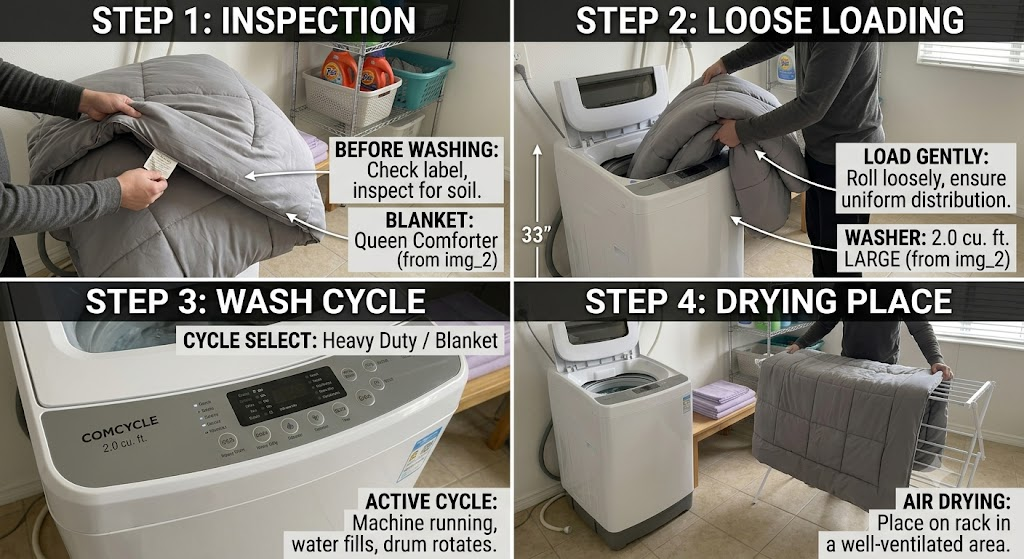
The process is similar, but you need to be more cautious.
1. Inspect the blanket
Look for:
- Loose stitching
- Tears
- Frayed edges
- Broken seams
- Damaged filling
Whirlpool recommends repairing holes, tears and snags before washing blankets to prevent further damage.
2. Remove loose dirt and pet hair
Shake the blanket outdoors if possible. If it’s covered in pet hair, remove as much as possible before washing.
3. Confirm machine-wash instructions
Never skip this step. Some blankets are machine washable, while others aren’t.
4. Load it loosely
Don’t compress the blanket into a dense ball.
5. Choose a suitable cycle
If the washer has a bulky, bedding, gentle or delicate setting, follow the manufacturer’s guidance for that fabric.
6. Watch the spin
If the washer starts banging, shaking or repeatedly stopping, the load may be unbalanced. Stop the cycle and redistribute the blanket rather than letting the machine continue violently shaking.
7. Dry it completely
A blanket that feels dry on the outside may still be damp inside. Make sure it dries completely before folding and storing it.
This is particularly important for thick blankets and comforters.
What About King-Size Comforters?
This is where I’d draw the line for most compact portable washers. A king-size comforter is large, bulky and capable of holding substantial amounts of water. A full-size washer may be a much better choice.
Whirlpool says washers with at least 4.5 cu. ft. generally have the capacity for king-size duvets and comforters, while its comforter guidance recommends around 5.0 cu. ft. for comforters.
Those figures aren’t portable-washer requirements. They’re useful context showing how much more space bulky king bedding can need compared with a compact portable washer.
So if you’re buying a portable washer specifically because you want to clean king comforters at home, don’t assume the portable format will save you a trip to the laundromat.
A commercial machine may still be the better option.
What About Electric Blankets?
Electric blankets deserve extra caution. Don’t treat an electric blanket like an ordinary fleece blanket. Follow the manufacturer’s instructions for:
- Whether machine washing is allowed
- Water temperature
- Cycle type
- Detergent
- Drying
- Controller removal
If the manufacturer prohibits machine washing, don’t put it in your portable washer. If machine washing is permitted, follow the manufacturer’s instructions rather than generic blanket advice. Whirlpool’s heated-blanket guidance also emphasizes proper loading and avoiding an overloaded washer.
Portable Washer vs. Full-Size Washer for Bedding
| Factor | Portable washer | Full-size washer |
|---|---|---|
| Apartment living | Excellent | Requires more space |
| Washing sheets | Good to excellent | Excellent |
| Twin blankets | Good on suitable models | Excellent |
| Queen blankets | Model-dependent | Usually easier |
| King comforters | Often impractical | Better suited |
| Storage | Easier | Permanent installation |
| Water hookup | Often sink-based | Usually dedicated hookup |
| Large weekly loads | Limited | Better |
| Bulky bedding | Limited | Better |
| RV use | Excellent | Usually impractical |
The trade-off is obvious. A portable washer wins on space and flexibility. A full-size washer wins on capacity and bulky laundry.
Common Mistakes When Washing Bedding in a Portable Washer
Mistake 1: Buying based only on the pound rating
A load rating doesn’t tell the entire story. Bedding also needs physical room inside the tub.
Mistake 2: Stuffing the blanket into the washer
If you have to force it inside, it’s probably too large.
Mistake 3: Ignoring the spin basket
This is especially important with twin-tub portable washers. The wash tub may fit the bedding while the spin tub doesn’t.
Mistake 4: Adding towels to balance the load
Don’t automatically add towels to an already overloaded washer. First determine whether the bedding is appropriate for the machine.
Mistake 5: Washing a king comforter because someone online said they did it
A customer review can be useful, but it’s not the same as a manufacturer’s recommendation. Customer experiences vary by model, blanket construction and washer condition.
Mistake 6: Ignoring the care label
The washer isn’t the only thing that matters. The blanket itself has washing requirements.
Because bulky bedding can move unevenly during a cycle, it’s also useful to know what to check if your portable washing machine is leaking water.
How We Reached These Recommendations
These recommendations are based on manufacturer specifications and care guidance, plus recent customer feedback used only to identify recurring practical issues.
They are not based on hands-on testing by the author.
For machine specifications, official manufacturer information takes priority. Customer reviews are useful for spotting real-world issues such as vibration, small spin baskets or connection problems, but individual reviews shouldn’t override the manufacturer’s load limits.
Portable washer models and specifications can also change. Always verify the current product page and owner’s manual before buying or washing bulky bedding.
So, Can a Portable Washing Machine Wash Blankets & Bed Sheets?
Yes, but with limits.
If your main goal is washing sheets, a portable washing machine can be a very practical solution.
If you want to wash lightweight blankets, choose a larger portable washer and make sure the blanket has enough room to move.
If you regularly wash thick queen or king comforters, quilts or other bulky bedding, a full-size or commercial washer is usually the safer and more practical choice.
The key isn’t simply whether the bedding fits.
The key is whether the washer has enough capacity for the bedding to move freely, rinse properly and spin without becoming dangerously unbalanced.
Bottom line
- Sheets: Usually yes.
- Twin sheets: Usually easy in a suitable portable washer.
- Queen sheets: Usually possible in a medium or larger portable washer.
- King sheets: Depends heavily on washer capacity.
- Lightweight blankets: Often yes.
- Thick blankets: Model-dependent.
- Queen comforters: Often better in a larger washer.
- King comforters: Usually better in a full-size or commercial washer.
- Electric blankets: Follow the manufacturer’s instructions.
- Twin-tub machines: Check the spin basket as carefully as the wash tub.
If you are buying a portable washer specifically for bedding, capacity should be one of your first buying criteria not an afterthought.
Recommended Reading:
- How to Fix Portable Washing Machine Vibration
- Portable Washing Machine Not Draining? 10 Ways to Fix It
- How to Clear a Portable Panda Washer E1 Error Without Calling Support
- Portable Washing Machine Not Spinning? 10 Causes & Easy Fixes

Sourabh researches and writes about home appliances, kitchen gadgets, and common appliance problems to help readers make smarter buying decisions. He specializes in Portable washing machines and appliance troubleshooting guides.
At compactHomeHub, Sourabh focuses on creating easy-to-understand content that simplifies technical appliance issues into practical solutions. His goal is to help users save time, avoid costly mistakes, and choose the right appliances with confidence.