If you’re living in a small apartment, an RV, a dorm room, or just trying to cut down on laundromat trips, a portable washer sounds like a dream. But before you plug one in, you’re probably wondering: how much electricity does a portable washer use and what’s it going to do to your power bill?
Portable washers are becoming popular for apartments, RVs, and small spaces because they use less water and power than many traditional machines. Before choosing one, check our complete portable washing machine guide to understand features, types, and buying factors.
How Much Electricity Does a Portable Washer Use?
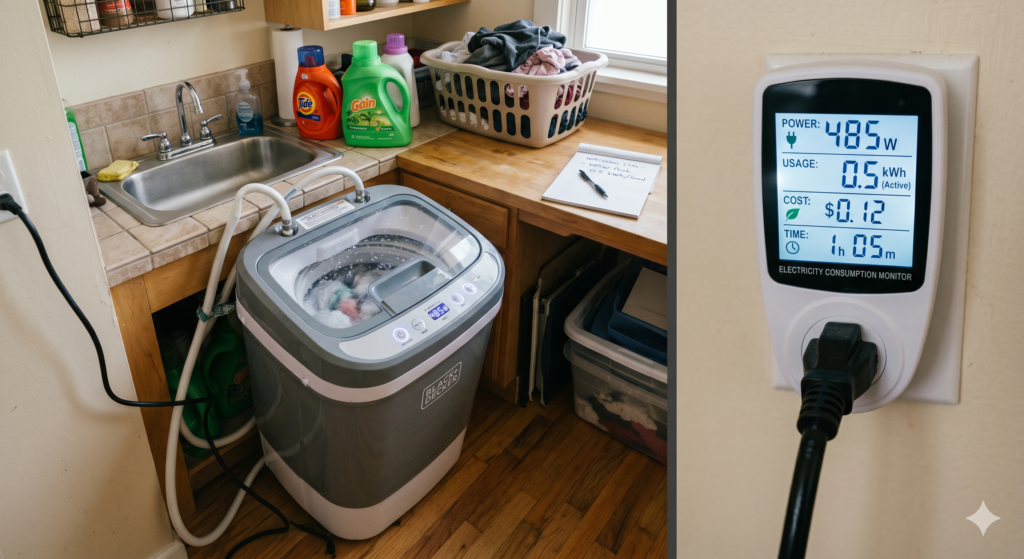
A portable washing machine typically uses about 0.3 to 0.5 kWh of electricity per load, drawing roughly 200 to 500 watts while it runs. At the average US rate of about 15 to 18 cents per kWh, that comes to around 5 to 8 cents per load, or roughly $1 to $1.60 a month if you wash 20 loads. That’s usually less than a full-size washer, which can pull 400 to 1,400 watts, though portables also wash smaller loads.
Your exact cost depends on the model, the cycle length and how often you run it. Most portable washers have no built-in heater, so if you fill one with hot water from your home water heater, that heating cost shows up on your bill instead. To check your own number, multiply the wattage on the back label by the hours of your usual cycle, divide by 1,000, then multiply by your electricity rate.
On average:
| Measurement | Portable Washer Electricity Use |
|---|---|
| Per Hour | 0.1 to 0.5 kWh |
| Per Load | 0.05 to 0.30 kWh |
| Per Cycle | 0.05 to 0.30 kWh |
| Per Month (20 Loads) | 1 to 6 kWh |
| Estimated Monthly Cost (USA) | $0.15 to $1.20 |
Why Portable Washers Use Less Electricity
Portable washing machines are designed for small loads and compact living spaces. Several factors help reduce electricity consumption:
- Smaller motors
- Lower water usage
- Shorter wash cycles
- Smaller drum capacity
- No built-in water heating in most models
- Reduced spin motor power
Proper installation can also affect safe and efficient operation, especially when connecting the washer to water and electricity.
A standard washing machine may use 500 to 1500 watts, while many portable units operate comfortably below 400 watts. Think of it this way: running a portable washer often uses less electricity than operating a microwave oven for the same amount of time.
Electricity usage depends on washer type, capacity, and washing habits. Comparing a portable washer vs regular washing machine can help you understand differences in energy consumption, water usage, and operating costs.
How Much Electricity Does a Washing Machine Use Per Hour?
This one depends on your machine’s wattage rating. Since most portable washers sit in the 200–500 watt range, here’s what that looks like hourly:
| Machine Wattage | Electricity Per Hour |
| 200W portable | 0.2 kWh |
| 300W portable | 0.3 kWh |
| 400W portable | 0.4 kWh |
| 500W portable | 0.5 kWh |
| 900W full-size | 0.9 kWh |
| 1,200W full-size | 1.2 kWh |
Most portable washers don’t actually run for a full hour their cycles are shorter. So even a 500W model won’t necessarily draw 0.5 kWh per load if it finishes in 30 minutes.
One thing worth knowing: the motor and agitation use the most power, but if your portable washer heats its own water (some do), that heating element can spike consumption noticeably. More on that below.
How Much Electricity Does a Washing Machine Use Per Load?
Per load is really the most practical way to think about this. Here’s a realistic comparison chart based on real-world wattage data from popular models:
| Machine Type | Avg Wattage | Cycle Time | kWh Per Load |
| Mini countertop washer | 200–250W | 15–20 min | 0.05–0.08 |
| Twin-tub portable | 300–350W | 30–45 min | 0.15–0.26 |
| Standard top-load portable | 400–500W | 30–45 min | 0.20–0.38 |
| Compact front-load portable | 300–400W | 45–60 min | 0.23–0.40 |
| Full-size top-loader | 700–1,000W | 45–60 min | 0.53–1.00 |
| Full-size front-loader | 400–900W | 60–90 min | 0.40–1.35 |
Your washer’s capacity also affects how efficiently you can handle your laundry, so choosing the right load size is important.
At the national average electricity rate of about $0.16 per kWh (as of 2025), the cost per load shakes out like this:
- Mini countertop washer: $0.01 to $0.01 per load
- Standard portable top-loader: $0.03 to $0.06 per load
- Full-size top-loader: $0.08 to $0.16 per load
That difference adds up over time, especially if you’re doing laundry frequently. Electricity use is only one factor to consider. If you’re comparing capacity, wash performance, convenience and features as well, see our guide to the portable washing machine options worth considering.
How Much Electricity Does a Portable Washer Use Per Cycle?
Most portable washing machines run on a standard 120-volt household outlet and use between 200 and 500 watts during a wash cycle. A typical wash cycle runs 15 to 45 minutes, so the math on electricity use per load looks like this:
- At 200W for 30 minutes = 0.1 kWh per cycle
- At 300W for 45 minutes = 0.225 kWh per cycle
- At 500W for 45 minutes = 0.375 kWh per cycle
A more average figure across popular models lands right around 0.3 to 0.5 kWh per load.
Compare that to a standard full-size washing machine, which uses 900 watts on average and runs for a full hour, consuming roughly 0.9 kWh per load. Some high-end front-loaders use as little as 0.5 kWh, while older or oversized machines can hit 2.0 kWh per cycle.
The bottom line: portable washers use significantly less electricity per load, largely because they handle smaller loads and have shorter cycle times.
How Much Electricity Does a Washing Machine Use Per Month?
Let’s say you do laundry 4 times per week a pretty normal routine for a busy household or a couple sharing a portable washer.
For a portable washer using 0.35 kWh per load:
- 4 loads/week × 4.33 weeks/month = ~17 loads/month
- 17 × 0.35 kWh = 5.95 kWh/month
- At $0.16/kWh: about $0.95 per month
For a full-size washer using 0.9 kWh per load:
- 17 loads × 0.9 kWh = 15.3 kWh/month
- At $0.16/kWh: about $2.45 per month
That’s a savings of roughly $1.50/month, or around $18/year just from the washer itself. It’s not going to change your life, but every dollar counts and if you’re in a state with higher electricity rates like California or Massachusetts, the savings get more meaningful.
Here’s a state-by-state breakdown of what a portable washer might cost you monthly (assuming 17 loads/month at 0.35 kWh/load):
| State | Avg Rate (2025) | Monthly Cost |
| Hawaii | ~$0.37/kWh | ~$2.20 |
| California | ~$0.27/kWh | ~$1.61 |
| Massachusetts | ~$0.24/kWh | ~$1.43 |
| New York | ~$0.22/kWh | ~$1.31 |
| Texas | ~$0.13/kWh | ~$0.77 |
| Washington | ~$0.10/kWh | ~$0.60 |
| US Average | ~$0.16/kWh | ~$0.95 |
What Factors Actually Affect How Much Electricity a Portable Washer Uses?
The wattage on the spec sheet isn’t the whole story. Several real-world factors push the number up or down.
Water temperature is the biggest one. Cold water washes use significantly less energy because the machine doesn’t have to heat anything. If your portable washer has a built-in water heater and you use hot water, you can see energy use jump by 50–90%. Washing in cold water is one of the single easiest ways to cut your energy use.
Load size matters more than most people realize. Running a half-empty portable washer doesn’t save much electricity — you still burn through almost as much energy as a full load. Always try to wash full loads to get the most out of each cycle.
Wash cycle selection is another factor. Quick wash or delicate cycles run shorter and use less power. Heavy-duty or extended soak cycles use more. If you’re washing everyday clothes that aren’t heavily soiled, the quick cycle is almost always enough.
Spin speed in twin-tub models can affect power use too — higher RPM spinning draws more watts but also extracts more water from clothes, which means less drying time afterward.
Age and condition of the machine plays a role over time. Worn agitators, clogged filters, or a weakening motor can all cause the machine to work harder and use more electricity than it should.Cold water vs. cold tap water: In winter months in northern states, your tap water might be much colder than in summer, so the temperature difference between your water source and your desired wash temp affects how hard any internal heater works.
Portable Washer vs Standard or Full size Washing Machine Electricity Use
Let’s do a proper head-to-head comparison so you can see just how much you’d save by going portable. If you are deciding between a portable and full-size washer, compare their electricity use alongside capacity, space, installation, and overall convenience.
| Factor | Portable Washer | Full-Size Washer |
| Average wattage | 200–500W | 400–1,400W |
| kWh per load | 0.10–0.50 | 0.40–2.00 |
| kWh per month (17 loads) | 1.7–8.5 kWh | 6.8–34 kWh |
| Monthly electricity cost | $0.27–$1.36 | $1.09–$5.44 |
| Annual cost | $3.24–$16.32 | $13.08–$65.28 |
| Load capacity | 6–16 lbs | 12–28 lbs |
| Installation required | No | Usually yes |
| Water use per load | 7–15 gallons | 15–30 gallons (top-load) |
The portable washer wins on electricity, water use, and convenience. The full-size washer wins on capacity. For solo users, couples, or people in smaller spaces, the portable is genuinely the smarter energy choice.
Hidden Energy Savings Most People Ignore
- Reduced Dryer Usage: Smaller loads often air-dry faster. Many users skip the dryer entirely.
- Lower Water Heating Costs: Portable washers frequently use cold water. Water heating can account for a significant portion of laundry energy expenses.
- Less Standby Power: Portable washers are usually unplugged when not in use. This eliminates phantom energy consumption.
- Shorter Laundry Sessions: Smaller loads encourage more efficient washing habits.
If reducing your monthly electricity bill is a priority, choosing an energy-efficient portable washing machine can help lower running costs while still handling everyday laundry needs.
Does Water Temperature Affect How Much Electricity a Portable Washer Uses?
Yes and it’s one of the most overlooked factors. Here’s the deal:
Most portable washers in the US don’t have internal heating elements — they use whatever temperature water comes from your faucet. In that case, water temperature doesn’t directly affect your machine’s electricity use.
But some portable and compact washers do include built-in heaters. If yours does, using hot water settings can add 200–400W of additional power draw during the heating phase. This can nearly double the electricity per load.
If you want to minimize electricity use:
- Choose cold water settings whenever possible
- Most everyday laundry including most colors, synthetic fabrics, and lightly soiled clothes washes just fine in cold water
- Reserve warm or hot settings for towels, bedding, or heavily soiled items
Studies have consistently shown that about 90% of a washing machine’s energy goes to heating water, not running the motor.
How to Cut Your Portable Washer’s Electricity Use Even Further
You’re already saving money by going portable. If you want to run a portable washer off-grid, understanding its wattage and energy consumption is the first step in sizing a suitable solar and battery system. Here are ways to squeeze out even more efficiency:
Always wash full loads. Partial loads waste energy and water you still run a full cycle for less laundry. Portable washers have a maximum load rating, but they also have a minimum efficiency sweet spot. Filling them up (without overpacking) gets you the best return on electricity spent.
Use cold water. We already covered this, but it’s worth repeating: cold water is almost always enough for everyday clothes. It’s better for fabrics, better for colors, and much better for your electricity bill.
Run your washer during off-peak hours. If you’re on a time-of-use electricity plan (common in California, New York, and other states), electricity is cheaper late at night or early in the morning. Running your portable washer at 10pm instead of 6pm can actually save you money depending on your plan.
Clean your filter regularly. A clogged lint filter makes your machine work harder than necessary. A quick monthly rinse of the filter keeps things running efficiently.
Skip the extra rinse cycle. Most portable washers have an optional extra rinse. Unless you have allergies to detergent or are washing baby items, skip it. It just uses more water and extends the cycle time.
Use the right amount of detergent. More isn’t better. Too much soap causes extra rinse cycles to be needed and can gum up your machine over time.
Air-dry when possible. This is technically a dryer tip, but since portable washer users often also use countertop dryers, it’s relevant: if you can air-dry even some of your laundry after spinning, you save enormous amounts of energy. Dryers use 2,000–5,000 watts. A clothesline or drying rack costs exactly zero.
Can a Portable Washer Run on a Portable Power Station?
This is a great question for RV folks, van lifers, and campers. The answer is: usually yes, but check your math first.
Most portable power stations can handle appliances up to 1,000–2,000W. Since portable washers draw 200–500W, they’re well within range for most power stations.
For a 500W washer running a 45-minute cycle, you’d use roughly 0.375 kWh of power. A 1,000Wh power station could theoretically run about 2–3 loads per charge, though efficiency losses mean you’d likely get closer to 1.5–2 in practice.
Are Portable Washers Energy Star Certified?
Most portable washing machines are NOT Energy Star certified. This is largely because Energy Star certification for clothes washers is designed for full-size machines, and the testing protocols don’t map perfectly onto compact or portable units.
That said, some compact washers (particularly compact front-loaders in the 1.0–2.5 cu.ft. range) do carry Energy Star ratings, and these are worth looking for if energy efficiency is a top priority.
When shopping without an Energy Star label, look for:
- Lower wattage ratings (aim for under 400W)
- Shorter advertised cycle times
- Cold water compatibility
- Water efficiency specs (gallons per load)
FAQs: Portable Washer Energy Use
Q. How much does it cost to run a portable washer for a year?
If you do 4 loads per week at 0.35 kWh per load and pay the US average of $0.16/kWh, that’s about $11.65 per year. Compare that to $30–$60/year for a full-size washer.
Q. Do portable washing machines use less water than regular ones?
Yes, significantly. Most portable washers use 7–15 gallons per load. Full-size top-loaders use 15–30 gallons, while HE front-loaders use 12–20 gallons.
Q. Can I use a portable washer in an apartment?
Absolutely that’s exactly what they’re designed for. Most connect to a standard kitchen or bathroom faucet with an included adapter. Most portable washers need a nearby water source, and many connect directly to a kitchen or bathroom faucet. If you’re using a COMFEE’ model, see our guide to portable washing machine sink hookup for the faucet-adapter connection.
Q. Is it cheaper to use a laundromat or a portable washer?
A laundromat typically charges $2–$4 per wash load. At $0.03–$0.06 per load for electricity at home, plus maybe $0.25 in water costs, even accounting for detergent and the upfront machine cost, a portable washer pays for itself in a few months of regular use.
Q. What’s the difference between a portable washer and a compact washer?
Portable washers are lightweight (under 40 lbs), hook to a faucet, and need no installation. Compact washers are larger and may need a dedicated water hookup, but they often have better capacity and more features.
Final Verdict
So, how much electricity does a portable washer use?
Most portable washing machines consume between 0.05 and 0.30 kWh per load, making them one of the most energy-efficient laundry appliances available. For the average American household, operating a portable washer typically costs less than $1 per month in electricity.
If you’re comparing a portable washer to a laundromat or a full-size machine, the electricity math is clearly in the portable washer’s favor. These little machines use a fraction of the power of a regular washer, cost almost nothing to run monthly, and are perfectly adequate for solo users, couples, or anyone managing a lighter laundry load.
The bottom line is simple: if lowering utility bills is a priority, a portable washing machine is one of the smartest laundry investments you can make.
Recommended Reading:
- How Does a Portable Washing Machine Work? Step-by-Step
- Portable Washing Machine Buyers Guide: 11 Things You Must Know Before Buying
- How Much Water Does a Portable Washer Use?
- Are Portable Washing Machines Worth It? 2026 Buyer’s Guide

Sourabh researches and writes about home appliances, kitchen gadgets, and common appliance problems to help readers make smarter buying decisions. He specializes in Portable washing machines and appliance troubleshooting guides.
At compactHomeHub, Sourabh focuses on creating easy-to-understand content that simplifies technical appliance issues into practical solutions. His goal is to help users save time, avoid costly mistakes, and choose the right appliances with confidence.