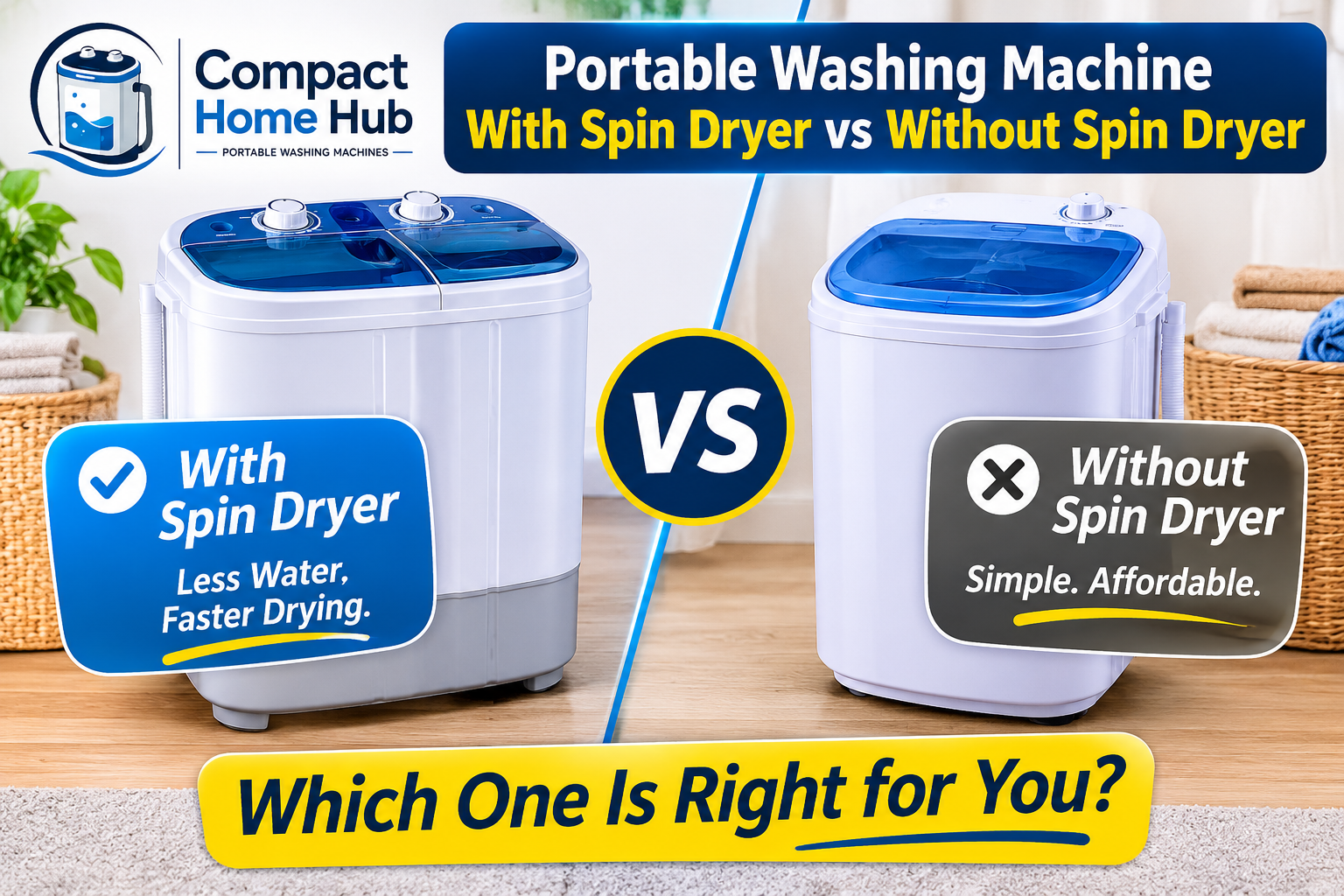
A portable washing machine with spin dryer removes excess water from clothes after washing, helping reduce the time needed for air-drying. A basic portable washing machine without a spin-drying function can wash clothes, but you may need to wring them out manually or use a separate spinner before hanging them to dry.
Which type should you choose? If you regularly wash clothes in an apartment, dorm room, RV, or small home and want less water left in your laundry, a washer with spin-drying functionality is usually more convenient. If you only wash a few lightweight items and want a simpler, lower-cost machine, a basic washer may be sufficient.
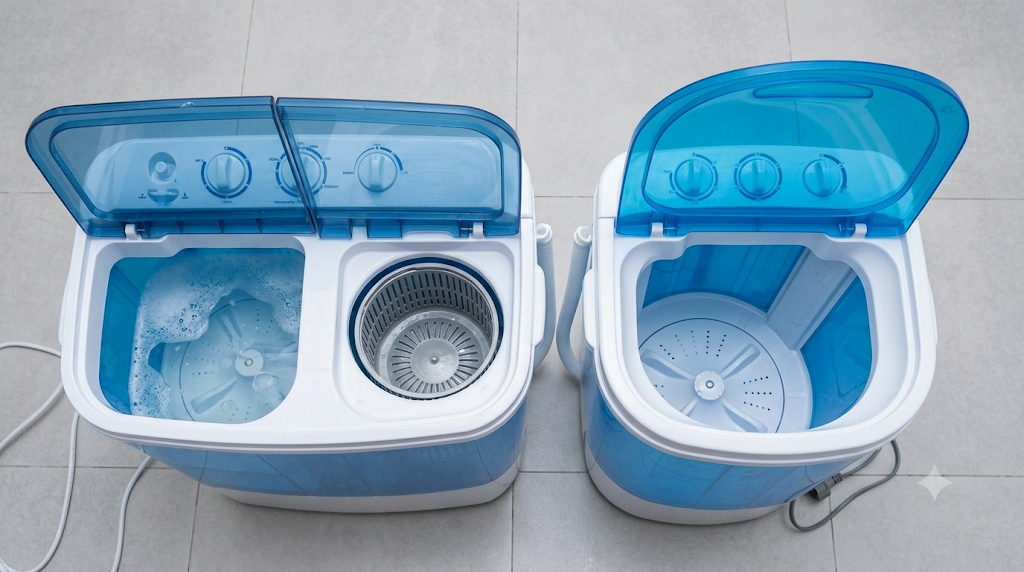
However, not every portable washer without a separate spin-drying tub lacks a spin cycle. Some fully automatic portable washers wash and spin clothes in the same drum. This guide compares the actual features rather than assuming that all machines fit into only two designs.
Portable Washer With vs Without Spin Dryer: Quick Comparison
| Feature | With Spin Dryer | Without Spin Dryer |
|---|---|---|
| Washing | Yes | Yes |
| Removes excess water | Yes, using a spinner or spin cycle | No dedicated spin function |
| Manual wringing | Usually unnecessary | Often required |
| Air-drying | Still required | Required |
| Drying convenience | More convenient | Less convenient |
| Machine design | Separate spin tub or integrated spin cycle | Usually a simpler single-tub design |
| User involvement | Low to moderate, depending on design | Moderate to high |
| Space requirements | Can be larger, especially twin-tub designs | Often smaller |
| Operation | May require transferring clothes or selecting a spin cycle | Wash, drain, manually remove excess water |
| Best for | Regular small-load laundry | Occasional washing and very lightweight clothes |
Quick verdict: A portable washer with a spin dryer is generally the more practical choice for regular laundry because it removes excess water before clothes are hung to dry. A washer without this feature can work for occasional small loads, but manual wringing adds effort.
1. What Is a Portable Washing Machine With a Spin Dryer?
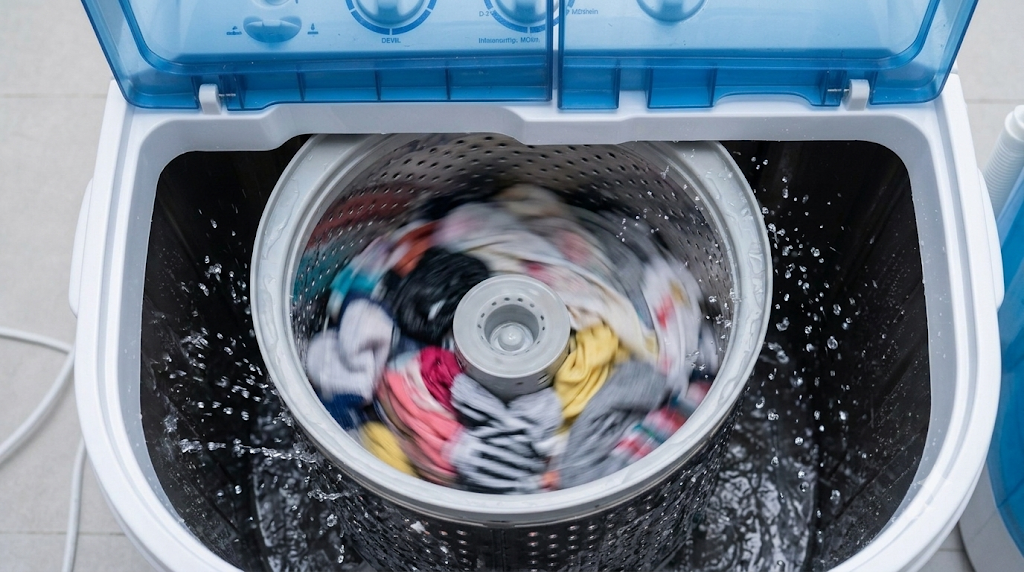
A portable washing machine with a spin dryer combines two laundry functions: washing clothes and extracting excess water after washing. Depending on its design, it may have two separate tubs or one drum that performs both functions.
Types of Portable Washers With Spin-Drying Functions
1. Twin-tub portable washing machine
A twin-tub washer has two separate compartments:
- Washing tub: Used for washing and rinsing clothes.
- Spin tub: Used to remove excess water from wet clothes.
After washing and rinsing, you transfer clothes from the washing compartment to the spin compartment. The spinner rotates at high speed, forcing water out through the basket openings. Some twin-tub machines allow washing and spinning to happen simultaneously when you have separate loads.
2. Fully automatic portable washing machine
A fully automatic portable washer generally uses one main drum for washing, rinsing, and spinning. You load the clothes, select a suitable program, and let the machine complete its cycle. Depending on the model, you may not need to transfer clothes manually. This design is convenient for people who prefer fewer manual steps.
How Does a Spin Dryer Work?
A spin dryer uses centrifugal force to remove water from wet clothes. When the spin basket rotates rapidly, water moves away from the clothes and exits through openings in the basket. The clothes come out with less moisture than they had immediately after washing.
However, a spin dryer does not use heated air to evaporate moisture. It is not equivalent to a conventional electric clothes dryer.
Important: Clothes generally remain damp after spinning and need additional air-drying or another suitable drying method.
2. What Is a Portable Washing Machine Without a Spin Dryer?
A portable washer without a spin-drying function is designed primarily to wash clothes. It may have a basic washing tub, a pulsator or another washing mechanism, and a drain outlet. However, it does not have a dedicated spin basket or a spin cycle for extracting water.
After washing, you generally need to:
- Drain the used water.
- Remove the wet clothes.
- Gently squeeze or wring out excess water where fabric care instructions allow.
- Hang the clothes on a drying rack or clothesline.
Some very small mini washers are designed for socks, underwear, baby clothes, and other lightweight items. They can be useful when you need to wash only a few items, but they are not necessarily suitable for everyday household laundry.
Common Features
- Simple single-tub design.
- Compact dimensions.
- Lightweight construction on some models.
- Basic wash controls.
- Manual water filling on some designs.
- Drain outlet or drain hose.
- No dedicated spin-drying compartment.
The exact features depend on the machine. A washer without a separate spin tub may still have an integrated spin cycle, so always check the manufacturer’s specifications.
3. Washing Performance: Does a Spin Dryer Improve Cleaning?
One important point is that a spin dryer does not directly improve washing performance.
The washing mechanism is responsible for removing dirt, sweat, and everyday stains. The spin function mainly removes excess water after washing. Therefore, a washer with a spin dryer is not automatically better at cleaning clothes than a washer without one.
Actual cleaning performance depends on:
- Washing mechanism.
- Water movement.
- Load capacity.
- Detergent quantity.
- Washing time.
- Fabric type.
- Water level.
- Rinsing effectiveness.
For example, a basic portable washer may clean a small load of lightly soiled clothes effectively even without a spin function. However, the clothes will retain more water after washing, making the next drying step less convenient.
Buying tip: Compare the washing capacity and cleaning features separately from the spin-drying specifications. Do not pay extra for a spinner expecting it to make the machine clean clothes better.
4. Spin-Drying Performance: Which Type Removes More Water?
This is the biggest practical difference between the two categories. A portable washer with a spin-drying function can extract a considerable amount of water before clothes are placed on a drying rack.
A washer without a spinner leaves more water in the fabric, requiring manual wringing or another extraction method.
| Factor | With Spin Dryer | Without Spin Dryer |
|---|---|---|
| Water extraction | Mechanical spinning | Manual squeezing or wringing |
| Effort required | Lower | Higher |
| Clothes after washing | Less wet | More wet |
| Drying preparation | Easier | Requires additional effort |
| Suitable for repeated laundry | More convenient | Less convenient |
Does a Higher Spin Speed Mean Better Drying?
Generally, higher spin speed can help remove more water, but RPM alone does not determine performance. Other factors include:
- Spin basket design.
- Load balance.
- Fabric type.
- Spin duration.
- Maximum permitted spin capacity.
- Machine stability.
For example, a twin-tub portable washer may advertise an 8 lb spin capacity while its washing capacity is 18 lb. This means you cannot necessarily transfer the entire washing load into the spin basket at once. You may need to divide it into smaller batches. Always check both capacities rather than relying on the largest advertised number.
5. Capacity and Load Handling
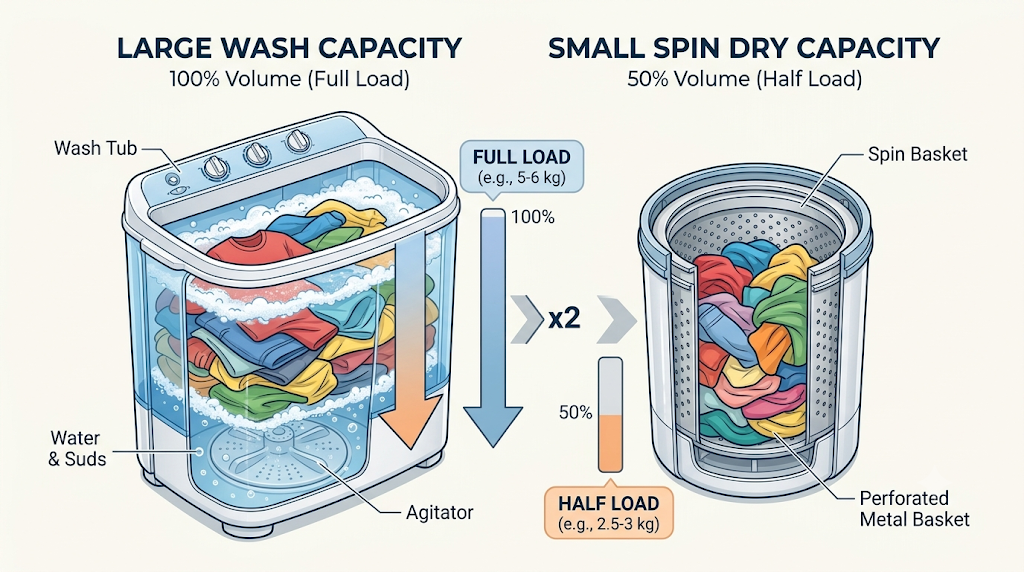
Capacity matters because portable washing machines are generally designed for smaller loads than full-size household washers. However, washing capacity and spin capacity are not always the same.
| Capacity Factor | With Spin Dryer | Without Spin Dryer |
|---|---|---|
| Washing capacity | Depends on the wash tub or drum | Depends on the wash tub |
| Spin capacity | May be lower than washing capacity | Not applicable |
| Load transfer | Required on separate twin-tub designs | Not required |
| Bulky clothes | Depends on tub size and manufacturer limits | Depends on tub size and design |
| Small daily loads | Suitable | Suitable |
Why Spin Capacity Matters
Imagine a portable washer with an 18 lb washing capacity and an 8 lb spin capacity. You can wash up to the stated washing limit under the manufacturer’s loading instructions, but the spinner cannot necessarily accommodate the entire wet load at once.
You may need to spin the clothes in multiple batches. This is particularly important when washing:
- Jeans.
- Towels.
- Sweatshirts.
- Bedsheets.
- Heavier cotton garments.
For a single person washing lightweight clothes, this may not be a major inconvenience. For frequent laundry, it can add time.
6. Space and Portability
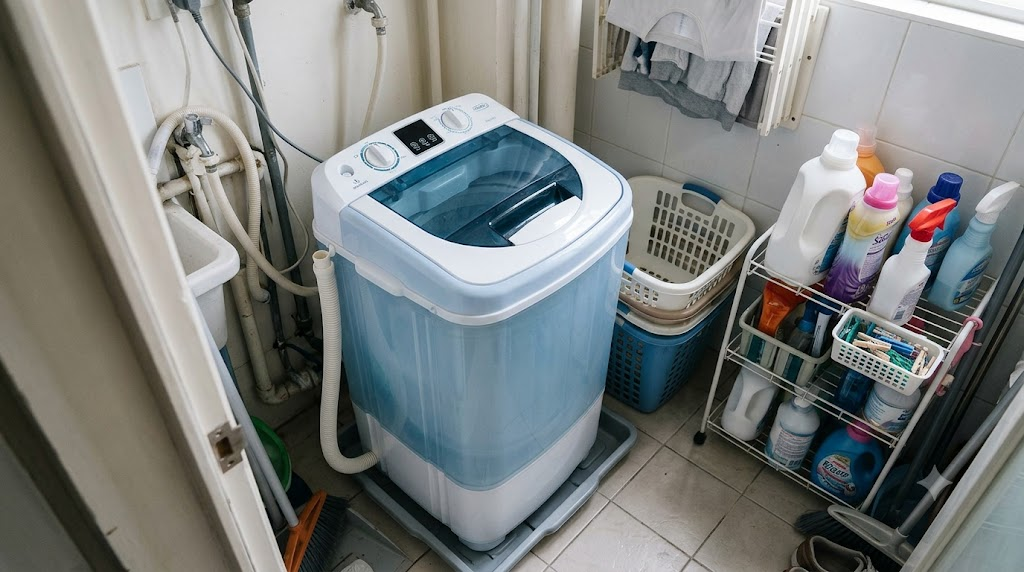
A portable washing machine should fit comfortably in your available space. The machine’s design affects how much room it needs.
Washer With Spin Dryer
A twin-tub washer has separate washing and spinning compartments. This generally makes the machine wider than a comparable single-tub design.
| Potential Advantages | Potential Disadvantages |
|---|---|
| Separate washing and spinning areas. | Wider footprint than some compact washers. |
| Can spin one load while washing another, where supported. | Requires more space for operation. |
| No need to purchase a separate standalone spinner. | Wet clothes must be transferred manually between tubs. |
Fully automatic portable washers may use one drum for both washing and spinning, so they do not necessarily require the same additional width as twin-tub models.
Washer Without Spin Dryer
A basic single-tub washer may be easier to fit into a small bathroom, closet, or storage area.
| Potential Advantages | Potential Disadvantages |
|---|---|
| Simpler construction. | Requires another method to remove excess water. |
| Often easier to store. | Manual wringing takes physical effort. |
| No separate spin compartment. | Wet clothes may need more space to drain before hanging. |
Recommendation: Measure the machine’s width, depth, height, and lid-opening clearance before buying. Also consider where you will keep the machine when it is not being used.
If floor space is your main concern, explore our guide to portable washers for tiny homes to compare compact laundry options for small living spaces.
7. Ease of Use and Daily Convenience
The amount of manual work required is another major difference.
Using a Washer With a Spin Dryer
A typical twin-tub workflow looks like this:
- Add clothes and water to the washing tub.
- Add detergent according to the instructions.
- Run the wash cycle.
- Drain the dirty water.
- Rinse the clothes.
- Transfer clothes to the spin tub.
- Arrange the load evenly and secure the spin cover if required.
- Run the spin cycle.
- Remove clothes and hang them to dry.
You still have to handle the laundry, but the machine removes much of the excess water. A fully automatic portable washer can reduce these manual steps further, depending on its programs and water connections.
Using a Washer Without a Spin Dryer
The workflow is simpler in terms of machine controls, but requires more physical effort after washing.
- Add clothes and water.
- Add detergent.
- Run the washing cycle.
- Drain the water.
- Rinse the clothes as required.
- Remove the clothes.
- Manually remove excess water where appropriate.
- Hang them to dry.
If you wash clothes frequently, repeating the manual wringing process can become inconvenient.
If you’re new to portable laundry appliances, follow our guide on how to use a portable washing machine to learn how to fill, wash, rinse, drain, and handle clothes safely.
8. Water and Electricity Consumption
A spin dryer does not automatically mean higher or lower overall electricity consumption. The total depends on the machine’s motor power, operating time, load size, and design. A twin-tub washer may have separate washing and spinning motors. A basic washer may use a simpler motor arrangement.
Consider these factors:
| Factor | With Spin Dryer | Without Spin Dryer |
|---|---|---|
| Washing electricity | Depends on motor and cycle | Depends on motor and cycle |
| Spinning electricity | Additional consumption when used | No dedicated spin motor |
| Water usage | Depends on wash and rinse procedure | Depends on wash and rinse procedure |
| Water extraction | Mechanical | Manual |
| Overall efficiency | Depends on usage and design | Depends on usage and design |
Do not assume that a washer without a spinner always saves money. If you regularly need to use another appliance to extract water or dry clothes, the overall convenience and energy picture may change. Check the manufacturer’s rated power and operating instructions before comparing models.
9. Noise and Vibration
Spin drying involves rapid rotation, which can create vibration. A twin-tub washer may vibrate noticeably if clothes are unevenly distributed in the spin basket. Common causes include:
- Unevenly loaded clothes.
- Overloading the spin basket.
- An unstable floor.
- An unlevel machine.
- Incorrect placement of the spin cover.
A washer without a spin function avoids this particular high-speed spinning operation, although its washing motor can still produce noise.
For apartment or dorm use, check the manufacturer’s noise specifications if available. Also look for customer feedback about vibration, movement, and stability. Always place the washer on a stable, level surface and follow its safety instructions.
10. Maintenance and Durability
Both types need regular cleaning and proper maintenance. However, a machine with a spin dryer has additional components that may require attention.
Washer With Spin Dryer
Check and maintain:
- Washing tub.
- Spin basket.
- Spin cover or safety lid.
- Drain hose.
- Lint filter, if provided.
- Spin motor and associated components.
Keep the spin basket free from lint and debris. Avoid operating the machine with an unbalanced load.
Washer Without Spin Dryer
Maintenance is generally simpler because there are fewer spin-related components.
Check:
- Washing tub.
- Drain outlet.
- Drain hose.
- Lint filter, if provided.
- Power cord and controls.
Regardless of the design, follow the manufacturer’s cleaning and storage instructions.
11. Which Type Is Better for Different Users?
The best choice depends on how often you wash clothes and how much manual work you are willing to do.
| User Type | Better Option | Reason |
|---|---|---|
| Apartment residents | With spin dryer | Reduces excess water before indoor drying |
| College students | Either | Depends on load size and laundry frequency |
| RV owners | Depends on available space and water setup | Portability and drainage matter |
| Single-person households | With spin dryer | Convenient for frequent small loads |
| Occasional users | Without spin dryer | A basic machine may be sufficient |
| People washing baby clothes | With spin dryer | Less manual water removal |
| People with limited storage | Compact washer without spinner | May have a smaller footprint |
| Frequent laundry users | With spin dryer | Less effort after washing |
Best for Apartments
A portable washer with a spin function is often more practical for apartment residents, especially when clothes need to dry indoors. Removing excess water before hanging clothes can make the drying process easier. However, check the machine’s dimensions, faucet compatibility, drainage arrangement, and noise level before purchasing.
Best for Dorm Rooms
Students who wash a few items regularly may prefer a compact machine. A washer with a spinner offers more convenience, but a small wash-only unit may be enough for occasional lightweight laundry. Also check dormitory rules. Some housing facilities restrict portable washing machines or require approval.
Best for RVs
RV owners should consider more than the spin function.
Check:
- Available storage space.
- Water supply.
- Wastewater drainage.
- Electrical requirements.
- Machine weight.
- Whether the machine can be safely secured during travel.
A twin-tub washer may be useful when space and water arrangements allow it, but its wider footprint may be a disadvantage in a compact RV. Never operate or store a portable washer in an RV contrary to its manufacturer’s instructions.
For laundry on road trips or in a recreational vehicle, see our guide to portable washing machines for travel for options to consider when space, water access, and drainage are limited.
12. Pros and Cons
Portable Washing Machine With Spin Dryer
| Pros | Cons |
|---|---|
| Removes excess water after washing. | Can cost more than a basic wash-only machine. |
| Reduces manual wringing. | Twin-tub designs may require more floor space. |
| Makes air-drying more convenient. | Separate spin tubs require manual clothes transfer. |
| Useful for frequent laundry. | Spin capacity may be lower than wash capacity. |
| Some twin-tub designs allow washing and spinning simultaneously. | High-speed spinning can cause vibration if the load is unbalanced. |
| Offers more control over the washing and spinning process. | Clothes still need additional drying. |
Portable Washing Machine Without Spin Dryer
| Pros | Cons |
|---|---|
| Simple design. | Does not mechanically remove excess water. |
| May have a smaller footprint. | Requires manual wringing or another water-extraction method. |
| Often easier to store. | Wet clothes can take longer to dry. |
| Can be suitable for small, lightweight loads. | Less convenient for frequent laundry. |
| No separate spin basket to maintain. | Not ideal for regularly washing heavier clothes and towels. |
| May have a lower initial purchase cost. |
13. What Should You Check Before Buying?
Before choosing either type, review these important specifications.
| Feature | What to Check |
|---|---|
| Washing capacity | Is it suitable for your regular laundry load? |
| Spin capacity | Can it handle the clothes you wash? |
| Spin speed | Is the RPM clearly stated by the manufacturer? |
| Machine dimensions | Will it fit in your available space? |
| Drainage | Does it use a gravity drain or built-in pump? |
| Water connection | Can it connect to your faucet or be filled manually? |
| Power requirements | Is the voltage compatible with your home? |
| Noise | Are noise specifications or reliable user reports available? |
| Controls | Are the controls easy to understand? |
| Warranty | What parts and components are covered? |
| Safety | Does it have the required lid, cover, and operating protections? |
Do not choose a machine based only on its advertised total capacity. Check the actual washing and spinning limits separately.
If you’re shopping on a budget, compare our guide to portable washing machines under $200 before deciding whether a spin-drying feature is worth the extra cost.
Final Verdict: Should You Buy a Portable Washer With or Without a Spin Dryer?
For most people who regularly wash clothes in apartments, dorms, and small homes, a portable washing machine with a spin-drying function is the more convenient choice.
It removes excess water mechanically, reduces manual wringing, and makes clothes easier to handle before air-drying.
A portable washer without a spin dryer can still be useful if you wash only a few lightweight items, have limited storage space, or want a simple machine for occasional use.
Here is the simplest way to decide:
- Choose a washer with a spin dryer if you wash clothes frequently and want to reduce the amount of water left in them.
- Choose a washer without a spin dryer if you mainly wash small loads and do not mind manually removing excess water.
- Consider a fully automatic portable washer if you want washing, rinsing, and spinning in one drum with fewer manual steps.
- Consider a twin-tub portable washer if you prefer separate washing and spinning compartments and are comfortable transferring clothes.
One final point: a spin dryer is not a substitute for a heated clothes dryer. If your main problem is completely drying clothes during rainy or humid weather, compare a portable clothes dryer or another suitable drying solution as well.
Frequently Asked Questions
1. Is a portable washing machine with a spin dryer worth it?
Yes, if you wash clothes regularly and want to reduce manual wringing. A spin dryer removes excess water and makes clothes easier to air-dry. It is especially useful in apartments and small homes where laundry is often dried indoors.
2. Does a spin dryer completely dry clothes?
No. A spin dryer uses centrifugal force to extract excess water. It does not normally use heated air to evaporate all remaining moisture. Clothes generally need additional air-drying.
3. Can I use a portable washing machine without a spin dryer?
Yes. You can wash clothes in a wash-only portable machine. After washing and rinsing, you need to remove excess water manually or use a separate spinner before drying the clothes.
4. Which is better: a twin-tub or single-tub portable washer?
A twin-tub washer has separate washing and spinning compartments and usually requires manual transfer of clothes. A single-tub fully automatic washer uses one drum for the complete cycle and generally requires less user involvement. The better option depends on your preference for convenience, space, and manual control.
5. Does a portable washer with a spin dryer use more electricity?
It may use additional electricity when the spin motor operates, but actual consumption depends on motor power, cycle duration, and usage. Compare the manufacturer’s rated power and energy information rather than assuming one design is always more efficient.
6. Can I spin all my washed clothes at once?
Not necessarily. Many portable twin-tub washers have a lower spin capacity than washing capacity. If the spin basket is smaller, you must divide the wet laundry into multiple batches. Always follow the rated capacity.
7. Is a portable spin dryer suitable for apartments?
Yes, provided the machine fits your available space and your apartment permits its use. Check the noise level, vibration, water connections, drainage, and electrical requirements before purchasing.
8. Is a spin dryer the same as a portable clothes dryer?
No. A spin dryer removes water through rapid rotation. A portable clothes dryer typically uses heated air or another drying mechanism to remove moisture. They perform different jobs.
9. Can I use a portable washing machine in an RV?
Some portable washers are designed for RV use, but suitability depends on the RV’s available space, water supply, drainage, electrical system, and the machine’s operating requirements. Check both the washer instructions and RV restrictions before using one.
10. What is more important: washing capacity or spin capacity?
Both matter, but they serve different purposes. Washing capacity determines how many clothes you can wash in a load. Spin capacity determines how many wet clothes you can extract water from at one time. Check both before buying.
Recommended Reading:
If you are comparing portable washing machines for a small home, these guides may also help:
- How to Use a Portable Washing Machine: Step-by-Step Guide
- Best Portable Washers for Tiny Homes
- Best Portable Washing Machines for Travel
- Best Portable Washing Machine Under $200

Sourabh researches and writes about home appliances, kitchen gadgets, and common appliance problems to help readers make smarter buying decisions. He specializes in Portable washing machines and appliance troubleshooting guides.
At compactHomeHub, Sourabh focuses on creating easy-to-understand content that simplifies technical appliance issues into practical solutions. His goal is to help users save time, avoid costly mistakes, and choose the right appliances with confidence.