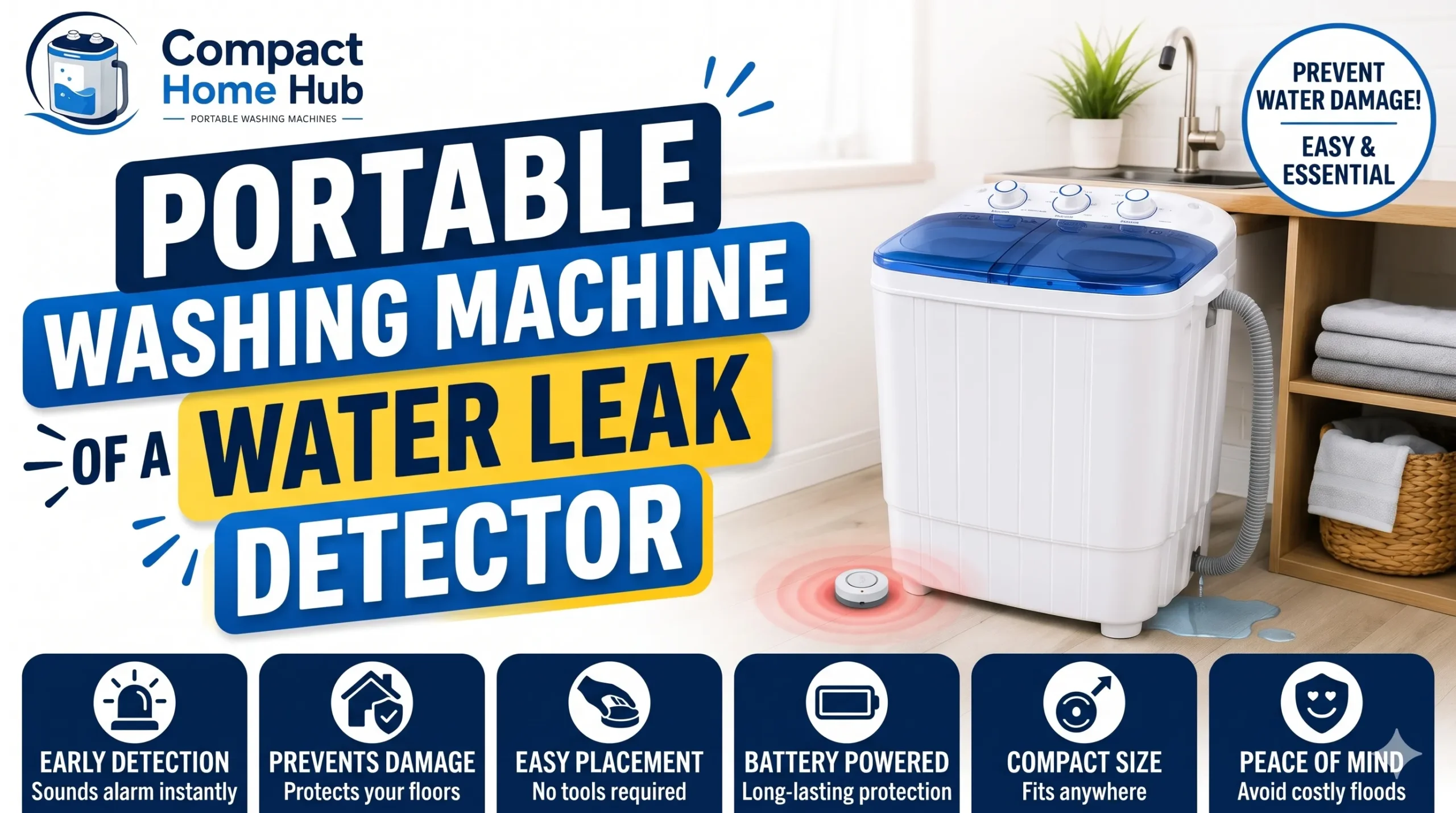
A portable washing machine makes laundry easier in an apartment, dorm room, or tiny home. But a loose hose or overflowing drain can leave water on your floor and potentially damage the apartment below.
A portable washing machine water leak detector helps you spot water leaks before they become bigger problems. Some models sound an alarm, others send phone notifications, and advanced systems can shut off a compatible water supply.
The challenge is choosing a device that works with your washer, fits your space, and provides the protection you actually need.
Quick answer: For most apartment renters, a battery-powered water leak alarm is a practical starting point. Choose a smart detector if you need phone alerts while away. Add a properly sized washing machine drip pan where suitable, and consider an automatic shutoff system only if it’s compatible with your water connections and approved by your landlord.
Affiliate disclosure: This article may contain affiliate links. We may earn a commission from qualifying purchases at no additional cost to you.
1. What Is a Portable Washing Machine Water Leak Detector?
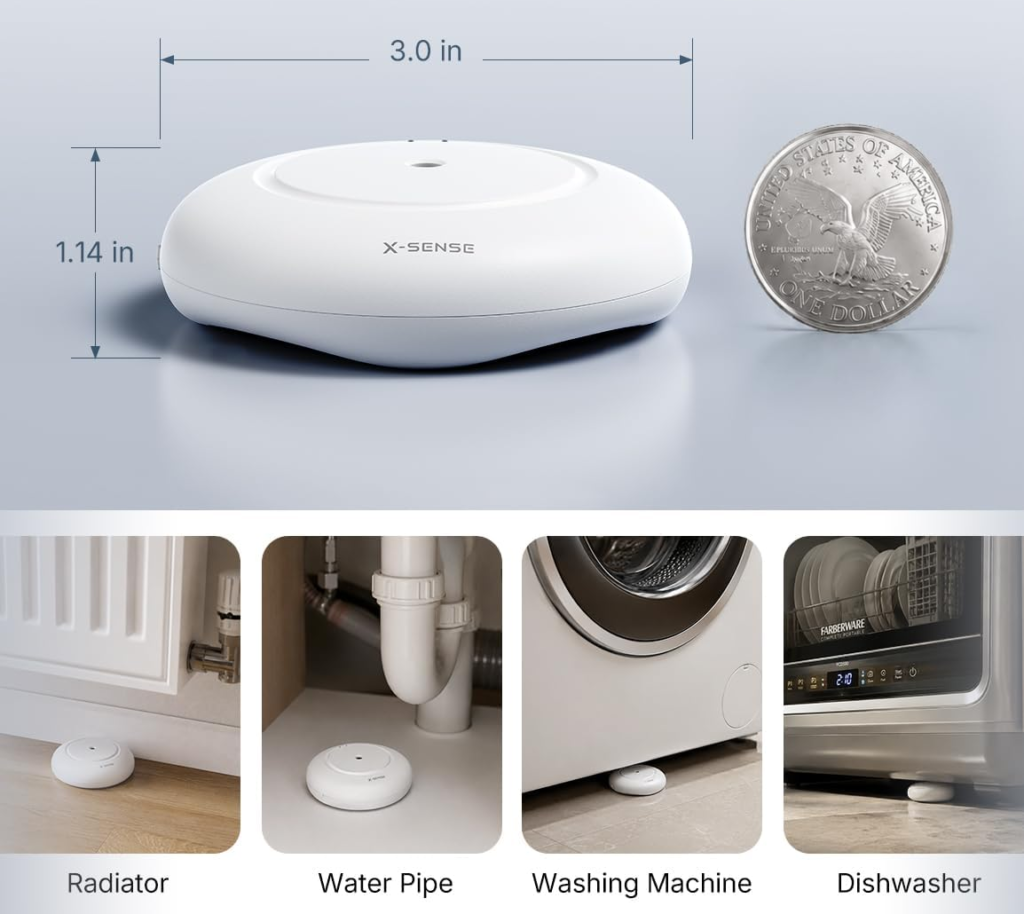
A
water leak detector is a small device that senses unwanted water near your washing machine and alerts you.
Most basic models have metal contacts that trigger an alarm when water bridges them. Smart models can also send notifications to your phone, while some systems work with a separate valve to shut off incoming water.
There are three main types.
| Type | How it works | Best for |
|---|---|---|
| Basic water alarm | Sounds when water reaches the sensor | Budget-conscious renters and students |
| Smart leak detector | Sounds an alarm and may send phone alerts | People who leave home during laundry |
| Automatic shutoff system | Detects a leak and closes compatible water valves | Suitable permanent washer installations |
A basic alarm won’t stop the leak. A smart sensor won’t necessarily stop it either. Automatic shutoff requires compatible equipment and a correctly installed valve.
For example, a shutoff system may limit a leak from an inlet hose, but it might not stop water escaping through a damaged drain hose or washer tub.
Learn how to set up a mini foldable washing machine correctly before connecting the water supply and drain hose.
2. Water Leak Detector vs. Washing Machine Drip Pan
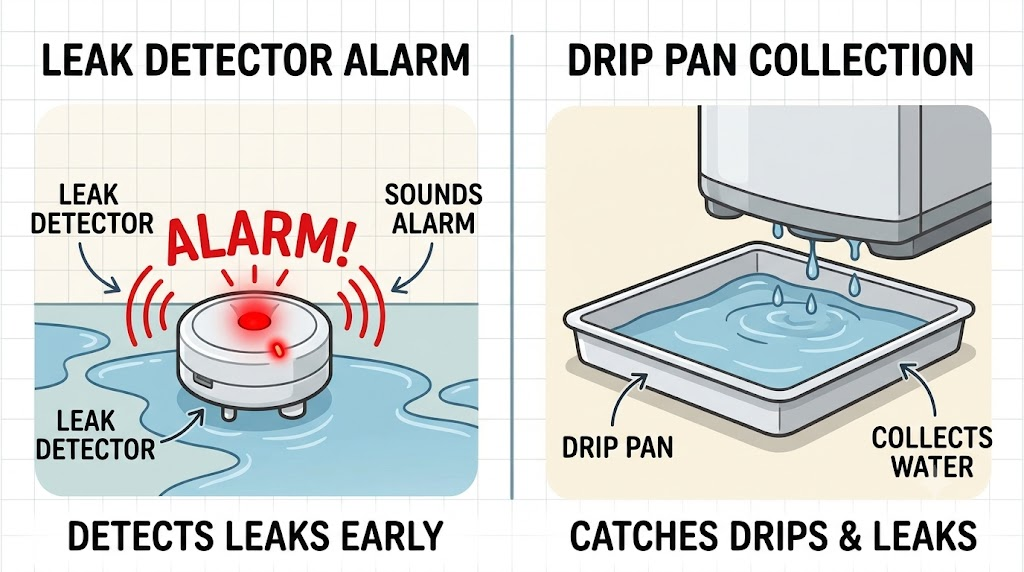
A detector and a drip pan serve different purposes. You may benefit from using both.
| Feature | Water leak detector | Drip pan |
|---|---|---|
| Main purpose | Detects water and alerts you | Collects escaping water |
| Audible alarm | Yes, on alarm-equipped models | No |
| Phone notifications | On compatible smart models | No, unless paired with a sensor |
| Stops incoming water | Only with a compatible shutoff system | No |
| Needs batteries | Many models do | No |
| Main limitation | Water must reach the sensor | Can overflow or miss water escaping outside the pan |
Imagine your washer develops a slow leak during a rinse cycle. The detector can alert you when water reaches its sensor, while a drip pan may collect some of that water.
However, a pan has limited capacity. A major leak can overflow it, and water from a poorly positioned drain hose may never reach it.Our advice: Prioritize a suitable detector, secure your drain hose properly, and add a drip pan if your washer can sit securely inside one.
3. How to Choose the Right Water Leak Detector
Before buying, consider how your washer fills with water, where it drains, and whether you need alerts while you’re away.
Check the alarm and notification features
A basic alarm is usually sufficient if you’re home during laundry and can hear the device. If you work outside the home or manage a vacation rental, a smart detector with phone notifications may be more useful.
Before buying a smart model, check whether it requires a hub, supports your Wi-Fi setup, or charges a subscription fee. Don’t assume every smart detector can shut off the water. That feature requires compatible shutoff hardware.
Check power and maintenance
Battery-powered detectors are convenient for renters because they don’t need a nearby electrical outlet. Look for a low-battery warning and an easy way to test the alarm.
For plug-in models, follow the manufacturer’s electrical safety instructions and keep the power connection away from areas where water could collect. Test your detector after installation and periodically according to its instructions. For smart models, confirm that notifications reach your phone.
Choose the right sensor location
Water can escape from several places:
- The inlet hose or faucet adapter.
- The drain hose or drain connection.
- A leaking washer tub or internal seal.
- A sink or basin used to drain the washer.
Place the sensor where escaping water is likely to collect. A sensor at the front of the washer may miss a leak behind the machine. For complicated setups, two sensors may offer better coverage: one near the water inlet and another near the drain.
Check warranty and compatibility
Review the manufacturer’s warranty, replacement battery requirements, app support, and return policy.
If a product claims UL or ETL certification, verify the specific model’s listing. Don’t assume that a certification claim automatically proves the device can prevent water damage. ENERGY STAR is generally not a relevant selection criterion for a standalone leak alarm.
4. How to Choose the Right Washing Machine Drip Pan
A drip pan can provide an extra layer of floor protection, especially in apartments with wood flooring, laminate, carpet, or neighbors living below. However, not every portable washer can safely sit inside a conventional washing machine drip pan.
Measure the washer before buying
Measure the washer’s outside width and depth, including protruding feet or other parts that affect its footprint. Then compare those measurements with the pan’s internal dimensions, not just its advertised outside size.
Check that:
- All washer feet rest securely inside the pan.
- The washer remains level and stable.
- The drain hose can reach its intended drain.
- Water connections remain accessible.
- The pan doesn’t block ventilation or interfere with the manufacturer’s installation instructions.
A conventional pan may be unnecessarily large for a compact washer, while a small tray may not support the machine properly.
Compare materials
| Material | Advantages | Limitations |
|---|---|---|
| Heavy-duty molded plastic | Lightweight and corrosion-resistant | Can crack if overloaded or damaged |
| Stainless steel | Corrosion-resistant and rigid | May cost more |
| Coated metal | Can provide a rigid structure | Damaged coatings may allow corrosion |
For many renters, a properly rated plastic pan is a convenient option. Avoid thin storage trays that aren’t designed to support a washing machine.
Understand dimensions and capacity
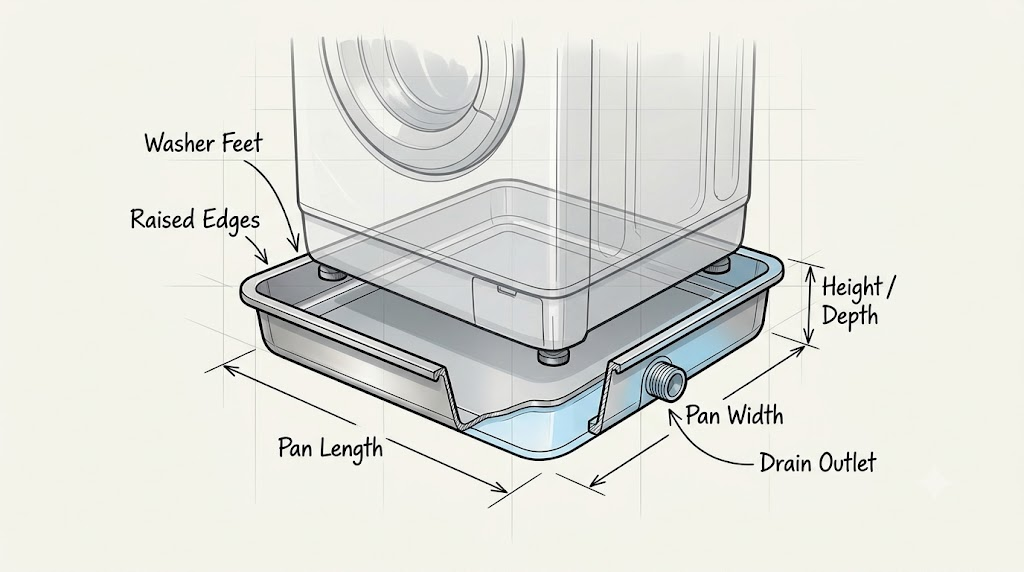
Pan dimensions usually refer to length, width, and height. The outside dimensions determine the floor space required, while the internal dimensions determine the usable area.
As a reference, Eastman lists a washing machine drain pan measuring 30 × 32 inches externally and 2⅛ inches high. This is a conventional pan, so check whether its size suits your portable washer before considering it. See Eastman’s manufacturer information.
You can estimate a rectangular pan’s capacity using:
Capacity in US gallons = internal length × internal width × usable water depth ÷ 231
Use inches for all measurements.
For example, a pan with an internal area of 20 × 16 inches and a usable water depth of 1 inch would hold approximately 1.39 gallons when filled to that depth.
Actual usable capacity may be lower because of the washer’s feet, sloped edges, and the need to keep water below the rim. A pan designed for small leaks should never be treated as protection against an unlimited water supply.
Check drainage and compatibility
Some pans have a drain outlet that can connect to an approved drainage arrangement. Others simply collect water.
Before buying, confirm whether a drain fitting is included, whether a hose can be connected, and whether your apartment has a suitable drain. An unused drain opening doesn’t provide automatic drainage.
If your portable washer drains into a sink or bathtub, a floor pan may not catch water from a hose that slips out of the basin. In that situation, securing the hose and positioning a detector near the likely spill area may be more useful.
Never force a washer into a pan that makes it unstable, and don’t move a loaded machine across a pan unless the manufacturer permits it.
Image suggestion: A labeled diagram showing pan length, width, height, raised edges, drain outlet, and washer feet.
5. Which Leak Protection Is Best for Your Living Situation?
Your living space matters as much as the detector’s features.
| Living situation | Recommended setup | What to watch for |
|---|---|---|
| Apartment renters | Battery alarm and suitable drip pan | Landlord rules and floor protection |
| College students | Simple, portable water alarm | Dorm appliance restrictions |
| RV and camper owners | Securely placed sensor | Vibration and temperature limits |
| Tiny homes and vans | Compact sensor near likely leak points | Limited floor space |
| Vacation rental owners | Smart sensors with remote alerts | Battery checks and guest instructions |
| Seniors with mobility challenges | Loud alarm or alerts to a caregiver | Easy access for testing |
| Budget-conscious households | Basic alarm and secure drain hose | A low price doesn’t guarantee reliability |
For RVs and vans, check the detector’s operating temperature range and secure it during travel. For vacation rentals, choose a system that clearly identifies which sensor has triggered an alert.
If you have mobility challenges, place the detector where you can test it without moving a heavy machine. Arrange help with inspections if the hoses or connections are difficult to reach.
Read our ZENY portable washing machine review to understand its features and limitations before choosing accessories.
6. Three Products to Consider
These products represent different approaches to leak protection. They are examples to research, not hands-on-tested winners.

1. GoveeLife Smart Water Leak Detector
A smart sensor system to investigate if you want alerts across multiple locations, such as a washer, sink, and water heater.
Buy it if: You want app notifications and the selected package supports your connectivity needs.
Skip it if: You expect the sensor alone to shut off the water supply.

2. YoLink Water Leak Sensor
A sensor option for people interested in a larger monitoring system. Some configurations use a separate hub.
Buy it if: You want to monitor several areas and are comfortable setting up a compatible system.
Skip it if: You want a standalone alarm without additional equipment.

3. FloodStop Washing Machine Leak Detector Kit
A shutoff-system option designed for compatible washing machine water connections.
Buy it if: You have suitable water supply lines and an approved installation.
Skip it if: Your washer is manually filled or lacks compatible plumbing connections.
Before purchasing, confirm the exact model, included accessories, compatibility, warranty, and installation requirements. Smart sensors don’t all offer the same alerts, and traditional shutoff kits may not work with portable washers that use faucet adapters.
7. How to Install and Test Your Leak Protection
Follow these five steps before running your first load.
- Inspect the hoses. Look for cracks, kinks, loose connections, and visible moisture. Replace damaged components with compatible parts.
- Position the pan. If suitable, place it on a stable surface and check that the washer sits level.
- Secure the drain hose. Make sure it cannot slip out of the sink or approved drain during operation.
- Place and test the detector. Follow the manufacturer’s instructions and confirm that the alarm works. For smart models, verify that phone notifications arrive.
- Recheck regularly. Inspect connections, test the alarm, replace batteries when needed, and look for moisture or odors around the washer.
If you use an automatic shutoff system, follow its commissioning instructions and verify that the valve operates correctly.
Don’t assume a detector makes it safe to leave a washer running unattended. Follow the washer manufacturer’s guidance, especially if it advises against unattended operation.
If you’re new to portable laundry equipment, our guide explains the basics of using a portable washing machine.
8. Common Mistakes to Avoid
- Buying a sensor without checking connectivity: A smart detector may require a hub or compatible Wi-Fi connection.
- Assuming a drip pan prevents flooding: Water can overflow the rim or escape behind the pan.
- Ignoring the drain hose: A loose hose can spill water outside the pan.
- Choosing a pan by outside dimensions alone: The internal space may be too small for your washer.
- Installing a shutoff valve without permission: Renters should check with their landlord before changing plumbing.
- Trusting a detector without testing it: Dead batteries or disabled notifications can leave you unaware of a leak.
Testing disclosure: This guide is based on product research and practical buying criteria, not hands-on testing of every product mentioned. Confirm current specifications and compatibility with the manufacturer before purchasing.
Frequently Asked Questions
What is the best portable washing machine water leak detector for an apartment?
A battery-powered alarm is a practical starting point for most renters. Choose a smart model if you need remote notifications, or a compatible automatic shutoff system if you need the incoming water supply to close automatically.
Do portable washing machines need a drip pan?
Not every portable washer needs one. A suitable pan can provide extra floor protection, but it must support the washer securely and fit the available space.
Can a water leak detector stop a leak?
A basic detector only alerts you. A compatible automatic shutoff system can close the incoming water supply, but it may not stop water escaping from a drain hose or damaged washer tub.
Where should I place a water leak detector?
Place it near the inlet connection or drain area where escaping water is likely to collect. Use additional sensors if one device cannot cover the main leak points.
How much water can a washing machine drip pan hold?
Capacity depends on its internal length, width, and usable depth. Calculate an approximate capacity from those measurements, but remember that the washer’s feet and sloped edges reduce usable space.
Can I use a leak detector in an RV?
Yes, if the detector suits the RV’s operating conditions. Secure it against movement, check its temperature limits, and test it after setting up your laundry area.
Do smart leak detectors work without Wi-Fi?
Some can still sound a local alarm when the internet is unavailable, but this depends on the model. Remote notifications generally require a working communication path.
Is it safe to run a portable washing machine while I’m away?
Follow the manufacturer’s instructions. A leak detector adds protection but doesn’t eliminate the risk of flooding or guarantee that you’ll receive an alert in time.
Final Verdict
For most apartment renters, start with a reliable battery-powered water leak alarm, secure the drain hose, and add a properly sized drip pan if your washer can sit safely inside it.
Choose a smart detector if remote alerts matter to you. Consider automatic shutoff only when the system fits your water connections and the installation is approved.
The goal isn’t to buy the most expensive device. It’s to choose practical protection that matches your washing machine, your living space, and the risks you need to manage.
Compare portable washing machines to find a model that fits your available space and laundry needs.
Recommended Reading:
- Portable Washing Machine Drip Pan: How to Choose the Right One for Your Apartment
- 10 Best Portable Washing Machine for Apartments 2026
- How to Use a Portable Washing Machine: Step-by-Step Guide
- 15 Must-Have Portable Washer Accessories in 2026

Sourabh researches and writes about home appliances, kitchen gadgets, and common appliance problems to help readers make smarter buying decisions. He specializes in Portable washing machines and appliance troubleshooting guides.
At compactHomeHub, Sourabh focuses on creating easy-to-understand content that simplifies technical appliance issues into practical solutions. His goal is to help users save time, avoid costly mistakes, and choose the right appliances with confidence.