A portable washing machine can make laundry much easier when your apartment doesn’t have a dedicated laundry room. You can wash everyday clothes at home without making frequent trips to a laundromat. But there’s one problem many renters overlook: what happens if the washer leaks?
Even a small leak can damage laminate flooring, seep beneath cabinets, or leave water trapped under a machine that’s difficult to move. If you live in an upstairs apartment, water damage could also affect the ceiling or belongings of the person below you.
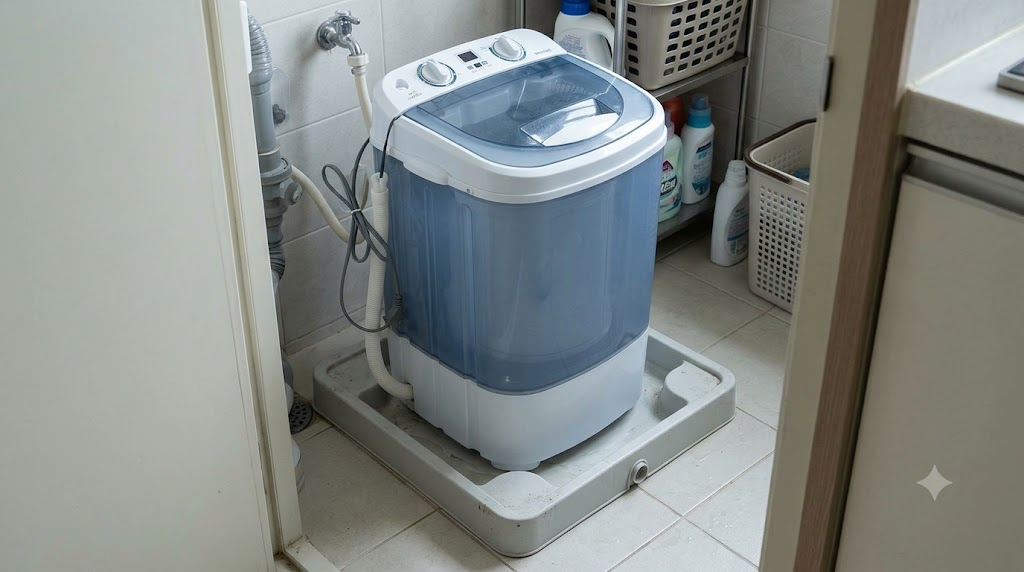
A portable washing machine drip pan can provide an extra layer of protection by catching some of this escaping water before it reaches the floor. However, not every washer pan fits a portable machine, and a shallow tray won’t protect against every type of leak.
Before choosing a drip pan, compare the best portable washing machines for apartments to find a model that fits your available space and laundry needs.
What Is a Portable Washing Machine Drip Pan?
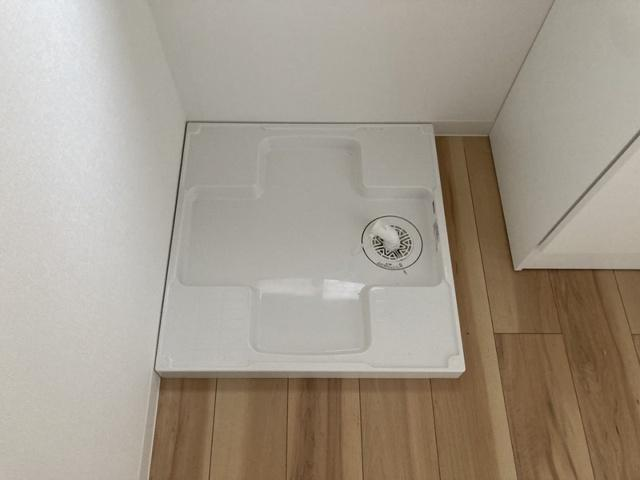
A portable washing machine drip pan is a shallow, waterproof tray that sits beneath a washing machine. It has raised edges designed to collect small leaks, drips, and spills that might otherwise reach the floor.
Some pans include a drain outlet that allows collected water to flow into a suitable drain when correctly installed. Others are simple trays that hold water temporarily until you can remove and clean them.
A drip pan is particularly useful when a washer sits on a wood, laminate, or other water-sensitive floor.
For example, imagine that a hose connection develops a slow drip while you’re washing a small load of clothes. A properly sized pan may catch some of that water and give you time to notice the problem before it spreads across the floor.
However, a drip pan isn’t waterproof protection for the entire room. Water can escape over its edges, travel along a hose, or leak from a connection outside the tray.
Quick answer: Choose a portable washing machine drip pan that fits the washer’s entire footprint, supports its loaded weight, has suitable raised edges, and allows enough room for any required hoses or drainage connections. For an apartment, pair it with a water leak detector for an additional warning if water escapes.
Why Do Apartment Renters Need a Washer Drip Pan?
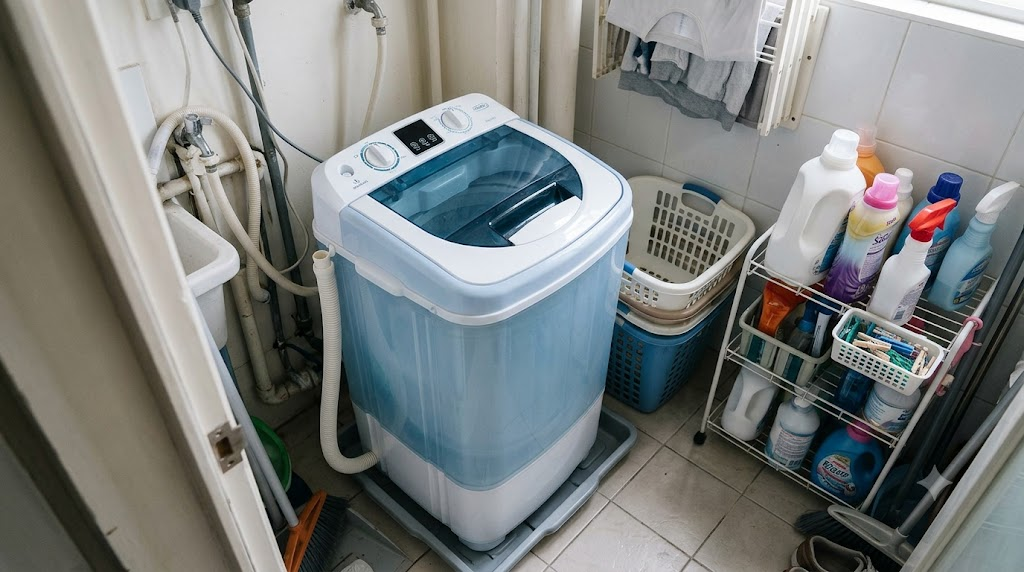
A drip pan isn’t necessary for every portable washer installation, but it can be a sensible precaution when the floor is vulnerable to water damage. Here are the main benefits.
1. Helps Protect Floors From Small Leaks
Water can damage wood flooring, swell some laminate materials, and collect beneath floor coverings. A drip pan helps contain a limited amount of water before it reaches these surfaces.
For example, if a loose connection produces a small puddle during a wash cycle, the tray may catch it. Keep in mind that the pan’s protection depends on its size, condition, and capacity. It won’t guarantee that your floor stays dry.
2. Adds Protection in Upstairs Apartments
A leak in an upstairs apartment can affect more than your own floor. Water may seep through gaps and damage a ceiling or another resident’s belongings.
A drip pan can help contain minor leaks, but a large hose failure can release water faster than a shallow tray can hold it. Check your hoses regularly and don’t leave a portable washer running unattended.
3. Helps Protect Cabinets and Nearby Fixtures
Portable washers sometimes sit beside kitchen cabinets or bathroom fixtures because those locations provide convenient access to water and drainage.
If water escapes around the base, nearby materials may become wet. A correctly positioned pan helps catch some water that reaches the area directly beneath the washer. Measure the space carefully, especially if the machine sits inside a cabinet opening.
4. Provides an Extra Layer of Protection in Small Homes
People living in studios, tiny homes, RVs, and compact laundry areas often have fewer options for moving a washer away from vulnerable surfaces.
A drip pan can be useful in these settings, provided the pan and washer are suitable for the location. RV and camper owners should also consider movement during travel and follow the appliance and vehicle manufacturers’ installation requirements.
How to Choose the Right Portable Washing Machine Drip Pan
Before purchasing a pan, focus on fit, construction, capacity, and the way your washer connects to water and drainage.
1. Measure the Washer’s Dimensions
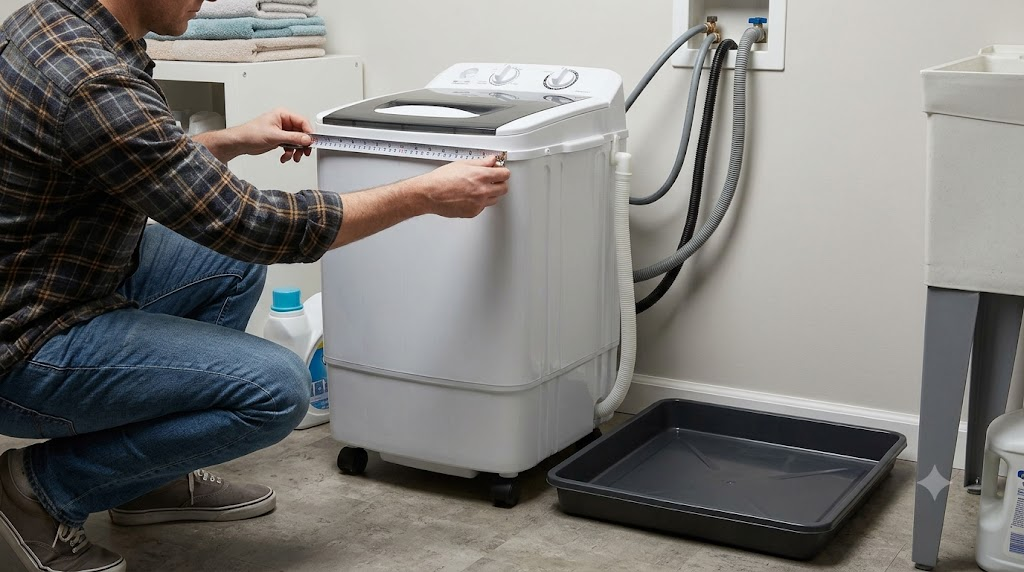
Size is the first thing to check. A pan that’s too small may leave part of the washer uncovered. One that’s too large may not fit between cabinets or through a narrow laundry area.
Measure these areas:
- Washer width: Measure from the left side to the right side.
- Washer depth: Measure from the front to the back, including any parts that extend beyond the body.
- Available floor space: Measure the location where the washer will stand.
- Hose clearance: Allow room for the inlet hose, drain hose, and any connections specified by the manufacturer.
Compare the pan’s usable interior dimensions with the washer’s footprint. Don’t rely only on the outside dimensions printed on the product listing.
For example, a pan advertised as 30 inches wide may have less usable space inside because of its raised sides.
Also, check whether the washer has wheels or a base that extends beyond the main body. The pan must support the machine properly without obstructing its movement during operation.
Buying tip: Don’t assume a pan made for a standard washer will fit a compact portable model. Measure first, then check the pan manufacturer’s fit guidance.
2. Choose a Suitable Material
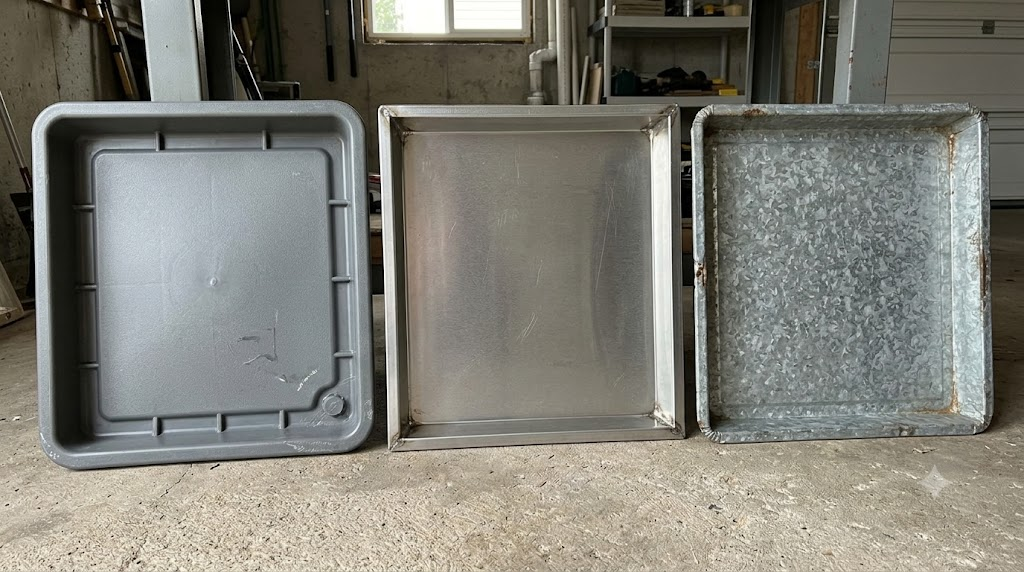
Washer drip pans are commonly made from plastic or metal. Each option has advantages and limitations.
| Feature | Plastic pan | Stainless steel pan | Galvanized metal pan |
|---|---|---|---|
| Weight | Usually lightweight | Depends on thickness and design | Depends on construction |
| Rust resistance | Doesn’t rust | Generally highly rust-resistant | Coating damage can expose the underlying metal |
| Portability | Often easier to move | May be heavier | Varies by model |
| Durability | Depends on plastic quality and design | Depends on grade and construction | Depends on coating and construction |
| Best suited for | Many small-space installations | Buyers seeking a rigid, corrosion-resistant option | Buyers seeking a rigid metal option |
| Main limitation | Can crack or deform if poorly made or improperly supported | May cost more and can have sharp edges if poorly finished | May corrode if its protective coating is damaged |
Plastic pans: These are often practical for apartments because they’re relatively light and easy to clean. Look for a rigid design that supports the washer’s weight and resists cracking.
Stainless steel pans: These can provide a sturdy option for some installations. Check the dimensions, edge finish, and manufacturer’s care instructions.
Galvanized metal pans: These have a protective coating intended to resist corrosion. Scratches or damaged coatings may reduce that protection.
Don’t choose a pan based on material alone. A well-made pan with the right dimensions and a suitable load rating is more useful than an expensive pan that doesn’t fit.
3. Check the Pan’s Height and Water Capacity
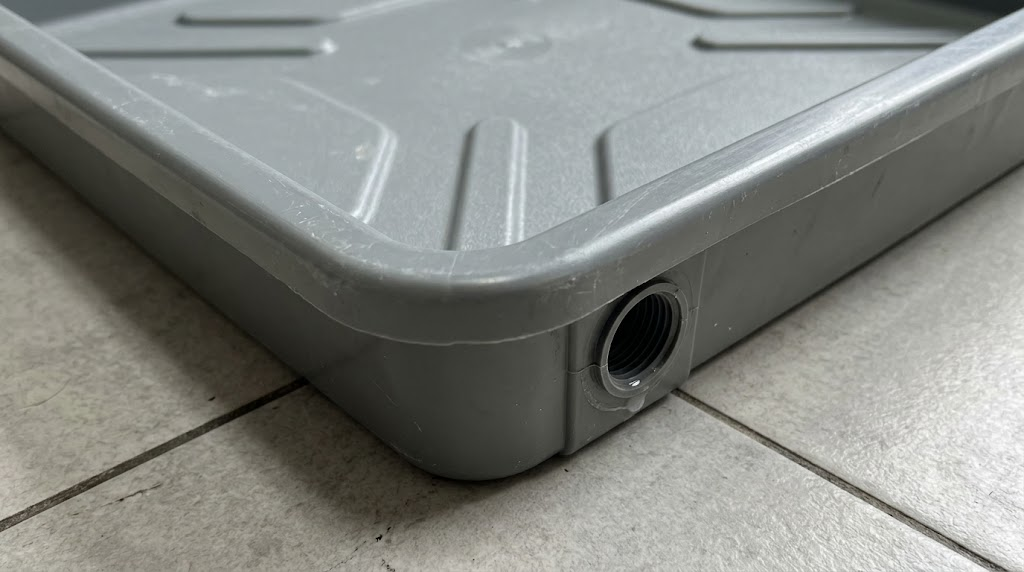
A drip pan’s raised edges help contain water, but the amount it can hold depends on its usable dimensions and depth. For a simple rectangular pan, an approximate capacity can be calculated using:
Length × width × depth = volume
Use the pan’s usable interior dimensions, not its exterior measurements. The actual capacity may be lower if the bottom slopes, corners are rounded, or the manufacturer specifies a maximum fill level.
A deeper pan may hold more water, but it can also be harder to slide beneath a washer or fit into a tight space.
For example, a pan with 24-inch by 20-inch interior dimensions and 2-inch-high sides has a theoretical rectangular volume of about 4.2 gallons. That’s a mathematical estimate, not a guarantee of usable capacity.
The actual amount of water the pan can safely contain may be lower.
More importantly, even a large pan can overflow during a major hose failure. Don’t treat capacity as a substitute for checking hoses, securing drain lines, and using a leak detector.
4. Consider Drainage Options
Some washing machine pans include a drain outlet. Others have no outlet and simply collect water. A drain outlet can be helpful if the installation has a suitable, approved drain connection. However, the outlet alone doesn’t make the pan self-draining. You need a compatible fitting and a safe route for the water.
Before choosing a pan with a drain outlet, check:
- Whether the outlet location matches your available drainage arrangement.
- Whether the required fittings are included.
- Whether a suitable drain is accessible.
- Whether installation requires plumbing changes or landlord approval.
- Whether the setup follows the pan and drain-fitting manufacturers’ instructions.
Many apartment renters won’t have a floor drain beside the washer. In that situation, a simple collection pan may be more practical, provided you inspect it regularly and can safely remove any collected water.
Never drill a hole in a pan or modify its drain connection without confirming that the modification is appropriate for the product and installation.
5. Check Weight Support and Stability
A portable washer can become significantly heavier when filled with water and laundry. The pan must support the machine in its operating condition, not just its empty weight.
Check the manufacturer’s load guidance and make sure the washer’s feet or base sit securely on the pan’s intended support surface. Avoid placing a heavy washer on a thin, flexible tray that bends under pressure. A pan that flexes or shifts may become less effective at containing water.
Also, don’t use a drip pan to compensate for an uneven floor. Level the washer according to its manual and make sure the machine doesn’t rock during operation.
6. Consider Your Apartment’s Floor Type
Different floors have different vulnerabilities.
- Hardwood: Standing water can stain or damage wood, especially around seams and edges.
- Laminate: Water that enters joints may cause swelling or separation.
- Vinyl: Although many vinyl floors tolerate moisture, water can still affect seams, adhesive, or the subfloor.
- Tile: The surface may tolerate water, but grout, surrounding trim, and the underlying structure may still be vulnerable.
A drip pan can help collect water, but moisture trapped beneath the tray may also cause problems. Lift and inspect the pan periodically, following the flooring and pan manufacturers’ care recommendations.
If the floor is carpeted or the washer would sit on an unstable surface, don’t assume a tray makes that location suitable for the appliance.
If you’re still deciding which washer to buy, start with our guide to the best portable washing machines for apartments and check each model’s dimensions before choosing a pan.
Do You Need a Standard Washer Pan or a Compact Drip Pan?
Standard washing machine drain pans are often designed for full-size laundry appliances. Some measure around 30 by 32 inches externally, which may be unnecessarily large for a small portable washer.
For reference, GE Appliances lists a standard floor tray with interior dimensions of 27 by 30 inches and exterior dimensions of 30 by 32 inches. That illustrates why checking both measurements matters.
A portable washer may need a smaller pan, but its exact size depends on the model. Don’t purchase a compact tray simply because the washer is described as portable.
Use this comparison to narrow down your options.
| Pan type | Main advantage | Main drawback | Best for |
|---|---|---|---|
| Compact plastic pan | Lightweight and space-efficient | May have limited water capacity | Small portable washers |
| Standard rigid washer pan | Wider range of sizes and designs | May occupy too much space | Larger portable or compact washers |
| Metal washer pan | Rigid construction options | Weight, price, and edge finish vary | Buyers prioritizing a sturdy tray |
| Flexible waterproof mat | Easy to store in some situations | May not provide raised-edge containment or structural support | Surface protection where compatible with the appliance |
A flexible mat isn’t automatically a replacement for a rigid drip pan. Check whether it can support the washer and whether it has raised edges designed to contain water.
How to Use a Drip Pan With a Portable Washing Machine
Choosing the right pan is only part of the job. Correct placement and regular inspection matter too.
Step 1: Check Permission and the Installation Location
If you rent, review your lease and ask your property manager about portable washers and water-related appliances when necessary.
Choose a location with a stable floor, a suitable electrical outlet, and an approved water and drainage arrangement.
Step 2: Position the Empty Pan
Place the pan on a clean, level surface. Make sure it doesn’t rock, bend, or sit on debris. Check that the pan’s drain outlet, if present, won’t be blocked by the wall or cabinet.
Step 3: Place the Washer Securely
Position the washer according to the appliance manufacturer’s instructions. Confirm that its base fits fully within the pan and that the machine remains level. Don’t force the washer into a pan that’s too small.
Step 4: Arrange the Hoses Carefully
Keep hoses positioned as directed by the manufacturer. They shouldn’t be kinked, pinched, or stretched. Make sure the drain hose is secured properly so it can’t slip out of the sink or approved drain during the cycle.
Step 5: Inspect the Setup Before Washing
Check the inlet hose, drain hose, faucet connection, and surrounding floor for signs of moisture. During initial use, remain nearby and watch for leaks, unusual movement, or drainage problems. A drip pan doesn’t make it safe to ignore the washer while it runs.
Drip Pan vs. Water Leak Detector: What’s the Difference?
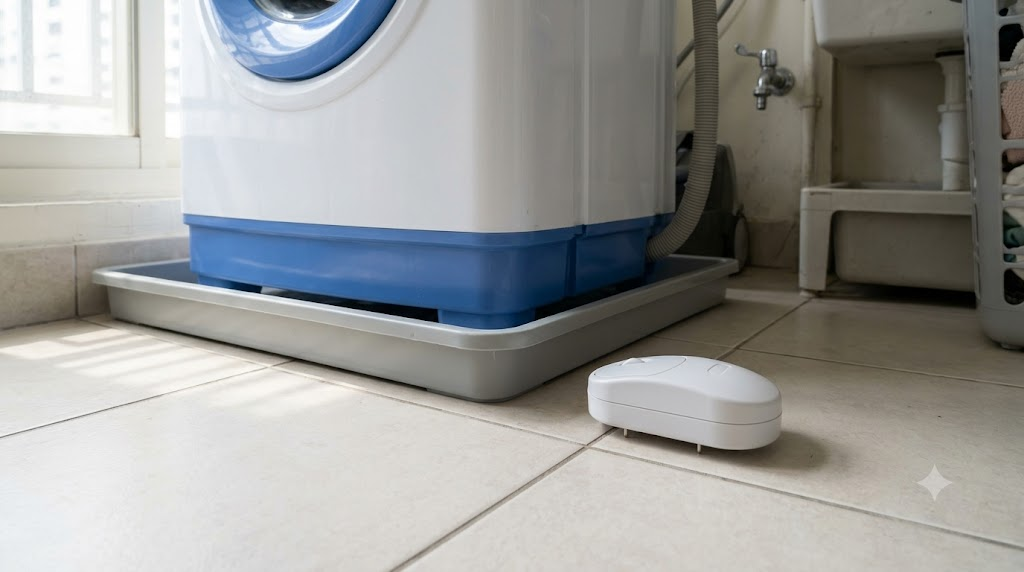
A drip pan and a leak detector serve different purposes. For many apartment renters, using both can provide more useful protection than relying on either one alone.
| Feature | Drip pan | Water leak detector |
|---|---|---|
| Main purpose | Collects some leaking water | Detects water and alerts you |
| Needs electricity | Usually no | Depends on the model |
| Sends an alert | No | Basic alarms beep; smart models may send notifications |
| Stops water automatically | No | Only compatible automatic shutoff systems can do this |
| Main limitation | Can overflow or miss leaks outside the pan | May not alert you if water never reaches its sensor |
For example, a loose connection may drip into the pan, where it can collect. A leak detector placed near the connection or in a low point where escaping water will reach it may alert you to the problem.
However, water can leak behind the washer or outside the pan. That’s why sensor placement matters.
If you buy a detector, follow its instructions and test it regularly. A basic alarm does not stop water flow. An automatic shutoff system can close a compatible supply valve when properly installed, but it won’t protect against every possible source of water.
Common Mistakes to Avoid When Buying a Washer Drip Pan
Buying Based on Outside Dimensions
The exterior measurement doesn’t tell you how much usable space the tray provides. Check the interior dimensions before ordering.
Assuming Every Pan Has a Drain Outlet
Some pans collect water without a drain connection. If drainage is important to your setup, confirm that the outlet and required fittings are included.
Expecting a Drip Pan to Prevent Every Flood
A pan is a secondary protection measure. It may not contain a large leak, and it won’t necessarily catch water escaping from a hose outside its edges.
Ignoring the Washer’s Weight
A pan that can’t support the loaded appliance may bend or become unstable. Verify the intended application and load support.
Forgetting About Maintenance
Water trapped under a washer can remain hidden. Inspect the pan periodically, remove collected water safely, and clean and dry the tray according to its manufacturer’s instructions.
How We Evaluated Drip Pan Options
This guide uses a research-based evaluation rather than claiming hands-on testing of products that we haven’t physically tested.
We compared manufacturer information and established buying guides to identify the main factors that matter for portable washers in apartments: dimensions, material, raised-edge design, drainage options, fit, and installation requirements.
We also considered the needs of renters, including limited floor space, the difficulty of making permanent plumbing changes, and the consequences of a leak in a multi-unit building.
We did not perform laboratory leak tests, measure the real-world holding capacity of specific pans, or verify long-term durability through extended use. Product-specific claims should be confirmed against the current manufacturer listing before purchase.
What Other Washer Drip Pan Guides Cover and What They Miss
Several existing resources provide useful information, but each has a different focus.
This Old House: Washing Machine Drain Pan Guide
The This Old House guide explains the purpose of a washing machine drain pan, common materials, installation, and maintenance. It’s a useful starting point for understanding conventional washer protection.
What this article adds is a stronger focus on portable washers in small apartments, where available space, temporary connections, and the dimensions of compact appliances can change the buying decision.
Eastman: Washing Machine Drain Pan
The Eastman product page provides manufacturer specifications for rigid plastic pans, including external dimensions and drain-related features.
This article builds on that type of product information by explaining why exterior dimensions alone aren’t enough and why renters should verify usable interior dimensions, washer weight, and drainage compatibility.
GE Appliances: Universal Floor Tray
The GE Appliances floor tray guide provides specific interior and exterior dimensions and describes a drain fitting option.
That information helps shoppers understand how dimensions and drainage features vary between products. This guide applies those considerations to the additional constraints faced by people with compact portable washers and limited installation space.
These resources are useful references, not proof that one pan is universally better than another. Product fit and suitability still depend on the washer, available space, and intended installation.
Who Should Buy a Portable Washing Machine Drip Pan?
A drip pan may be a sensible purchase if:
- You use a portable washer on a water-sensitive floor.
- Your washer sits near cabinets or other materials that could be damaged by water.
- You want an extra layer of protection in an upstairs apartment.
- You can find a pan that supports your washer and fits the available space.
- You can inspect and maintain the pan regularly.
You may need a different approach if your washer cannot sit securely in a suitable tray, your lease prohibits the installation, or the location has no safe water and drainage arrangement.
A drip pan isn’t a substitute for permission, correct installation, or regular leak checks.
Frequently Asked Questions
Does a portable washing machine need a drip pan?
Not every portable washer requires one. However, a properly sized pan can provide extra protection when the washer sits on a vulnerable floor or near cabinets. Check your appliance instructions, rental rules, and local requirements before installing one.
What size drip pan do I need for a portable washer?
Measure the washer’s width and depth, then compare those measurements with the pan’s usable interior dimensions. Make sure the entire base fits securely and that the pan doesn’t interfere with hoses or the machine’s operation.
Can I use a regular washing machine drain pan for a portable washer?
Sometimes. Many standard pans are larger than necessary for compact machines, but size alone doesn’t determine compatibility. Check the washer’s footprint, loaded weight, pan construction, and available space.
Will a drip pan stop water damage?
No. A drip pan can contain some leaking water, but it may overflow or miss water escaping outside its edges. Regular hose inspections and a suitably placed leak detector provide additional precautions.
Should my drip pan have a drain outlet?
A drain outlet can be useful when you have a suitable, approved drain connection. If you don’t, a collection pan may be more practical. Don’t assume a drain outlet can be connected safely without the required fittings and appropriate installation.
Can I put a portable washer on a flexible waterproof mat?
Only if the mat is suitable for the appliance and installation. A mat may protect a surface from minor drips, but it may not have raised edges or enough structural support to serve as a drip pan.
Where should I place a water leak detector?
Place the sensor where escaping water is likely to reach it, such as near a hose connection or a low point beside the washer. Follow the detector manufacturer’s placement instructions and test the alarm regularly.
How often should I inspect the drip pan?
Check it before or after laundry sessions and whenever you notice unusual moisture, odors, or changes in washer behavior. Periodically move or inspect the washer as safely permitted by its instructions so that hidden moisture doesn’t go unnoticed.
Final Verdict
A portable washing machine drip pan can be a practical addition to an apartment laundry setup, especially when the washer sits on a vulnerable floor. The right choice depends on more than price: dimensions, material, load support, raised edges, drainage, and maintenance all matter.
Measure your washer before buying, verify that the pan is designed for the appliance’s weight, and make sure the setup complies with your lease and the manufacturer’s instructions. Pair the pan with regular hose inspections and a suitable water leak detector if you want an additional warning against leaks.
Most importantly, remember that a drip pan is a backup measure not a guarantee against flooding. A safe installation and early leak detection remain essential.

Sourabh researches and writes about home appliances, kitchen gadgets, and common appliance problems to help readers make smarter buying decisions. He specializes in Portable washing machines and appliance troubleshooting guides.
At compactHomeHub, Sourabh focuses on creating easy-to-understand content that simplifies technical appliance issues into practical solutions. His goal is to help users save time, avoid costly mistakes, and choose the right appliances with confidence.
1 thought on “Portable Washing Machine Drip Pan: How to Choose the Right One for Your Apartment”
Comments are closed.